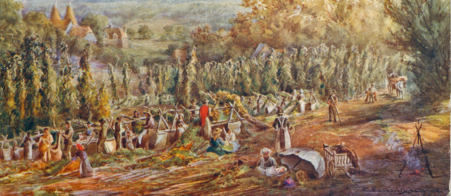
Hop-pickers in Kent by Charles Corke (with mother and baby in the foreground)
This is a story about my great great grandmother, Alice Ayres, who was the eldest of nine children in a Romany family. Her father was a basket maker and dealer from Hampshire by the name of Morris Ayres, and her mother was Mary James from Sussex. Alice was born at Hadlow in Kent during the hop picking season of 1836, and there is an entry inside the cover of her abridged version of the New Testament that records her baptism at Brenchley, which is to the east of Tunbridge Wells and just a few miles south of Hadlow. The church record there describes Alice’s father Morris as ‘Hopping at Manwarings‘ (usually pronounced Mannering), a well known hop growing family based then at Cowden Farm on the road from Brenchley to Horsmonden.
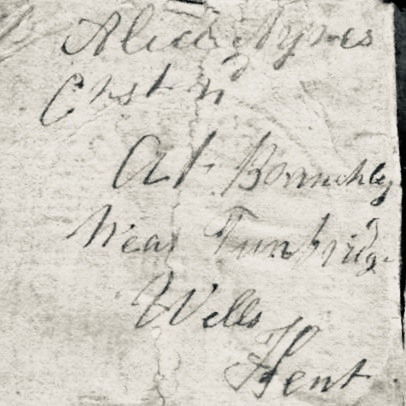
Left. Bible note “Alice Ayres Christened at Brenchley, Near Tunbridge Wells, Kent” Below. Register entry at All Saints Church, Brenchley on 18 September 1836 “Alice Daughter Morris & Mary Ayres, (Abode) Froyle in Hampshire A Hopper, (Trade) Hopping at Manwarings“.

Alice had a typical Romany Gypsy upbringing for that period, travelling around with her parents in a horse-drawn cart (the iconic wagons with their characteristic sloping sides did not appear until a few years later), most likely sleeping in a bender tent, and sometimes living in larger groups alongside blacksmiths and tinsmiths (Stanleys), wheelwrights and bucket makers (Coopers), and others. It seems that the Ayres family moved mainly through Hampshire, Surrey and Kent — Alice’s younger siblings were born between 1839 and 1857 in Ripley [Orris], Tilford [Charles], Farnham [Samson], Chilworth [Ellen], Long Sutton [Mary Ann], Send [Matilda], Farnham again [Theodosia] and Froyle [Morris]. However, baptisms and birth registrations apart, the Ayres kept pretty much below the radar during Alice’s childhood, and any attempt at understanding the full context in which she was raised poses quite a challenge — especially to those of us who are now disconnected from that world.
It is said that families like Morris and Mary’s would often stay on the land of the farmers for whom they worked, and at other times at their favoured stopping place en route (atchin tan in the Romani language). In this context, it is a pity that no precise recollections were passed down in our family concerning Alice’s own use of Romani, or the Romani-English dialect that it turned into. She was after all the great granddaughter of Samuel Ayres, the leader of the Hampshire-based family whose extensive vocabulary was well documented in the early eighteen hundreds — each one of over three hundred Romani words and phrases used by Old Sam and his family were traced back to their Hindi/Sanskrit and Urdu/Persian origins by the remarkable East India Company translator (and sometime Bengal Lancer) John Staples Harriott. His report was published eventually in a learned journal (Transactions of the Royal Asiatic Society), the author having by then reached the rank of colonel in the Bengal infantry — he was promoted later to major-general in Queen Victoria’s coronation honours.
Harriott stayed at Mill Court in Binsted while visiting the Froyle camp in 1819-20, and Alice’s father Morris was there for some of that time as an infant (a younger brother was born in Froyle in 1819). Morris may have been too young to have been amongst the children who “danced and sang” for John Staples Harriott when he left Mill Court, and who thanked him for their supper “in a very pretty manner” — Harriott said of them afterwards in his published article that the children from Old Sam’s camp were far more gracious than he expected (p.588). Such first-hand glimpses into families like Alice’s are rare however and, as the historian Jeremy Harte explains, we need — in the absence of the unmediated Romany voice from the past — to tread a very careful path between the idealised caricatures found in art and literature and the pigeonholed stereotypes presented in the nineteenth century press, in court proceedings and elsewhere.
As it happens, there are quite a few court reports in the Hampshire papers to draw upon, starting in the 1860s when Alice was in her twenties. Morris was fined twice for camping too close to the highway, near Winchester and again at Littleton, three times for letting his horses stray, at Binsted, Alton and Bentworth, and once for organising a boxing match with his brother Paul in an improvised roped ring on Cotsford Down near Micheldever, which involved Alice’s boxer cousin Edward Ayres. It is fascinating now to read in all this that the “defendant caused some amusement in court by his cross-examination of the constable.” It puts these misdemeanours into perspective, with Alice’s resourceful father Morris paying his fines while cheerfully leaving his own defiant mark on the proceedings. And on another occasion, when Morris was charged with being intoxicated, his spirited plea was “that he was guilty of having a little beer, but was not drunk.”
Two more charges deserve closer inspection, each one involving riotous behaviour by a crowd at a public house during which the attendant police officer was injured. One was at the New Inn at Preston Candover, not far from Froyle, which started with a fight between 20 or more people in the tap-room, and which a policeman tried to break up. Things got out of hand when the fight spilled over outside, at which point Morris and his brother Riley were acting only as seconds. The policeman hit them several times with his staff and they hit him with sticks, or vice versa according to the prosecution, for which they received two months hard labour. The other riot was further afield, at the Coach and Horses near Hilsea Barracks in Portsmouth. It reads like another mêlée, this time with Royal Artillery gunners who were also in the pub. We can only wonder what Alice made of it when not only her father Morris but also her mother Mary and her seventeen year old brother Samson were all committed to the Winchester Quarter Sessions and charged alongside others with the riot. Eventually they were acquitted and the slate was wiped clean, so to speak, except of course for the craftily constructed news reports that maligned them anyway, and which can still be read today.
The papers published their own interpretation of events but they missed out on the inside story, that these confrontations may well have involved two hostile factions within the family itself. A longstanding feud is said to have begun in 1825 when Old Sam died tragically in the Alton workhouse, his clothes having caught fire while sitting in his room there. His youngest son Samuel Jnr (Alice’s grandfather) was blamed for putting his father away against the wishes of others in the family, and the eldest daughter Barbara Ayres then fell out with her brother in a big way. Their children followed suit, including Morris and then his sons in their turn, the enmity reputedly boiling over into a fracas from time to time, like the altercation in Preston Candover that was described above. It seems that the hatchet was not buried for more than a hundred years, when a cousin marriage in the 1930s forced everyone to take stock (Silvanus Ayres heard the story of the feud directly from that same couple, his grandparents, and has posted some very detailed accounts on social media).
By marking the various locations mentioned so far onto a regional map from the 1800s, a general impression can be gained of the path that was trodden by the Ayres family, perhaps quite literally in the early years. The map shows the known birthplaces and baptisms of Alice and her brothers and sisters (marked in red) and then, from 1860 onwards, the whereabouts of Morris & Mary based on the above press coverage (marked in blue). Also pinpointed are the places where daughter Alice lived once she had flown the nest (marked in green).
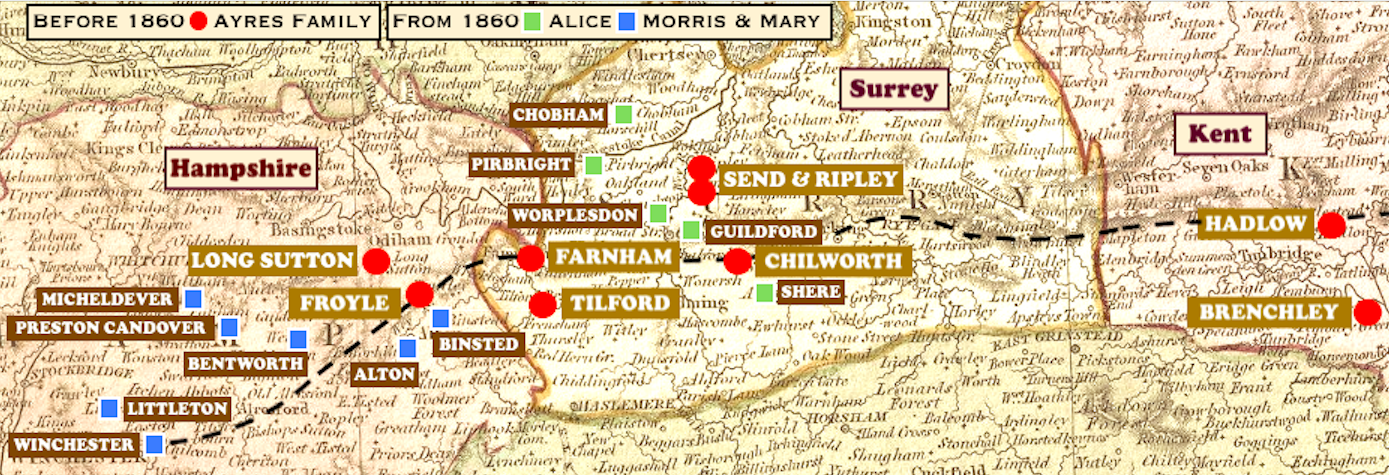
Known whereabouts before 1860 [red circles], and after 1860 for Alice [green squares] and her parents [blue squares]. The background is Pinkerton’s Map of Southern England (Wikimedia).
It looks as though the growing Ayres family camped at locations along an old cross-country track that linked the agricultural areas of Hampshire, Surrey and Kent. This route is represented on the map by a dashed line, following the Pilgrim’s Way from Winchester past Froyle and into Surrey, then onto the Hog’s Back near Farnham and alongside the North Downs into Kent. Alice’s sister Ellen was baptised in 1846 at one of the wayfarers’ landmark churches, St Martha on the Hill at Chilworth — the curate noted in the register that Ellen not only was christened at St Martha’s but was born there too. The youngest sister Theodosia was baptised at St Mary’s in Froyle in 1851, although in a later census return she indicated that her actual birthplace was Farnham, where her brother Samson had been born a few years earlier (Samson’s birth certificate tells us plainly that he was “born 17th September 1843 in a tent at Farnham“). These stopping places along the way — Froyle, Farnham and Chilworth — were well known to Romany families then.
The use of the east-west route by a sizeable itinerant population in times past is discussed in a Surrey History Centre study written by Alan Wright, who points to the seasonal jobs that were available such as fruit picking at Send & Ripley, field work at Chilworth, and harvesting in Surrey’s plentiful hop gardens, to which we can add the well-known hopping centres in and around Froyle in Hampshire and Brenchley in Kent. Off the main track, the Blackwater valley was also a favoured itinerary, travelling up between Farnham and Guildford through Ash & Normandy towards Pirbright Common and Chobham Common. There were large encampments on the heaths there, larger still when the Ascot races were on. The camp residents were supported by local agricultural work, including pea picking and other activities — for instance, Alan Wright’s study describes tent dwellers in Chobham who, into the 1900s, were making beehives there from straw provided by local farmers. As the map shows, it was in this area of Surrey that Alice would live from the late 1860s onwards.
When Alice’s brothers and sisters started their own families, the next generation’s birthplaces were again scattered around the old route, but now extending down to the New Forest in Hampshire and up to West Molesey in Surrey, by the River Thames. This was the case until the mid 1870s, but Alice’s sister Ellen and her brother Samson died about then, and subsequently the rest of the family were based mainly in Hampshire (Orris with his wife Polly Cooper; Charles with his wife Elderia Saunders; Theodosia with her husband Richard White) and also in Somerset and Dorset (Mary Ann with her husband Michael Saunders, a cousin of Elderia).
As it happens, Alice was the only one of Morris and Mary’s children to try a more settled way of life early on. In 1870, she set up home with a butcher’s boy from Shere with Romany connections, Edward Bristow, but he died within a few years, and Alice then moved into a room at the Elephant and Castle in Guildford with two little daughters — they were my great grandmother Ellen who was three at the time and her sister Mary Caroline who was one.
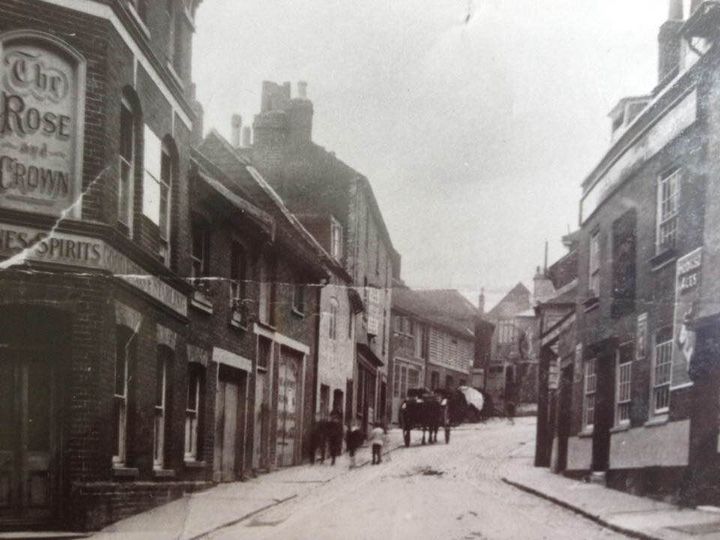
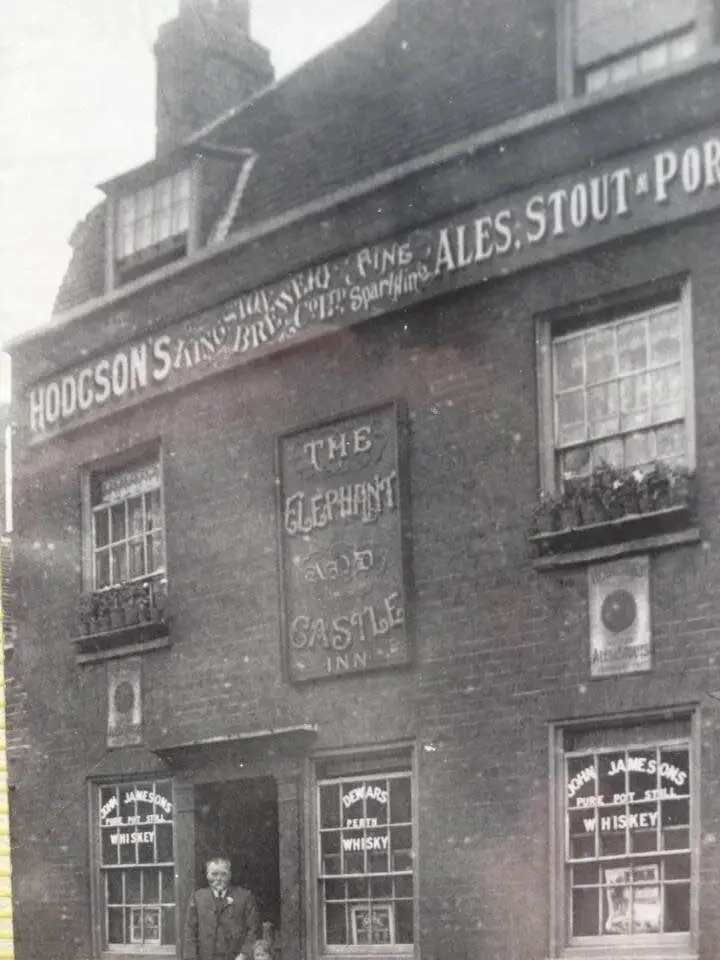
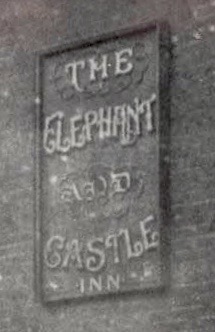
Castle Street, Guildford — The Rose & Crown to the left and The Elephant & Castle Inn to the right (also pictured here more clearly from a different angle).
While there, Alice married a widowed rag and bone man named Henry Pudvine, who apparently liked his drink a lot — this is confirmed by reports of Henry’s disorderly conduct in local papers from that time, and is not just the hearsay handed down to us by my grandmother’s generation. At one point they lived in a cottage at Pitch Place near Worpelsdon. After the two daughters married and moved away, Alice and Henry set themselves up on Whitmoor Common — Henry was in the papers again then, not for squatting on the heathland but because his hens were stolen from his premises there.
Eventually, the couple moved into a cottage at Fellmoor, between Henley Park and Pirbright, where they became the tenants of Henry de Worms. He was a cabinet minister and a member of the Rothschild family, and prominent enough to be caricatured in Vanity Fair (below right). He is also pictured here with his second wife, in front of the Jubilee Fountain that they presented to Pirbright village in 1897.
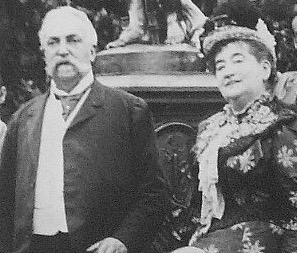
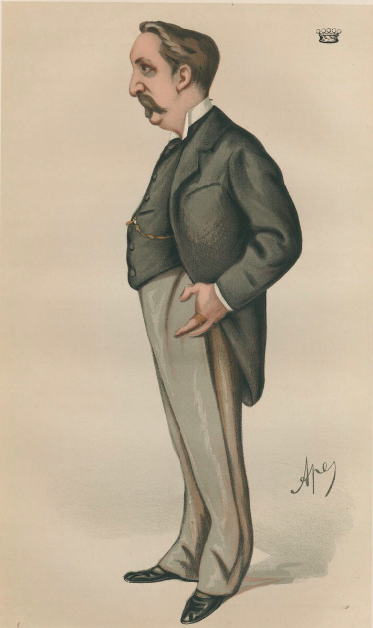
The Nasty Landlord — Henry de Worms (Lord Pirbright) and his second wife
Henry de Worms was a pushy man by all accounts. In Parliament he was known for his free trade policies, and in particular for an attempt to remove the sugar bounty that was said to be a brake on the emergent economies of the West Indies (and, perhaps more to the point, a potential constraint on the wealth of the sugar merchants and heirs of plantation owners in his Liverpool constituency). Although he persuaded many in Europe to back the scheme, it fell apart when a few states refused, following which the British parliament then rejected his bill. Henry de Worms was elevated to the Upper House as Lord Pirbright, although this was delayed slightly because his choice of title went against the wishes of some of the local residents. He seemed to be in regular conflict with his neighbours — altering rights of way on a pretext, relocating bridges without permission, and so on. A telling story concerns the annual Christmas party for village children in the church school, generously sponsored by his Lordship and the Lady Pirbright. The local paper reported on 23 December 1898 that the party was cancelled — the vicar, who had not been asked in advance, pointed out anyway that it was against School Board rules to open the premises during vacations. Lord Pirbright’s melodramatic response was to announce on 2 January 1899 that he would pay for a brand new village hall, and — to cap it all — that it would be opened by a member of the Royal family.
The newly enobled Lord Pirbright was also intent on building model houses that bore his crest and initials all around the village. On 4 December 1899, his estate office began to demolish Alice and Henry’s hovel of a home while they were still living there, removing the roof tiles and knocking down the chimney stack — it was midwinter, and they had not moved out as they had nowhere to go. A shocked resident living nearby at Fox Corner (Mr H.H. Grist) wrote to The Surrey Times, which reported on both sides of the dispute a week later. It feels almost surreal now to read the actual words used by Alice to have her say back then, in 1899, although there is always the chance that the reporter cut out or added some of the content. It looks nevertheless as though Alice was quoted directly when she spoke of her poor health, as follows:
“I have had to stay there while I have been ill. The parish won’t allow us any doctor just because we have a crippley old pony and cart, and I had to get one myself, and he told me the best place for me would be in the Workhouse Infirmary. But I wouldn’t hear of that.“
The Surrey Times went on to publish a markedly obsequious rejoinder to their first article from some of Lord Pirbright’s loyal tenants a week later. In the end, Lady Elizabeth Coomaraswamy — another local resident — came to Alice and Henry’s aid by writing to the paper to object to the actions of the Pirbright estate, and to the distinct lack of empathy, while calling for contributions to a fund that she had established with her own money in order to help rehouse the couple.
The candid statement by Lord Pirbright’s agent that he ordered the tiles to be removed from the cottage with a view to driving the tenants out (23 December 1899) is reproduced below together with the compassionate letter from Lady Coomaraswamy (1 January 1900).
…..(left) by Lord Pirbright’s agent ….. (right) from Lady Coomaraswamy…..
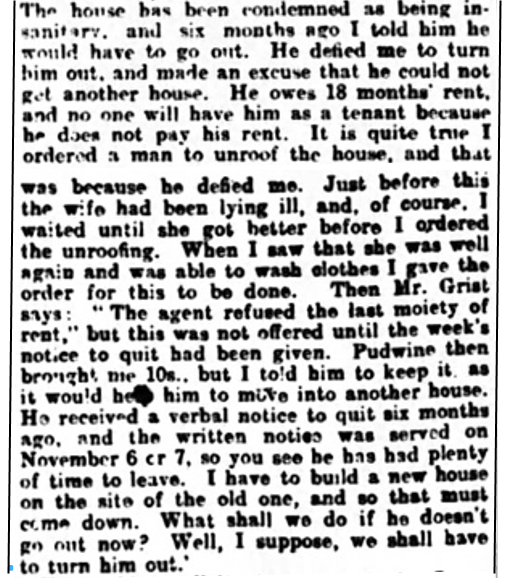
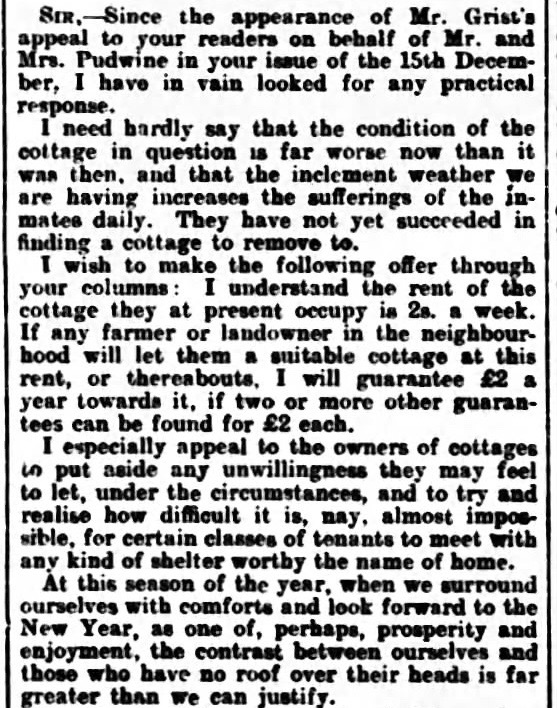
I cannot find a picture of the benevolent Elizabeth Coomaraswamy, who was the widow of a Tamil politician. He was Sir Muthu Coomaraswamy, the first Asian barrister in London, knighted by Victoria, and later commemorated on the stamp from which he still eyes us intently. Her son Ananda Coomaraswamy was a student at UCL at the time, and he went on to be the curator of Indian art in the Boston Museum of Fine Arts, a prolific author and leading intellectual who still has loyal followers today.
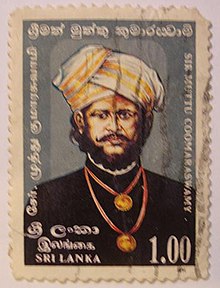
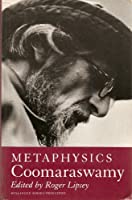
The Good Samaritan was Elizabeth Coomaraswamy (no known picture) — her husband was Sir Muthu Coomaraswamy (left) and her son Ananda Coomaraswamy (right)
The outcome of Alice’s otherworldly encounter with the great and the good was to move a few miles north to Sparrow Row in Chobham, into another tiny cottage, where she and Henry lived for a further fifteen years. Henry only seems to have got into the papers there on one occasion — in 1903, he was fined one shilling for allowing his pony to stray.
There are no surviving photographs that we know of, although a portrait of Alice may have existed when she was younger. Curiously, after the death of her first husband in 1877, the County Court in Guildford ordered Alice’s brother-in-law William Bristow to return “two pair of pictures, two odd ones, and a likeness” that Alice had stored in his house. William claimed title to these items on the grounds that his brother Edward Bristow had never married Alice, but the court did not accept this argument and the judge awarded £1 in damages to Alice to be reduced to one penny if the pictures were returned. Just shy of one hundred years later, my grandmother passed on the following pair of small Victorian paintings that fit the bill, plus a bevelled mirror that was similarly framed in black, but sadly a portrait of Alice has never surfaced.
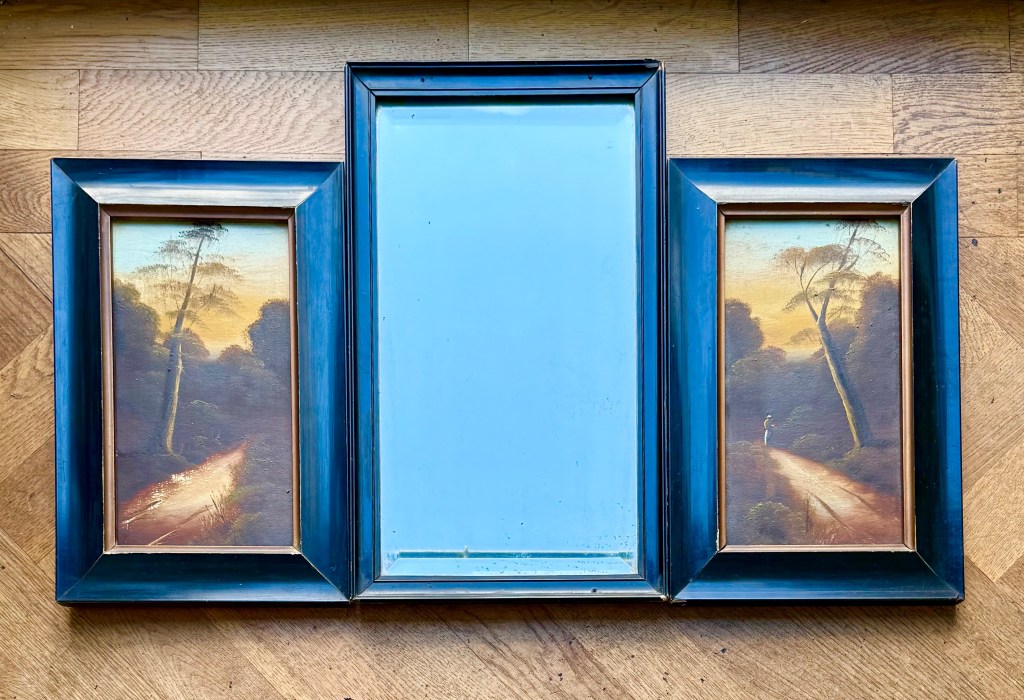
Perhaps the ‘likeness’ was not a painting or sketch of Alice at all, but simply an old-fashioned way of referring to the mirror that we still have … but that is just wishful thinking. Whatever, in the absence of the possible portrait and of any photographs of Alice, even later in life, at least the setting for her advanced years can be captured fittingly in old snapshots of neighbours Granny Beetle and John Leary outside their cottages on Sparrow Row at that time.
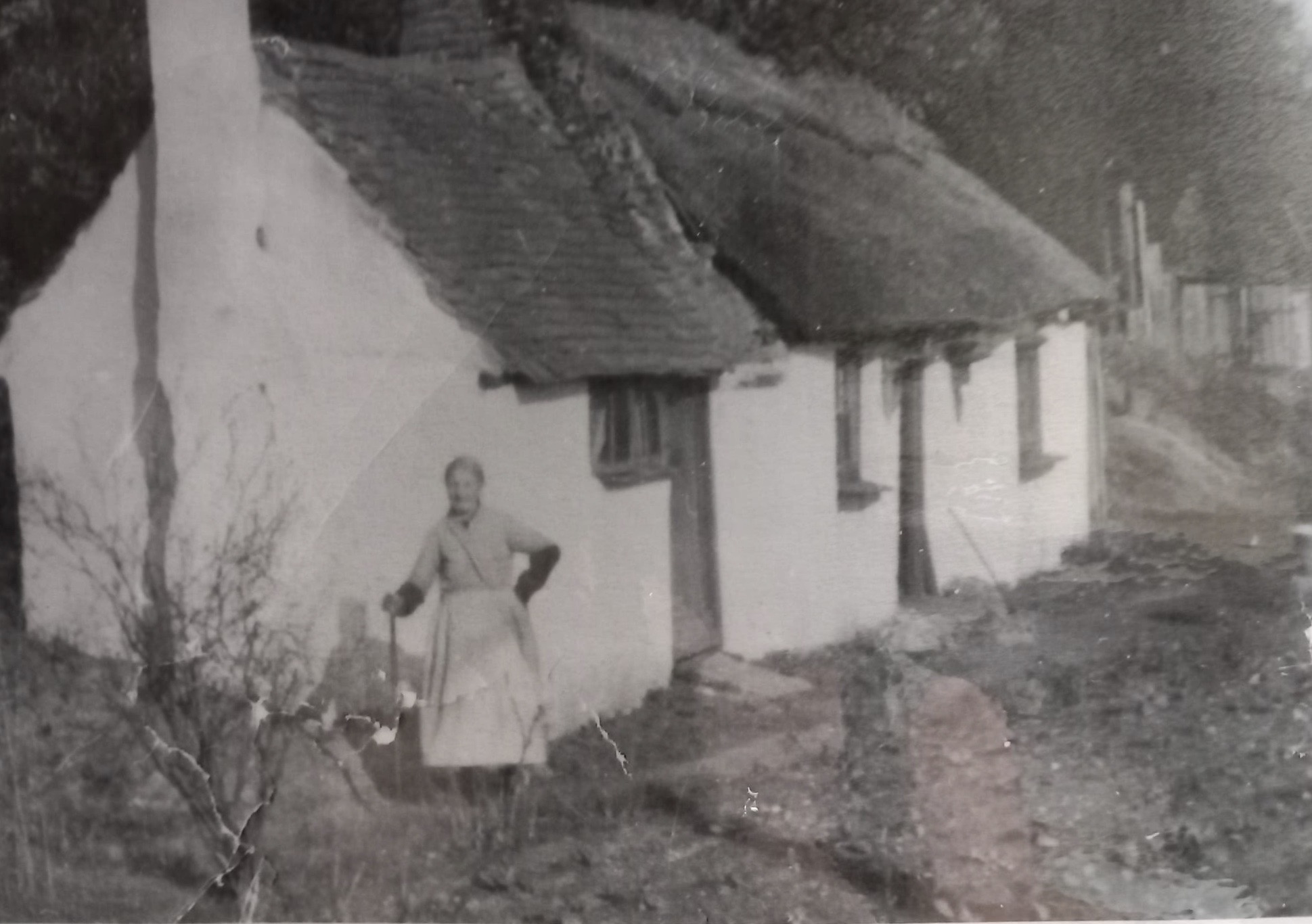
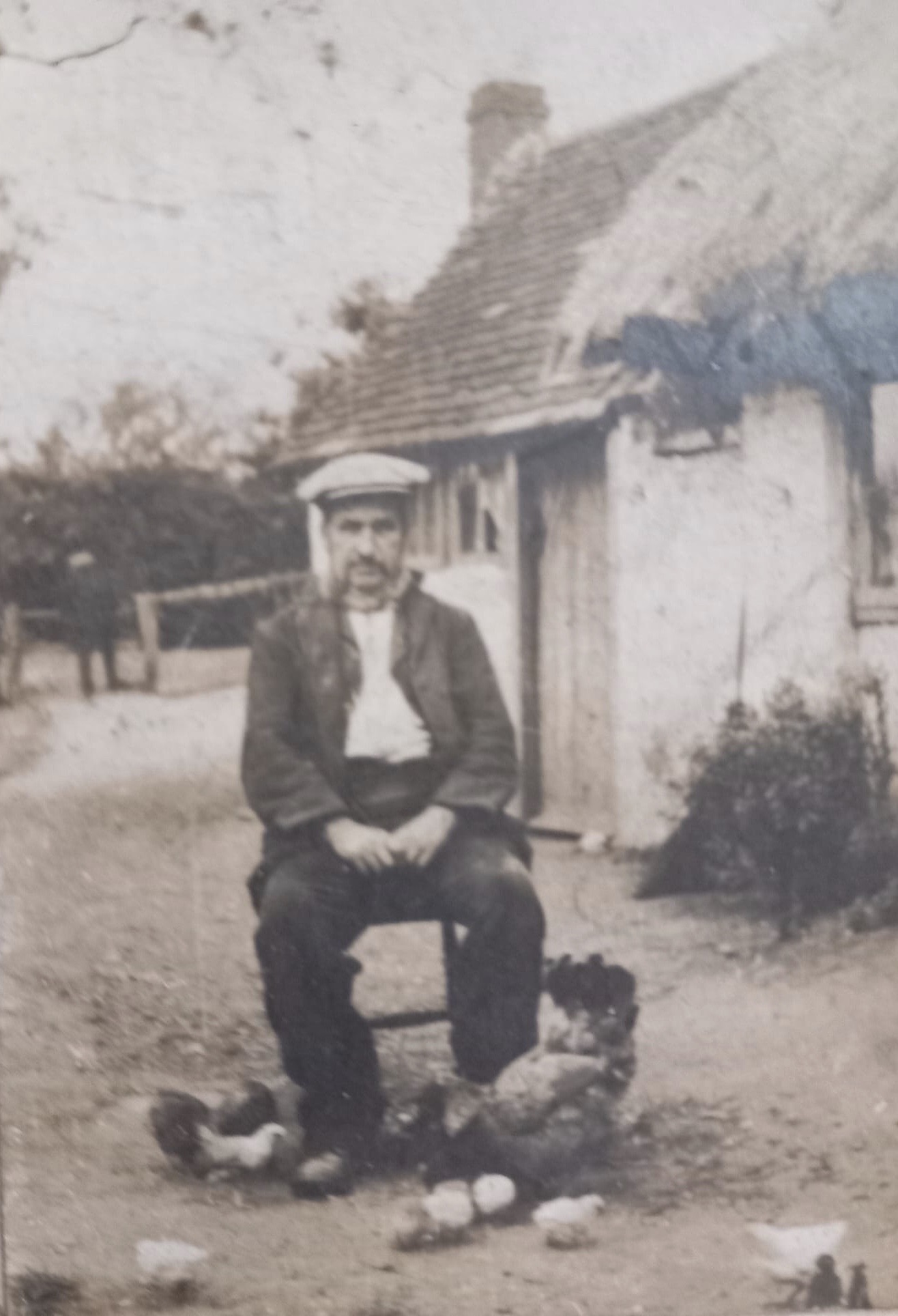
Sparrow Row, Chobham — neighbours Granny Beetle and John Leary
Today, this story can be pieced together thanks to the easy access online to past issues of local newspapers, nostalgic photographs from other people’s family albums that find their way onto various platforms, and the now searchable historical records that were drawn up in manuscript long ago. Under the circumstances, I suspect that my father did not get to hear the half of it in his day. The only tale that was handed down to us about Alice was that her errant second husband Henry had to be bailed out from time to time by my great grandfather, who was a printer on the London Evening Standard living north of the river in Kentish Town — he had to find a way of quickly getting down to Surrey to his mother-in-law’s in order to liberate Henry from the lock-up. Such anecdotes had a hidden purpose of course, told as they were with great affection but also a hint of disapproval regarding the excessive drinking, and perhaps even a suggestion of more revelations to come.
Where there is a benefactor (the admirable Elizabeth Coomaraswamy in this case), there is also a beneficiary. And so it was that Alice was able to live her final years in a rented cottage free from the threat of demolition, and from her fear of the workhouse, in what is nowadays a very coveted spot (the neighbouring home, Granny Beetle’s Cottage, reached a value of more than one million pounds on Zoopla some time ago). The indirect beneficiaries were the two young daughters who were living in a room with their hawker mother at the Elephant and Castle Inn in 1881. Some 33 years later, daughter Ellen was at 1 Sparrow Row in Chobham together with her printer husband when Alice died there on 22 October 1914. The family bond was still very strong. Indeed, when my grandmother Lizzie married five years afterwards, her Ayres relatives attended the wedding.
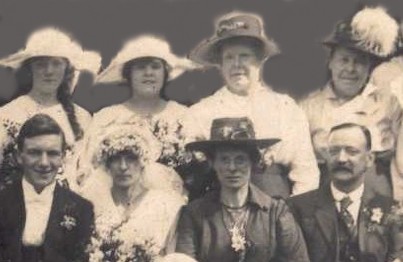
The Ayres cousins at Lizzie’s wedding in 1919 (back row). Alice Ayres’ daughter Ellen is seated in the front row with her husband Edward on her left and their daughter Lizzie, the bride, on her right. Standing behind them are Ellen’s cousins (two of Alice’s twenty nieces on the Ayres side), with their daughters.
Regrettably my father did not get to know the Ayres relatives who were in this picture, but he liked to tell us all about Ellen, the tough-minded grandmother he much admired. She had a stall on the Caledonian Road market on Tuesdays and Fridays, but a different calling on other days as a lay midwife in her neighbourhood. And with her husband in a safe job, she would also look after the down and outs with a hot meal when needed, we were told. His favourite story was about the Islington police, who were on the beat all day in the 1920s. In case of bad weather, the standard issue was a large and very heavy oiled cape. When the sun came out, they rolled these up and stored them away to lighten their load — not in one of their dark blue Police Boxes, but in Ellen’s porch. It was by far the safest location along the Holloway Road, they reckoned!
References
John Staples Harriot, Observations on the Oriental origin of the Romnichal, Transactions of the Royal Asiatic Society, 1830, 2(1) 518-558 (apart from on this one publication, the author’s name spelling was invariably ‘Harriott’).
Jeremy Harte, On the far side of the hedge: Gypsies in local history, The Local Historian, January 2016, 46 (1) 27-46; and Travellers Through Time: A Gypsy History, Reaktionbooks, London, 2023.
The Hampshire Telegraph and Naval Chronicle: 5 July 1862 (Rioting at Hilsea)
The Hampshire Advertiser: 15 June 1867 (County bench); 2 May 1868 (A Gipsey’s Life); 19 Jun 1872 (Encampment); 1 Apr 1874 (Pugilism); 27 Mar 1875 (Cattle straying); 6 May 1876 (Horses straying); 17 Jun 1876 (Petty sessions); 4 Oct 1879 (Horse straying)
The Surrey Times and County Express: 28 April 1877 (Alice Ayres v William Bristow — Claim); 15 December 1899 (Landlordism at Pirbright, a letter from H.H. Grist); 22 December 1899 (Landlord and tenant at Pirbright); 29 December 1899 (Lord Pirbright and his tenants); 6 January 1900 (The Pudwine case, a letter from Lady Elizabeth Coomara Swaney dated 1 January 1900).
Alan Wright, Their Day Has Passed: Gypsies in Victorian and Edwardian Surrey, Grosvenor House Publishing, Tolworth, 2017
Acknowledgments
I am grateful to the holders of the old photographs of Granny Beetle and John Leary for posting and annotating them on social media. Alice Ayres’ bible was amongst my grandmother Lizzie’s effects when she died in 1968 — the hand written entries inside the cover told us when and where Alice had been baptised, when her children were born and when her sister Ellen died, all of which provided a firm basis for further investigation. The articles in the Hampshire and Surrey papers were found more recently, mainly by searching on Newspapers.com using a variety of surname spellings. Additional information collected by others and put generously into the public domain has been extremely valuable, specifically that made available by Kerry Hawkins (from which I learned how Samuel Ayres contributed to the early Romani linguistic research carried out by J Staples Harriott) and by Silvanus Ayres (whose striking stories about the Ayres family feud he first heard from his grandparents). Finally, Norman Burton provided helpful comments on an earlier draft, in particular regarding Alice’s mother who was generally known as Mary James but described in one register as ‘formerly Mary Hylton.’ It turns out that Alice’s mother was born in Chithurst, Sussex in 1815 to parents Mary James (the daughter of Robert and Eleanor James) and George Hilton (the son of Thomas & Jane Hilton) — the use of parental surname variants in the Romany community was not uncommon at that time.
Links to related posts
Letters to Lizzie. About the impact of the first world war on Lizzie and the men in her life (her brother, her fiancé and her eventual husband), and her landmark appeal for a widow’s pension.
The Romany Family at Claremont. About the paintings and drawings of Sarah Cooper and her extended family made by the then Princess Victoria, and the related entries in Victoria’s diaries. Alice Ayres’ youngest sister Theodosia was married to Sarah’s grandson Richard White, and her younger brother Orris to Sarah’s niece Polly Cooper.


 Stuart McLeay

Leave a comment