DRAFT IN PROGRESS. The wartime letters transcribed below were written by my father Ted McLeay to his mother Lizzie between 1939 and 1945. This first batch (the first 53 out of 160) covers his initial RAF service in England 1939/42. The other letters, which have yet to be transcribed, were sent when Ted was on operations later in the war in South Africa, Sri Lanka, India and West Africa, in 1943/44. Each of the letters is typeset below in a standard black font while a blue font is used for a kind of retrospective Diary that attempts to relate the content of each letter to wartime events. Also included, by way of illustration, are some personal photographs and others obtained from the web.
By May 1939, the writing was clearly on the wall. Nazi Germany occupied part of Czechoslovakia in March, and then tore up its non-aggression agreement with Poland in April. In the meantime, Britain and France tried to counter Hitler’s threats with a bilateral guarantee of Polish independence, while Franco proclaimed final victory in the Spanish Civil War and Mussolini’s Italy invaded Albania. The Age of the Dictators was in full flow. On 22nd May 1939, the military alliance known as The Pact of Steel came into force between Italy and Germany. Interestingly, as Britain and France were specified as the main threat to the Axis Powers rather than the Soviet Union, Japan backed out of The Pact of Steel at the last minute (they signed a new Tripartite Pact sixteen months later). In the circumstances, preparations for conflict were under way right across Europe, and further afield as well, not only in the form of rapid rearmament but also military recruitment. It was at this time that Ted joined the RAF, on 3rd May 1939, four months before the declaration of war. In the letter below, the first of the many that he sent to his mother Lizzie, he says “I am now No. 641817“.
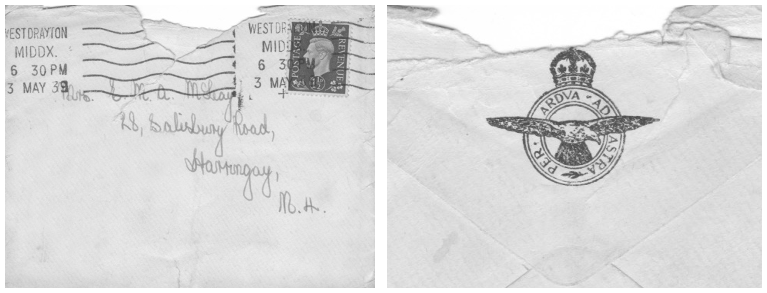
1. West Drayton, Wednesday 3rd May 1939
Dear Mum,
As I have no address I am not able to let you know where to write, but when I do settle down I’ll let you know for certain. I’m starting this on Tuesday evening and I don’t suppose I’ll be able to finish it tonight. When I arrived at Victory House this morning I filled up another form then we had a medical. While I was in the recreation room with all the other chaps I was called into another room by an officer and he asked me if I would like to go as a Telapathetic Operator (or something like that), he said I was of the required standard of education & that I would start at 3/3 a day but after I had had a long talk I said no to it.
Well we were all spoken to by a lot of people & finally came to this place West Drayton, two stations past Ealing Broadway on the G.W.Rly. We had another medical upon arriving and then got our blankets and mug, knife and fork. Eat a good dinner and stayed in hut until tea. Had another good meal and then were kept waiting around to swear the oath which we didn’t do tonight after all. I expect we will be doing this in the morning.
Am now in Wednesday, lights out was at 10.15. I got a good night’s rest & got up at 6.15. Breakfast is 7 o’clock & then we went on to swear the oath. This we did and I am now No. 641817. We go to Cardington, Beds. tomorrow at 7.30 so I will be able to let you have my address soon. Have been kicking a ball around all day and I expect to go to bed early this evening. Hope you are alright and will write soon.
With Love,
Ted
P.S. Don’t get uniform for ten days yet.

2. Cardington, Thursday 4th May 1939
No. 641817
A.C.2 EJ McLeay
Hut 441
Squad 44
No.2 Depot
Royal Air Force
Cardington
Beds.
Dear Mum,
I have put my address on the top as you can see, that is squad 44 not squadron and please print in block capitals all addresses so I can get them easily. This morning (Thursday) we left West Drayton for here and upon arriving found everything much more military. We are all wireless ops in my hut and start our ten weeks on Monday. We have to wait 2-3 weeks for our Uniform. We have to do a great deal of work here until we go to the training school and I doubt if I will be able to come for a few weeks, but I will as soon as I can.
There seems to be a great deal of things to be bought but I am sending some money which I want you to put away for me. I may require some clothes but I cannot tell until next Monday so I will let you know then.
I feel great & hope you do,
Love,
Ted
P.S. Don’t forget to send pen to Mr Owen. Will you, love.
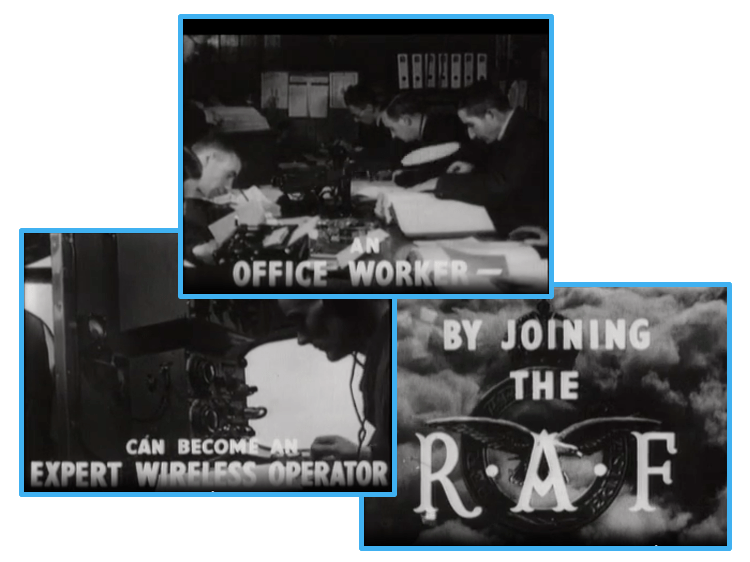
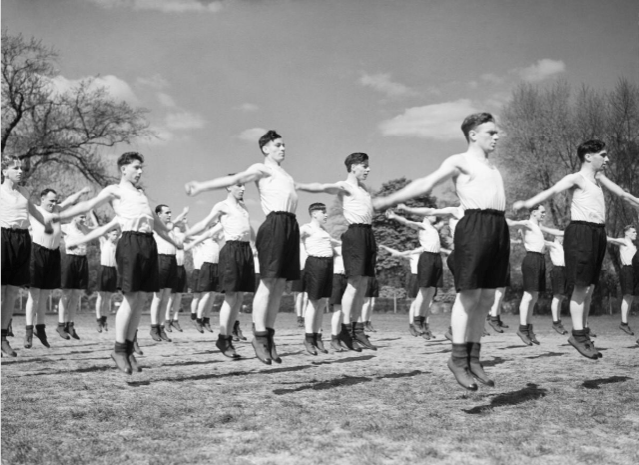
The RAF had set up No. 2 School at Cardington in 1937 to provide an introductory programme for new ground staff and air crew. The preliminary course involved physical training, drill, using arms, handling aircraft and initial education, to be followed by specialist instruction elsewhere. As there was no compulsory draft when Ted joined up, the pre-war recruitment drive mainly emphasised career opportunities, for instance that a fitter in civilian life could become an aircraft mechanic, a butcher an RAF cook, or an office worker an expert wireless operator. When Ted started at Cardington in May 1939, his first letter home (above) tells us “We are all wireless ops in my hut and start our ten weeks on Monday … We have to do a great deal of work here until we go to the training school.“
3. Cardington, probably Saturday 13th May 1939
641817 A.C.2 EJ McLEAY
H FLIGHT 44 SQUAD
No 2 DEPOT RAF
CARDINGTON
BEDS.
Saturday
My Dear Mum,
I was glad to get your letter & hope you are still quite well. The cake was very nice & the boys thanked you very much.
Our Uniforms go to the tailor for altering. Out working suit first, then a month’s time our best one, so I will be home in my working suit at Whitsun. There’s no difference in the two but I suppose they wait to see if you fill out before tailoring your best suit.
I have tried to change the pants, but there’s no one here who wants 42” pants, but it’s a good idea of yours to alter them.
We are getting into the routine of the place now and have had our vaccination and inoculations.
As I am not able to go out I was not able to get a card for your Birthday. I hope you had a good time & will bring you something home.
I wrote to Norman on Friday & should hear from him soon.
The other chaps are quite good company & we all did our housework on Friday evening for about 4 hours & again Saturday Morning for an hour.
I have had a letter from Nan. She says that Ena won a Scholarship to go to Grammar School.
We have not done much in the past 2 or 3 days. We drew 10/- this week. I had to pay 2/- for a running shirt, 6d for sports & sandpaper, 2d for wireless & 1d for cleaning materials.
I had 3/- left last week, so I’m not going to get broke even after that, I’ve got 9/6 left.
I don’t think I can say any more so I’m finishing up for now Mum.
All the Best,
With love,
Ted
Ted’s early letters provide a glimpse into camp life back then in the run-up to WW2. The new recruits were inoculated and vaccinated and restricted to the camp much of the time, keeping their billets spotless as part of the routine. The RAF supplied the entrants with standardised clothing, which was then sent away for alteration. Ted’s personal book-keeping was punctilious i.e., brought forward from last week 3s0d, drawings 10s0d, expenditure 3s6d, carried forward to next week 9s6d. “I’m not going to get broke,” he says in the above letter to his mother. It looks as though he wrote to Lizzie on her birthday (she was forty-five on Saturday 13th May 1939), apologising for not sending a birthday card as he could not go out to buy one and promising to bring a present with him at Whitsun. Ted was certainly at home on Whit Sunday 28th May 1939, perhaps in his newly fitted working suit. In the next letter below (sent two days later), he explains how he got back to his hut on the camp at Cardington from King’s Cross Station in about two hours: “I got to King’s Cross at 9.00 and … we started about 9.30 … got to camp at about 11.20 and … had a ten-minute walk from the gate to the hut.” The journey would take about the same time today, by train from St Pancras as far as Bedford followed by a bus to the RAF Roundabout at Cardington.
4. Cardington, Tuesday 30th May 1939
30th May 1939
Dear Mum,
I got to King’s Cross at 9.00 and did not have to wait long before we started about 9.30. We got to camp at about 11.20 & was glad to know I had kept my winter vest on. It was very cold out here & I had a ten-minute walk from the gate to the hut.
The cake saved my life this morning. I woke 7.15 & got no brekker but had some of the cake & felt much better after it. It’s turned out very nice this afternoon although it was very cold this morning. We’ve had to do a full day’s drill today, but I didn’t feel so bad after it.
There doesn’t seem to be much here, so I’ll leave it till tomorrow and see if anything else turns up.
Wednesday
I can’t find my shoes anywhere but I’m sending my suit here.
My vaccination is much cleaner today & looks like healing up. The boys are settling down again now & most of them are writing home.
Well Mum I’ve got 10 mins walk to the Post Office, so I’ll have to close now.
Cheerio Mum,
Love Ted xxx
5. Cardington, June 1939
Undated
Dear Mum,
I was pleased to get your letter & hope you are now slacking off at work.
On Thursday, we had a test at four w.p.m. & I passed it with No mistakes. I am now in the 6 w.p.m. class. That is the first test we have had.
There is a 1000 chaps from this camp needed at London on 22nd June for the King’s return from Canada, on lining the route, we are now drilling for it & I expect I shall be coming in it. I’m not sure about anything at the moment, but we will know definitely soon.
I don’t think I’ll need the other suit unless it turns suddenly cold again. It’s been hot again today & we’re getting quite tanned.
Could you send my swimming trunks on some time please Mum, we’ve a river where all the boys go, there’s corporals there as well.
My friend in the next bed, Eddie Lowman of Southampton, had a good time over Whitsun & told me to thank you for your cake, he said he liked it very much. He used to be a Sunday School teacher at home.
Well mum I think that’s all for the moment so Cheerio.
Lots of love,
Ted xxx
PS Have saved about 8/- this week. If you get a smooth bone a small one would you send it on please. Love. Ted
The events of June 1939 are, in a way, a wistful reminder of another side of camp life, the “pomp and circumstance of glorious war” (Act Three of Shakespeare’s Othello). In the undated letter above, which must have been sent in early June 1939, Ted tells his mother that an impressive one thousand Cardington trainees are required to line the King’s route on his return from Canada. Although the circumstances soon led to this number being downscaled, Ted wrote home on 11th June 1939 (below) to say that he could still be one of the few going up to London as his flight was deemed to be the best on parade. By 16th June, however, he learned that he would not be taking part after all as the number of men needed was down to one hundred, to be drawn from senior ranks only. Maybe the circumstances did not warrant the pomp after all, shrewdly ducking a comparison with Fascist Germany’s never-ending display of military might. Interestingly, Ted explains to Lizzie in his letter dated 16th June 1939 that his next weekend leave would allow him to travel to London anyway, on 24/25th June, two days after the mooted guard of honour.
6. Cardington, Sunday 11th June 1939
Cardington
Sunday 11th
Dear Mum,
I was terrifficly pleased to get the cake on Tuesday, I made it last till Thursday & it did me as it saved me breaking into my savings. I’ve got 17/- now in 2 weeks.
I’m sending my 4 w.p.m. paper home now. Hope it pleases you. After we had been into the 6 w.p.m. class twice, on the 2nd time we had a test. That was Friday. Part of it was “impecunious writers” I got the first word right but I left the ‘wr’ off writers. If I haven’t more than one mistake I will pass. I think I have passed. Please keep paper.
It doesn’t matter about the bone thanks mum. I’m using the handle of the knife.
It’s been very hot this week but we’re kept very cool. First of all we took off our jackets, collars & ties & rolled our sleeves up then we had orders to parade in P.T. shorts, not bad eh? We looked like native police in S.A.. Last night however it started to pour with rain at about 10.30. It’s not raining this morning but very cloudy.
I’m almost sure to be coming to London on Thursday 22nd whether we will stay there or not I don’t know but if not I will be coming on the Sunday 25th & Sat.
Thanks for shorts. I have not used them yet but I will be doing so shortly I expect.
On Thursday we had a Kings Birthday parade & although we are only about 7th in seniority we were told we were the best flight on parade only 80 of us were picked out of 170.
I have had four games of cricket so far & have a batting average of 19 runs per innings.
On Friday we had a full pack inspection. I came through OK our pack only weighs 20lbs. We’ve got to make another one for Monday. Well mum I hope to see you pretty soon.
Cheerio Mum,
Best of Love
Ted
7. Cardington, Friday 16th June 1939
Friday 16th
Dear Mum,
I was pleased to get your letter & hear you are feeling much better!
We were disappointed to hear that we will not be going to London on 22nd June as they only need 100 men now, and therefore taken the Senior flight.
I was glad to hear about Peter, & Harry’s little baby & I hope to be home on 24th June all being well so perhaps you can arrange for us to go over on the Sunday.
My spelling is no doubt out of place, but there is a great deal of work now mum & I don’t have much time, but if I take my time I think I can get my spelling OK.
I did have my 6 w.p.m. & am at present taking 8 & 9 w.p.m. but I find it difficult at the moment.
Eddie & I went to a concert on Sunday evening at the RAF club, Bedford. It was pretty good, the acts were chaps from this camp & there were some good ones.
We had a full pack inspection on Tuesday & have got one on Monday by the CO of this station & one on Tuesday by the Area CO. So we’ve got plenty on our hands this W.E. as we’ve got to paint the hut as well.
I heard from Norman on Tuesday but he didn’t have much to say.
Thanks for the Belt mum, I haven’t been able to use it yet as the weather is very cold but I will do directly it changes.
I got a pleasant surprise when I got the cake & the boys who have had some say it was smashing.
Well Mum I cannot think of any more to write, but will write sometime next week for certain if I am coming home. I expect to be but if the hut isn’t up to standard you never know.
Best Love,
Ted
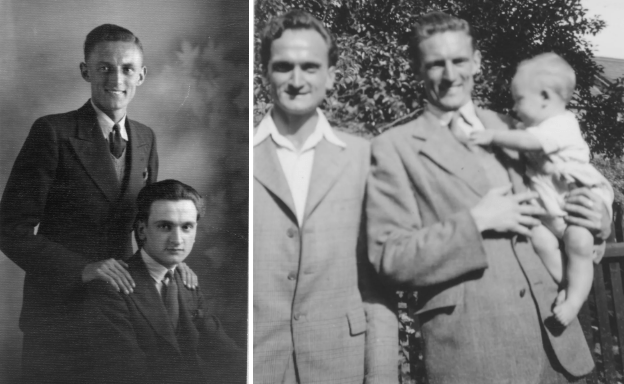
June 1939: On the left, a youthful Ted McLeay standing behind his schoolfriend Norman Huff – photograph taken while on leave in North London. On the right, Norman and Ted in 1947 (with me). Norman is mentioned in the letters dated 13th May and 16th June above, and 28th June 1939 below in which Ted tells Lizzie that the two of them met up with Joyce and Audrey Sharp.
8. Cardington, June 1939 (dated ex-post 28-Jun-39)
Cardington
Dear Mum,
I got your letter with my toothbrush & paste in this morning & was glad you had sent them on as I was I beginning to get a nasty taste in my mouth. At first I thought it was my gloves which I have left on the couch. Would you please send them on.
Norman & I saw Joyce & Audrey on Sunday & they all came down to Kings Cross. I caught the 10.15 all right & got to camp at 12.30.
We had a pretty strenuous time since I got back & expect it will be even more so as we have not long to go before we pass out.
There will be no chance of getting any more weekends after this so I [was] lucky to take mine last week, as expect there will be quite a few going home this week.
I had a good time over the weekend & am looking forward to my summer leave.
Last night we played the next hut at Jimmy Macker & beat them up easily.
Well mum dear there is nothing else for the present so cheerio,
Love
Ted xxxxx
9. Cardington, July 1939 (dated ex-post 3-Jul-39)
Cardington
Sunday
Dear Mum,
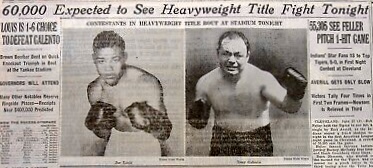
On the same night as Joe Louis fought Tony Galento we had a fight in our hut but I wasn’t in it. One chap got a black & t’other a cut lip.
Thanks for sending on my gloves but I got them too late for inspection on Saturday, however they weren’t noticed to be missing so I got by without, luckily.
Nothing much has happened this week so there’s not a great deal to tell you. This weekend was the last weekend we can get passes for so I will not be home before August.
Next Sunday there will be a terrible lot of work to do as it is the only spare time we will have to do all our blanco & brass and make up full packs before passing out so I don’t think it would be advisable to come out as I would get all behind if I did. Too bad I should have liked you to come down.
I’ve got rid of my cold alright now & hope you are feeling OK too.
We pass out at Wireless on Wednesday. We had a test at 8 w.p.m. last week sometime & I only made 1 mistake. I didn’t put a ring round a full stop like this

Well Mum doesn’t seem to be any more, reason writing is so light is because I am trying to speed up my writing all round.
Cheerio,
Best Love,
Ted xxxxx
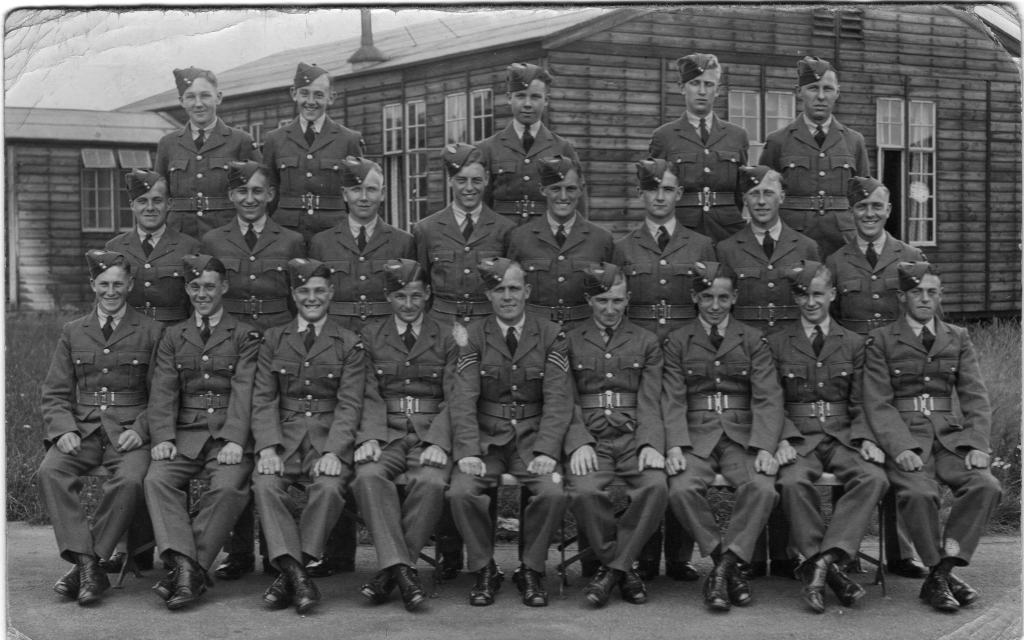
Ted moved from Cardington to Yatesbury in July 1939 in order to undertake his specialist training as a Wireless Operator. The RAF camp at Yatesbury was established in WW1, and repurposed in 1937 as an Electrical and Wireless (E&W) School to train radar operators. Ted found Yatesbury to be a depressing place initially — “muddy & dirt all over the show” he says in the letter of 15th July below. In the letter, he explains how “the place is all chalk, and the rain stirs it up and it gets all over you. My trousers are filthy and so are my boots.” A very cold place in winter, he says in a later letter in December 1939, much colder than London in the snow. Unfortunately, Ted just missed out on having the science fiction writer Arthur C. Clarke as his radar instructor, which might have brightened things up (Clarke was recruited as a tutor at RAF Yatesbury in 1940, after Ted had passed out as a Wireless Operator).
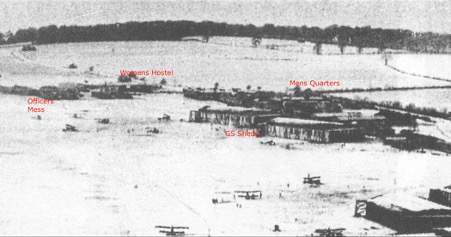
This early photograph of RAF Yatesbury dates back to WW1, showing how bleak it can be.
10. Yatesbury, Saturday 15th July 1939
No 641817 A.C.2 EJ McLeay
Hut Z6, No. 3 Wing
A Squadron
No. 2 E&W School
RAF
YATESBURY
Nr Calne
WILTS.
Saturday 15th
Dear Mum,
Sorry I haven’t written before but I was waiting until we got here before doing so.
We passed out alright at drill & PT alright & were sorry to leave our drill behind really, but when we got here yesterday we wished we were back at Cardington. This seems an awful place, not that I mind it being miles from nowhere but it’s muddy & dirt all over the show. The discipline is apparently very slack & we don’t start our course for about 2 or 3 weeks during which time we have to do fatigues & we have no overalls, still I suppose it will be alright when we do start the course. Most of us have been split up & parted but we have about 10 of us in the hut I’m in, the other 16 have been here about 12 weeks & have all failed the course mostly because they wanted to.
I saw Den Sharpe soon after I got here & he is still on the course alright, he is trying to pass out as AC2, but I am going to have a go at AC1 if possible. If you fail the course you go as General Duties & stay at 2/- a day for the next year or so when you can try and remuster to another trade, however I won’t be doing that I hope.
I am sending you a photograph of our hut at Cardington. I have a large one but I will fetch that home at August. I don’t know for certain when we will get our leave but I believe it is from the 5th August for 2 weeks, but I will let you know for certain next time I write. I won’t send the tins back mum but will bring them home at August, it doesn’t matter about sending any more cakes before then thanks mum as there isn’t long to go now.
This place is terribly depressing & it’s raining hard at the present, however I suppose it will cheer up a bit on Monday. Well mum hope you are not too depressed yourself with my letter, but I thought it would be best to tell what it’s really like here.
Hope you are keeping well yourself & are not too lonely, So long for now mum
Best love
Ted xxxxx
Morse code was a crucial communication method for the Royal Air Force during WW2. The war artist Charles Ernest Cundall captured the scale of the training programme in his dramatic painting of a large cohort of wireless operators who were undergoing their initial education in Morse Code, in this case in Blackpool.
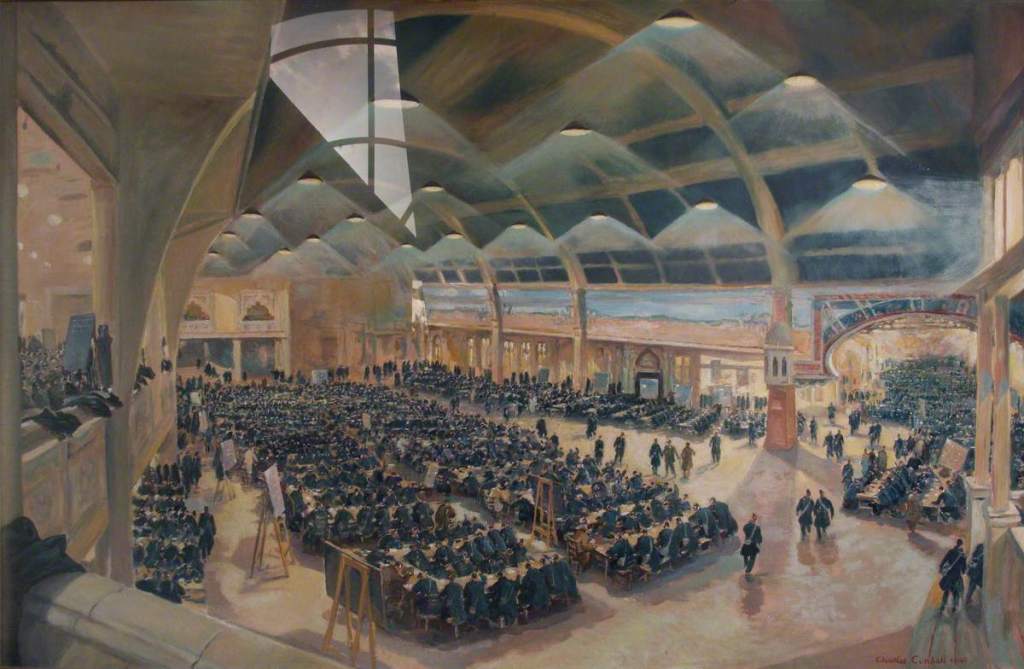
In the letter dated 18th July, below, Ted notes that he had reached 10 words per minute before starting at Yatesbury. In the next letter, 23rd July, he mentions trying 12-14 w.p.m. RAF pilots had to be able to send and read Morse Code at a minimum of 15 w.p.m., and those on the Wireless Operators’ course had to attain a speed of 18 w.p.m. in order to pass out. It is said that highly skilled telegraphists could decode 30-40 w.p.m. accurately, and the highest ever speed of Morse Code interpretation was recorded in July 1939, at 75.2 w.p.m.
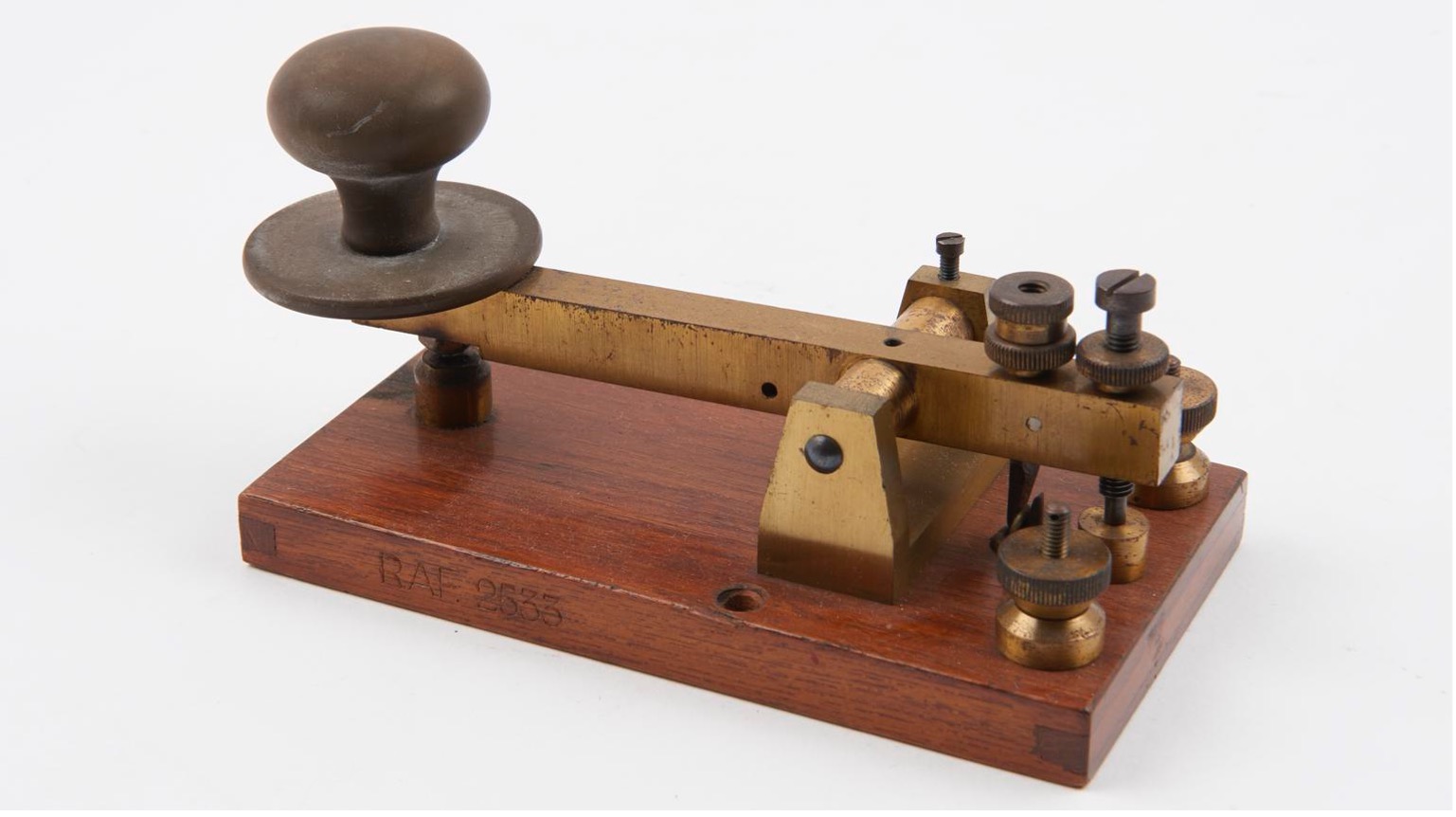
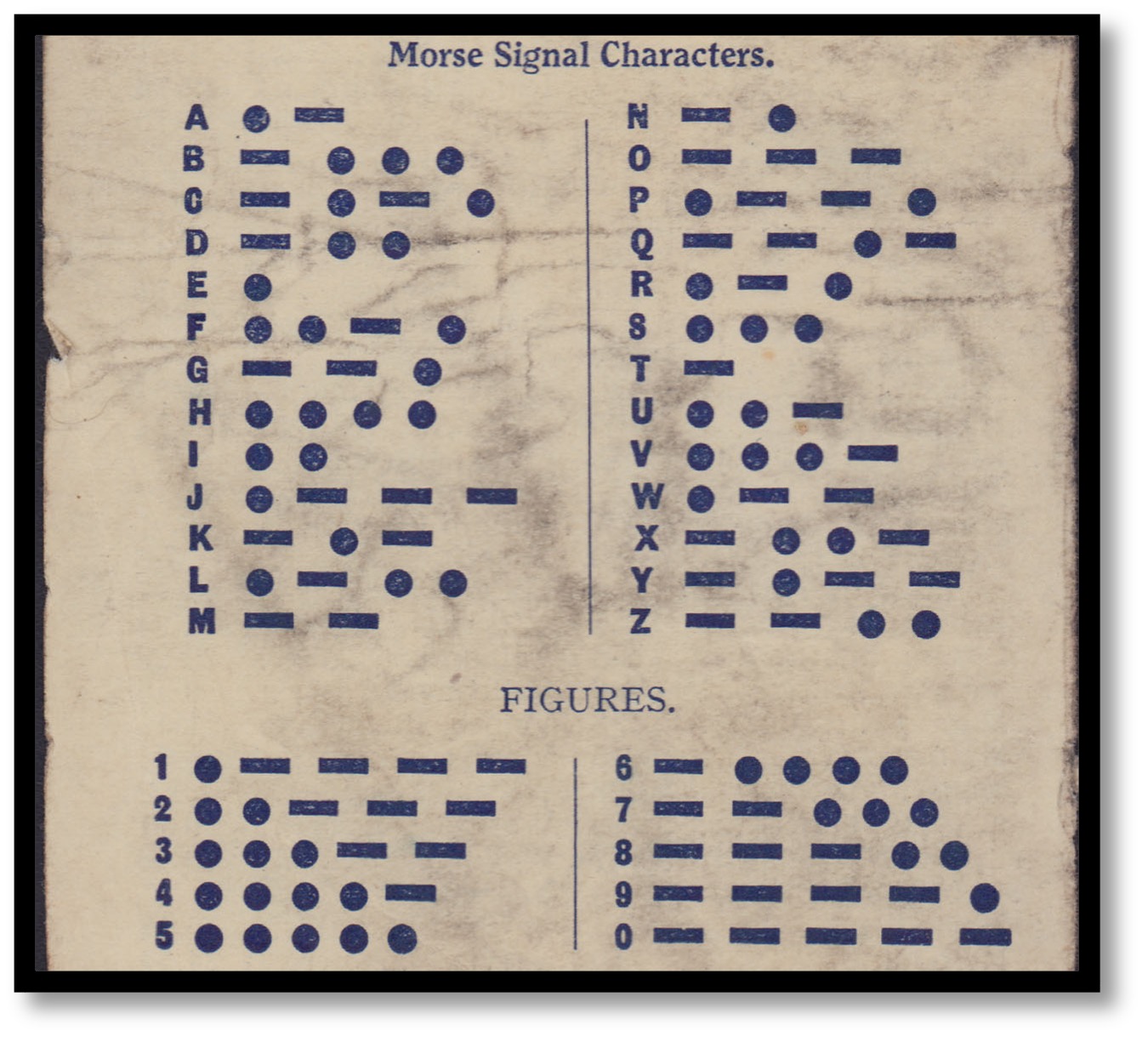
A morse key stamped ‘RAF’ and manufactured about 1938 (left, Science Museum) and a training manual extract showing the Morse Signal Characters (right, Bomber Command Archive).
11. Yatesbury, Tuesday 18th July 1939
614187 A.C.2 EJ McLeay
Hut Z6 A Squadron
3 Wing No. 2 E&W S
RAF Yatesbury
(Nr Calne) Wilts.
Tuesday 18th
Dear Mum
I was glad to hear from you & pleased to know had been out & had a good time. I dont suppose I’ll know Michael when I see him next he’ll be so big.
On Sunday it was quite dry & it did not seem so bad here, I had a game of football last night but until I get my boots after August, I don’t suppose I’ll play much. Today it has been raining all day & we were doing fatigues in it this afternoon carting a boxing ring around. The place is all chalk & the rain stirs it up & it gets all over you. My trousers are filthy & so are my boots as they do not issue you with [dungarees].
We go into morse for 2 hours every morning, but will not be able to start our course for another 2 or 3 weeks maybe not till after August but it won’t matter much as we won’t be able to forget anything during the holidays. Some of our chaps went to make up a unit of 100 to start the course today. [H]ow they picked them out I don’t know, it wasn’t by Morse seniority as there are about 5 of us who were doing 10 at Cardington. I am not on the course. I don’t believe they are going to have any more classes at AC1 as they think it is too much to learn in the time. So I will be able to pass out at AC2 at the most.
It doesn’t matter about sending a cake before August thanks mum. The food is better than at Cardington & about the same amount.
I got a letter from Nan yesterday & she said that Ena is in hospital with Acute Appendicitis so I have written to Nan & told her that you would be coming over most probably. I hope you find time to to go over as I expect Nan is rather upset.
Den is a terriffic fast writer now, I suppose it is the morse. I was watching him write home the other evening & he was through four pages in no time. He has asked me go camping with him & the rest of the family for a week at August to Clacton, that is from the 5th to the 12th. Our leave is from the 3rd to the 20th & I told him I would have to find out when you were going away first. What week have you got mum? [I]f it is this week perhaps you would like to go to Clacton & stay at the place Peg stayed at last year. What do you say? Let me know soon won’t you mum as I’ll have to let Den know.
Well mum I expect I will let you know more about this place by the next time I write. So cheerio for now.
Best Love,
Ted xxxxxxxx

Train Landscape, 1939, by Eric Ravilious. The painting features the Westbury White Horse on Salisbury Plain, seen from a third class railway carriage. Of thirteen known Wiltshire White Horses, the closest to Yatesbury is on Cherhill Down near Calne, the one mentioned in the letter below. The figure was turfed over shortly afterwards to prevent the Luftwaffe from using it for navigation.
12. Yatesbury, Sunday 23rd July 1939
Yatesbury
Wilts.
Sunday 23rd
Dear Mum,
Was pleased to get your letter. It has been raining here all the week & I have not been out at all so far still I expect I will be going out this evening. I expect we will be starting our course tomorrow week so we will only have 2 days on the course before holidays. I will be home sometime on Thursday evening maybe before you get home. I am waiting to hear from Mr Sharpe before I can tell you whether or no I will be going to Clacton with them.
I was sorry to hear Mrs Gibbs was ill. I hope she is much better now. I didn’t know Mr Gibbs was after a job, what was it?
I meant to send Nan a photo but did not have the size envelope, still I will next time.
I can do 10’s easy now & am trying 12-14 now. When we start our course however we go back to 8’s & work up at a word a week.
I have paid my fare home now Mum & have got the next seat to Den.
After the 1st day’s fatigues it hasn’t been so bad as I’ve had most days indoors. Well the weather doesn’t seem so bad today & a couple chaps & I are going to have a look at the ‘white horse’ on the hills, so I will close now, cheerio Mum.
Best wishes & love,
Ted xxxxx
In addition to Morse Code training, Ted’s letters provide an insight into the mathematics content of his course, and he tells his mother that he is getting on well with the subject. In the letter below, dated 30th July 1939, he says to Lizzie “We had an educational test last Tuesday & I got all 20 sums right, they weren’t very hard. I’ll show you the handout later.” A post script at the end of the letter takes this a bit further, first by commenting “Am still liking it very much myself, but a lot of boys wish they had not joined“ and then by copying one of the test questions for Lizzie to see, i.e.

We might ask now what was the learning intention of such a complicated calculation in the training of decoding experts? Was it to promote speedy deduction, accurate interpretation, competent computation, or perhaps judicious approximation?
Ted’s liking for problem-solving chimes with one of the stories we heard in our childhood. Later in the war, when he was on ground-to-air communications at RAF Oakington, he would be woken up when he was off-duty and called to the operations room if bad weather blew in. The messages from pilots or navigators would break up in stormy conditions, and Ted by then had a reputation as the resident expert at providing an impromptu interpretation of fragmented speech and partial code segments. On one occasion, however, when he was guiding a bomber pursued by enemy fighters back across a stormy North Sea, an additional problem presented itself when his transmitter started to fade. Although he had taken a radio mechanic’s course in the meantime, and knew how to fix problems if time were available, he instead resorted to the traditional approach of giving the transmitter a big thump in the hope that it might be a faulty valve that would work again if reconnected. Luckily it was and it did. Ted often thought later in life about the pilot out there with a Messerschmitt on his tail who was unaware that his safe return was in the hands of eighteen year old ground staff who were hitting their transmitters to get them to work properly and trying to piece together broken up messages.
13. Yatesbury, Sunday 30th July 1939
641817 A.C.2 EJ McLeay
Hut Z6 A Squadron
No 3 Wing, No 2 E&W S
RAF Yatesbury
Nr Calne
Wilts.
Sunday 30th
Dear Mum,
I was pleased to receive your letter & to know the weather is getting better. I hope it keeps better.
Glad to know Mrs Gibbs is getting better & that Mr Gibbs found a little job. I expect it helped them a lot.
Went to Yatesbury last Sunday there’s about 3 houses and a post office there. Yesterday we went into Calne about 4 miles away. We walked around a bit as my pal wanted to get some shoes, & then we came back. There’s not much there, except Harris Wilts Sausage factory.
I hope the knitting for Peter has gone OK. I have written to Nell, Peg & Uncle Bob, and wrote a special one to Uncle Bob, telling him about my classing. Well you don’t know yourself do you. We had an educational test last Tuesday & I got all 20 sums rights, they weren’t very hard. I’ll show you the handout later. We were put in 4 classes of 25 chaps in each, making a unit of 100. I was in the first class which was E, the four classes being E,F,G,H. We start our course tomorrow so now you know as much as I do Mum.
I leave here at 1.30 & will get home before you but don’t leave anything to eat as I’ll wait till you come home. I have got to get a decent hair cut. I’ll also want some clothes won’t I? Some brown shoes, socks, a shirt, vests & pants. So we can get them in the evening.
Dennis got a line from his Dad & he says that it’s OK. I suppose I will be going on Saturday, presumably in the car. Mrs Sharp is not going I know now. Mr Sharp, Dennis, Audrey & Joyce are going but as for the 3 children & Dorothy (Den’s other sister) I don’t know. I heard from Joyce on Saturday & she says they decided a long time ago I was going on holiday with them. So it was just as well I didn’t book up. I will be able to take my rackets & learn tennis & maybe dancing too.
Norman has gone on holiday this week to Scarbro and I am expecting to hear from him soon.
I got a letter from Nan yesterday & she sent me 4 stamps for some fancies. I will get her something but I suppose you could do with the money more so I won’t get you anything. I believe I have got £3-12-0 in the box haven’t I Mum?
Well what with my last week’s keep in grub I hope to give you 35/- if not more (which I doubt) so we may be able to go somewhere in the 2nd week for a couple of days.
Cheerio Mum dear see you Thursday,
Love,
Ted xxx
PS Am still liking it very much myself, but a lot of boys wish they had not joined.
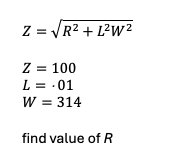
About [the] only one who got it right as far as I can see.
14. Yatesbury, Wednesday 23rd August 1939
641817 A.C.2 EJ McLeay
Hut Z6 A Squadron
No. 3 Wing, No. 2 E&W School
RAF Yatesbury
Nr Calne, Wilts.
Wednesday 23rd
Dear Mum,
I went to Kings Cross after taking the children down to Regent’s Park for their Uncle to mind them. Joyce came to see me off and we left about 8.30. I was apparently so lucky. I had to sit in the gangway but was lucky in the fact that I could lie down on 2 kit-bags & sleep or rest anyhow. Our coach was only one out of three which didn’t break down. The others come in about 2 hours after us. I haven’t handed in my pass yet as we were in late on Sunday, but I am hoping I will not get into trouble as the Senior man in our hut said it did not matter as I had not heard anything.
We went straight on in the usual way on Monday but I got up too late to get any breakfast. However I wasn’t very hungry.
I haven’t been into Calne for my byke yet and will most probably go in on Friday eve. Jack Doyle brought back his bike so we will be going for a ride on Sunday. If we are not duty wing on Saturday week I will be coming up for the week-end, and most probably bring Jack Doyle with me. The days skip by down here so it won’t seem very long before I get home again.
Well Mum there’s not very much to say as we have not done anything out of the ordinary yet but I’ve got a lot of notes to do so I will finish now, hope you feel better for your rest. See you soon.
Best love,
Ted xxxxx
In early August 1939, tensions rose sharply between Germany and Poland. In Britain, the RAF’s planes filled the skies for several days while air defence tests were carried out. The news that brought everything to a head came on 24th August 1939 when the Soviet Union and Nazi Germany signed the Molotov–Ribbentrop Pact, a non-aggression agreement named after the respective foreign ministers at that time. A so-called ‘secret protocol’ to the pact laid out the signatories’ future spheres of influence, clearing the way for Hitler’s seizure of Western Poland, which took place on 1st September 1939, Stalin’s annexation of Eastern Poland two weeks later, and eventually the Soviet invasion of Finnish Karelia.
Ted’s letter below was sent on 28th August, and refers for the first time to the “war scare“, informing his mother Lizzie that he would not “get any leave next week-end as all week-ends have been cancelled” and that “We are just waiting developments now.” Ted’s letter also tells Lizzie about a “guard being put round the camp” with “rifles & bayonettes,” explaining how he and the other trainees must now “walk round all day with gas masks on our backs.“ With the camp on a war footing, “everything is ready down here” he says, adding that “we have our air raid dugouts but some of us have to run over the hills in a raid.” Clearly, Ted thinks that the latter option is preferable, as it “seems safer to me to get away from the camp“.
15. Yatesbury, Monday 28th August 1939
Yatesbury
Monday 28th
Dear Mum,
I was pleased to get your letter & know you are OK. I suppose it is more company for you at work, but don’t go overworking and making yourself ill.
We have only had about an hours rain since I got back although it has been pretty bad not far away at times.
I wont be able to get any leave next week-end as all week-ends have been cancelled and we are not allowed out in civies. There is a big guard being put round the camp now rifles & bayonettes and loaded sticks. We are having to walk round all day with gas masks on our backs. We are just waiting developments now as everything is ready down here we have our air raid dugouts but some of us have to run over the hills in a raid. Seems safer to me to get away from the camp.
I will write to Aunt Nell if I get time but we have pages of notes to write so I may not be able to.
Audrey went into St. Mary’s last Wed but came out Friday owing to the war scare. She will most probably be going in again Wed. Too bad she gets so bad isn’t it. Why don’t you go up and see them If you are at a loose end. I don’t suppose Mrs Sharpe has gone away this week. The address is 44A Blythwood Road.
I’m getting on OK with the course and hope to pass 0.K.
Well doesn’t seem to be anything else at moment Mum.
Cheers for Now,
Love,
Ted xxxx
PS Will send some money next week if there is no sign of being able to come home soon. Ted
16. Yatesbury, Saturday 2nd September 1939
RAF
Yatesbury
Wilts.
Saturday, 2nd Sept
Dear Mum,
I was glad to get your letter and hear you are not worrying so much now. I am not worrying myself and we are still going to school just the same and I got in a game of cricket this afternoon and again tomorrow.
I’m glad to see you are going to Nell’s for certain. It is the best thing I believe and why don’t you look for a better job nearer home.
I can’t think of anything special for you to save for me until I see what you’ve got. I’m sending you 10/- (5/- for last week & 5/- for this). Hope it will help you.
I heard from Joyce that Audrey is not going into hospital yet owing to the war scare. I will give your wishes to Audrey.
We are having plenty of rain at this very moment and have no lights owing to Air Raid blackouts. Well I don’t think there is anything more to say as nothing is happening at the moment.
I hope you will not do too much work when moving and don’t worry about me. Give my best withes to A Nell and all.
Best Love,
Ted xxxxxx
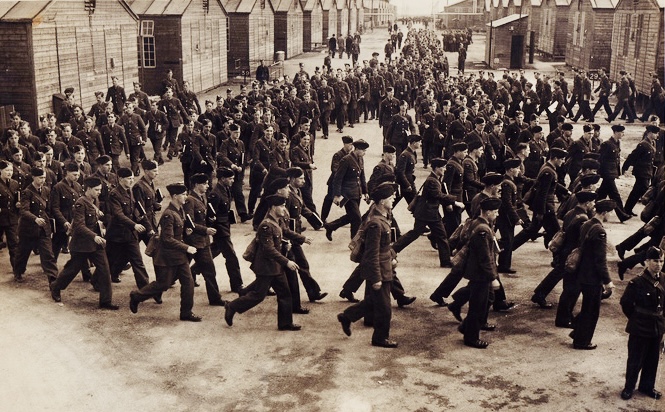
The news that Britain was at war with Germany was broken by Prime Minister Neville Chamberlain at 11.15am on Sunday 3rd September 1939. Ted’s letter (above) was sent the day before on 2nd September 1939 and refers once again to the “war scare,” this time also mentioning the “air raid blackouts” at RAF Yatesbury. The letter strikes a characteristically buoyant note: “I am not worrying myself … I got in a game of cricket this afternoon and again tomorrow.” Reading it now leaves us wondering whether the second match scheduled for 3rd September 1939 actually went ahead?
The next day, 4th September 1939, saw the first RAF raid of World War II, when twenty-nine aircraft from Bomber Command (fifteen Bristol Blenheims and fourteen Vickers Wellingtons) were sent to attack warships in the German Bight near Hamburg. Although the RAF planes damaged two battleships, seven aircraft were shot down by anti-aircraft fire. Far away from the conflict, in rural Wiltshire, Ted tells Lizzie in his letter dated 7th September (below) that he played “two games of football in two days and you wouldn’t know anything was on,” although elsewhere in the same letter he makes it clear that camp life was not really that easygoing as they were “digging trenches last Monday“.
The letter below also makes reference to other wartime developments in Britain, firstly the priority removal of schoolchildren from likely target areas. In this regard, Ted passes on a message from his paternal grandmother Nan about his younger cousins John (then known as Jackie, 13) and Ena (11): “Jackie has been evacuated” and “Ena is at Eastbourne“. Secondly, the letter of 7th September touches on the conscription measures that passed through parliament on the day that war was declared (The National Service Armed Forces Act 1939), covering all adult males aged 18 to 41. Ted tells Lizzie that her brother Bob (aged 39) has written to say that he “expects to be called up some time“. As it happens Bob had been in the RAF before, towards the end of WW1. Ted also mentions Lizzie’s carpenter brother-in-law Fred (aged 36), hoping that he “won’t be called up but I suppose if it goes on for long he will” (in later letters we hear that Lizzie’s youngest brother Jock, aged 24 in 1939, was called up in 1940). The third turn of events that week was the sounding of air raid warnings in London and elsewhere, perhaps set off in error or possibly by way of practice for likely attacks (the historical record is unclear). Ted writes “I expect you are rushed about quite a bit at the office and everywhere in London with the Air Raid Syrens!“
17. Yatesbury, Thursday 7th September 1939
Yatesbury
Wilts.
Thursday 7th
Dear Mum,
I was pleased to get your letter and sorry to hear you are worried. Don’t worry Mum, with luck I will be home Sunday week, not certain but quite likely.
I would try and get rid of the furniture and house as soon as possible if I were you Mum as it’s going to be a very great difference to your money.
I hear you had to get up at 3 o’clock one morning, did that apply to you too Mum, I bet it was hard work wasn’t it?
We are not very busy here, not as much as we thought we would be at least, we were on digging trenches last Monday eve, quite fun. I expect you are rushed about quite a bit at the office and everywhere in London with the Air Raid Syrens!
Give my best wishes to any of the family you see. I heard from Uncle Bob same day as I got your letter and he expects to be called up some time, he thinks I should be able to get an allowance for you, I doubt it but I have asked for an allotment form and will put down 6/- for you out of my wages so if its any more you will know how much. Hope you have got 10/- I sent you.
Hope Uncle Fred won’t be called up but I suppose if it goes on for long he will. Give Aunt Nell & Uncle Fred my best wishes and the baby.
I got a letter from Nan and she says she hasn’t heard from you, when is her birthday Mum? Jackie has been evacuated and Ena is at Eastbourne.
We, Doug and I, have had 2 games of football in 2 days and you wouldn’t know anything was on.
Will Cheerio Mum hope to hear from you soon.
Best love,
Ted xxxxxx
The next letter below is dated 5th December 1939, some three months after the outbreak of war. From Britain’s perspective, these initial months were marked by devastating attacks on merchant shipping and fishing fleets in the North Sea and the Atlantic, as well as naval vessels (on 14th October 1939, the HMS Royal Oak was torpedoed by a U-boat at Scapa Flow in the Orkneys, with the loss of over 800 crew). The maritime records list 155 British vessels as sunk or wrecked by enemy action between September and December 1939 (five every four days). Of these only 17 were naval, compared with 90 carrying cargo, 35 fishing boats, 11 tankers and tugs and 2 carrying passengers. Of the known causes, 72 were sunk by torpedos or damaged by ship gunfire, 52 were struck by sea mines and just 8 were bombed by airplanes. The presumption that Luftwaffe planes were mainly involved in releasing parachute mines that would float in the sea off the English coast was confirmed on the night of 21st/22nd November 1939 when Heinkels based to the north of Hamburg (on the North Frisian islands of Sylt near the Danish border) and to the west of Hamburg (at Borkum near the Dutch border) were seen dropping them into the estuaries of the Humber, the Stour and the Thames. The above locations — Borkum, Sylt and Scapa Flow — are marked on the map below, together with the whereabouts of other incidents involving the RAF and the Luftwaffe at that time, as detailed in the next paragraph.
The first Luftwaffe airplane to be destroyed in the North Sea was not a mine layer, but a Dornier seaplane that was forced down near Fisher Bank on 26th September 1939 by aircraft from HMS Ark Royal (the carrier was there to support the blockade of merchant shipping heading towards Germany, and warships and U-boats attempting to reach the Atlantic). More Dorniers were brought down close to the east coast, one off Blyth on 26th September 1939 (by 607 Squadron’s Gladiators based at RAF Usworth), another that same day off Berwick, yet another off Scarborough on 10th November 1939 (by 220 Squadron’s Hudsons flying out of the Coastal Command station, RAF Thornaby) and one more further out in the North Sea on 29th November 1939 (known to have been in the 2nd Küstenfliegergruppe at Sylt). In addition to Dorniers, a number of Heinkel bombers were also intercepted over the North Sea, the first shot down by Spitfires off Whitby on 17th October 1939, the next off St Abbs Head in Berwickshire on 21st October, also by Spitfires, and another on 29th November to the east of Amble in Northumberland (this aircraft was traced to StabKG26 at Lübeck, east of Hamburg, and was brought down by a Hurricane from 111 Squadron flying out of RAF Acklington). A portentous development was the arrival of Heinkel bombers in close flight formation, albeit still few in number at that stage. On 21st October 1939, nine of them attacked a convoy off the Humber Estuary and were pursued by the Hurricanes of 46 Squadron based at RAF Digby — two of the Heinkels crashed into the sea off Norfolk, another off Spurn Head and one near Denmark.
As indicated, the above details have been mapped below. This helps to picture the North Sea as the initial theatre of war, the starting point for the large scale aerial conflict that ensued.
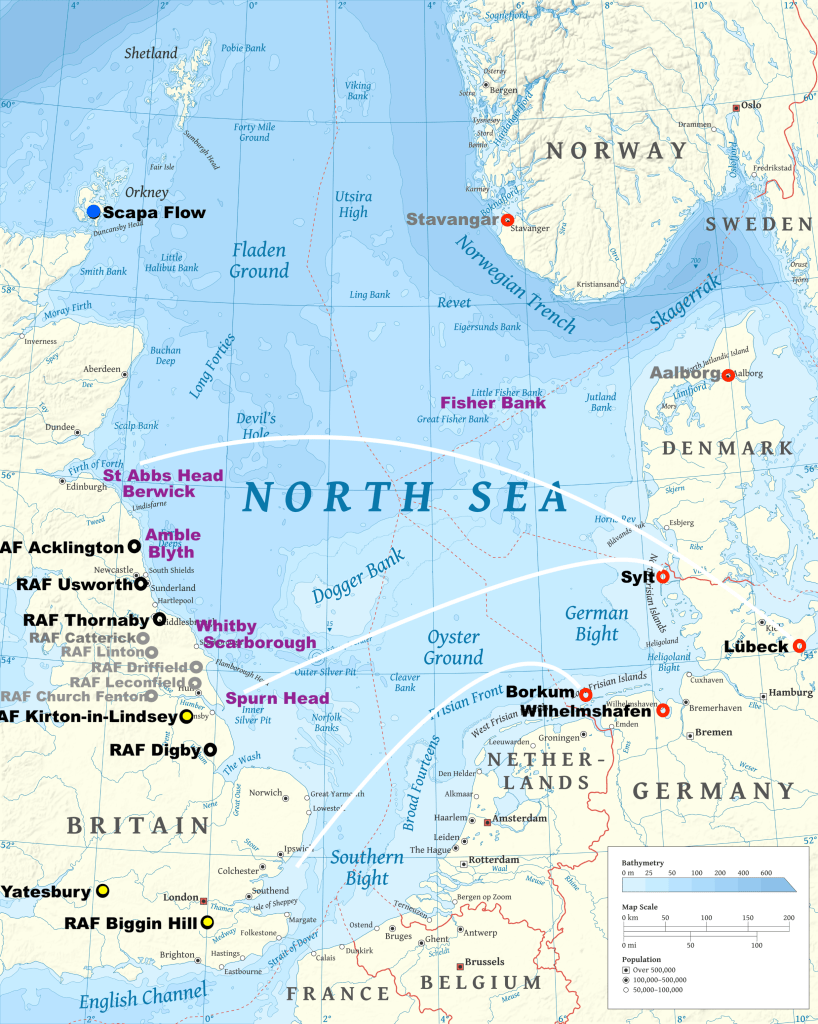
1. North Sea locations of selected Luftwaffe airfields in late 1939 (Borkum, Sylt, Lübeck & Wilhelmshafen); 2. Illustrative flight paths; 3. Positions where enemy aircraft were brought down on the north-east coast of England in 1939 and the RAF stations where defending fighters were based (RAF Acklington, Usworth, Thornaby & Digby). In addition, the map shows Ted’s postings at the beginning of WW2 (RAF Yatesbury, Biggin Hill & Kirton-in-Lindsey) plus further locations relating to events in his sector on 15th August 1940 at the height of the Battle of Britain, described later (RAF Catterick, Linton-on-Ouse, Driffield, Leconfield & Church Fenton; and Luftflotte airfields at Stavanger & Aalborg in occupied Norway and Denmark).
Further south at this time, the RAF’s Advanced Air Striking Force had its first engagements in France, having joined the BEF ground troops there in September 1939. During October and November 1939, they brought down their own complement of Dorniers and Heinkels.
A particularly notable event for the RAF occurred on 2nd November 1939, when the Biggin Hill radar system successfully positioned its first enemy aircraft, a Dornier, which was then intercepted and destroyed over the English Channel by Hurricanes. RAF Biggin Hill was Ted’s next posting after his training at RAF Yatesbury, and before he moved to RAF Kirton-in-Lindsey in Lincolnshire.
18. Yatesbury, Tuesday 5th December 1939
RAF
Yatesbury
Tuesday 5th December 1939
Dear Mum,
I was pleased to get your letter to-day and know you are all OK. I expect you profited by going out last Sunday.
I have got a rotten cold which I have had since last Friday. I was on guard Friday night and it was pouring of rain and blowing blue murder. That just finished my cold off and made it permanent. I was feeling pretty much out of training as I hadn’t played football for 3 weeks or more. The football pitches are more like swimming baths now. Anyhow I wasn’t feeling too good over the week-end and couldn’t do much learning, which didn’t increase my chances of passing out. We had our board yesterday and I couldn’t think clearly at all. I expect I passed OK but I made quite a few mistakes so I won’t get as good a recommendation as I would have liked. Still as long as I pass it’ll do.
My cold seems a little better to-day although I have been sneezing, I think it’s a touch of ‘flu’. If it doesn’t pack up I’m going sick in a day of two.
I got a parcel from Rene last Friday, she’s at [?], she sent a cake and some chocolates, pretty good of her to remember.
Well they’ve done the dirty on us, we now only get 6 days leave 21st-27th. Noon both days, of all the ridiculous times to get back, midday. The only thing they have done is give us warrants. But I’d rather have the 4 extra days and pay my fare home. Still maybe they’ll alter it yet again, not downwards I hope.
I hope you had a good time over at Arnos Grove. I expect you did. It was quite a nice change for you. How are they all now? I wrote to-night, I said I’ll write and tell them what day I’ll be over at Christmas. Do you know if we are going anywhere for certain and what days we are staying at home? I’ll be able to tell them then.
The weather here is awful and it started snowing this morning but not for long, it certainly is cold enough for it.
Doug has been on Air operating this week, messing around with planes, and he is going up on Thursday. I won’t before Christmas. He says it’s quite interesting and should be fun flying.
There are a lot of ‘old cad chaps’ in our hut now, one of them went up to London for a short week-end. He missed the coach back so he came back by taxi. Not bad eh. We also have some Auxilliaries, and one of them sleeps next to me. He looks about 19 or 20 but is really 29½ and married with two children. He’s a nice chap, a Cardiff man. He wishes he was at home. I don’t think he should have joined the Auxiliaries even.
The Russo-Finnish clash looks like turning into a complete Scandinavian clash doesn’t it. I expect it’ll be one war all over soon, U.S.A. as well. Still I don’t expect it’ll last long.
Well Mum I can’t think of anything else to say and it’s 8 o’clock so I’ll pack up and go to bed. Please give my best wishes to Aunt Nell, Uncle Fred and Peter.
Best of love
Ted xxxxxx
P.S. Please thank Mr Jessop for his kind wishes.
The initial period of WW2 is sometimes called the ‘Phoney War’ because of the sporadic nature of the conflict and the relatively small number of large-scale military offensives. Perhaps the most ominous event at this time was on 30th November 1939, when Stalin’s Soviet Union invaded Finland and occupied Karelia. Ted’s letter of 5th December 1939 (above) mentions “the Russo-Finnish clash,” and then speculates that a worldwide war would be on the way: “I expect it’ll be one war all over soon, USA as well” followed by a rather hopeful “Still I don’t expect it’ll last long“.
Two weeks after this letter, on 18th December 1939, a daylight raid was carried out by Vickers Wellington bombers in an attempt to prevent German warships from supporting U-boats in the North Atlantic. The brief confrontation is known as the Battle of the Heligoland Bight, which proved to be a pivotal moment for the RAF in WW2. In fact, two raids had already taken place in the German Bight, the first on 4th September (the day after the declaration of war) when several RAF aircraft were lost, as mentioned earlier, and the second on 3rd December when an anti-aircraft battery was destroyed by the first RAF bomb to fall on German soil. For the third raid, however, a newly installed radar system detected the incoming force about 70 miles out and up to 100 Luftwaffe fighters were launched from local airfields in and around Wilhelmshafen where the warships had taken refuge. The ships were found to be close to civilian residences, so they could not be bombed under the RAF’s rules of engagement then in force, and the operation was abandoned at the last minute. Of the twenty-four Wellingtons taking part, two had already turned back early but ten were shot down, another two were ditched in the sea and three more crash landed in East Anglia on their return. The scale of the losses on 18th December 1939, compounded by the failure of the earlier raid in September, led the RAF to abandon daylight missions in favour of night bombing.
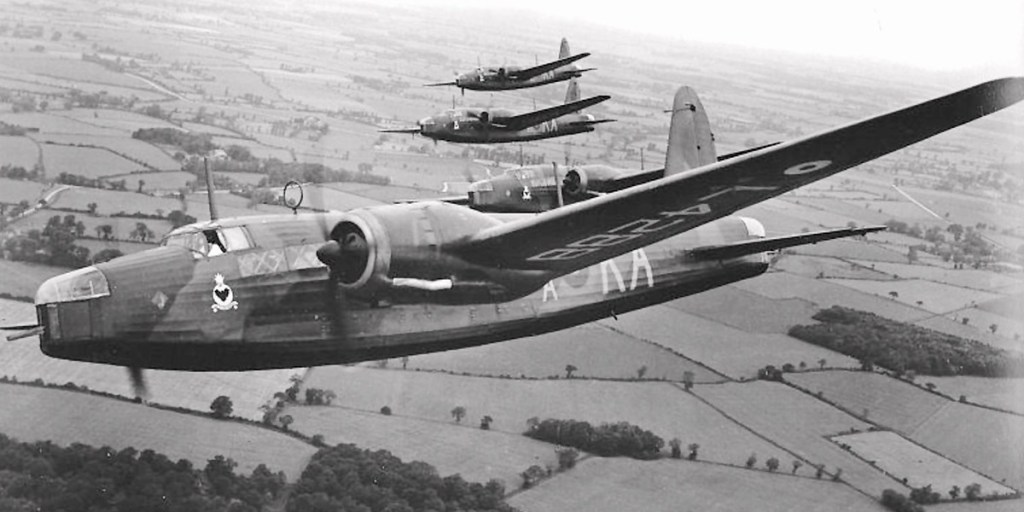
As for Ted at this time, he was almost at the end of his Wireless Operator course at RAF Yatesbury. The letter below conveys the outcome in a few simple words — “I passed exam OK“
19. Yatesbury, Friday (dated ex-post 29-Dec-39)
RAF
Yatesbury
Friday
Dear Mum,
As you can see I got back OK. The connections were pretty good. We got in not too late but I was pretty tired. I am just scribbling a note to let you know I am OK. I hope you get it tomorrow night. I passed exam OK. Am going to try and get a Week End next week but cannot promise. Will let you know next week.
Let me hear from you and I’ll write so as to let you know about next Week End if possible.
Well Cheerio Mum,
Best love to all.
Ted
P.S. Theres only about the same amount of snow as in London luckily. But its very cold in comparison? Ted
In January 1940, the preparations for all-out conflict continued. At key airfields, deep protected shelters and concrete runways were constructed. Other projects included the reconfiguration of the air defence system, particularly the upgrade to VHF in key geographical sectors in order to bring the RAF’s radio communications up to date, and the introduction of schemes such as IFF (Identification Friend or Foe) to minimise ‘friendly fire’ errors.
Ted began his posting at RAF Biggin Hill on 11th January 1940, and he comments in the letter below sent the next day that “there are no Squadrons here at the moment.” This has all the appearances of an episode from the satirical war novel Catch 22, but it was simply that 79 Squadron had relocated temporarily to RAF Manston in Kent, and 32 Squadron to RAF Gravesend, while building works were carried out. Ted started his Direction Finding (DF) work at Biggin Hill when the aircraft returned, briefly operating the new radar equipment there prior to his next posting to RAF Kirton-in-Lindsey in Lincolnshire.
In Germany at the time, Hitler’s immediate concern was the invasion of Scandinavia in order to safeguard German naval and merchant shipping routes, although this was part of a far more comprehensive strategy. Following the intended subjugation of Denmark and Noway, the next step would be the occupation of the Netherlands, Belgium, Luxembourg and France, and eventually the planned invasion of Britain.
20. Biggin Hill, Thursday (dated ex-post 12-Jan-40)
641817 A.C.2 EJ McLeay W/Opp.
R.N. Block Room 3
RAF
Biggin Hill
Kent
Thursday
Dear Mum
I got here OK yesterday afternoon and at the moment am sitting doing nothing so I thought I would write this evening just a short note as there isn’t much to do, but there’s not much to tell you about this camp as we have been shifting beds all day.
We are a 6d bus ride from Bromley and can get a return for 2/2 from there to Hounslow by train which is OK isn’t it. If I gets a pass this W.E. (by the way the passes are 24 hours noon to noon and I can’t say when I will be home, we get one per week perhaps) and 7 days per quarter. What we are going on I don’t know as there are no Squadrons here at the moment. I expect it will be on the Ground Station. Still if I do get away this W.E. I’ll be able to tell you more about it here. If not I’ll have to write and see if I can tell you you all I do know which is not much.
On Monday I have got to go to the accounts and make an alteration to the allowance, make it 7/- an even amount which will be better.
Well Mum I’ll pack up now as I don’t think I cant tell you much more about this place yet it seems OK though Mum.
Cheerio for now Mum,
Best love,
Ted xxxxx
EJM’s note: “Big gap here. I was at Biggin Hill on DF (Direction Finding) work and on my days off (or 3/4 days) was able to cycle home in 2 hours or so & return to camp so letters were obsolete. Spent 3 weeks in Farnborough Hospital with stomach pains & on release posted to Kirton”
Ted was stationed at RAF Biggin Hill between January 1940 and April 1940. During this time, the first enemy aircraft was brought down on English soil, a Heinkel bomber that was attacked by a Hurricane from 43 Squadron based at RAF Acklington in Northumberland, and which crash landed on farmland near Whitby in North Yorkshire on 3rd February 1940. On the same day, two more Heinkels were shot down by the same Squadron, one of them over the North Sea off Tynemouth and another off Amble. In another ‘first’ a Bristol Blenheim of 82 Squadron surprised and sank a U-Boat on 11th March 1940, the first to be destroyed by a Royal Air Force aircraft on patrol. The conflict was still intermittent at this stage.
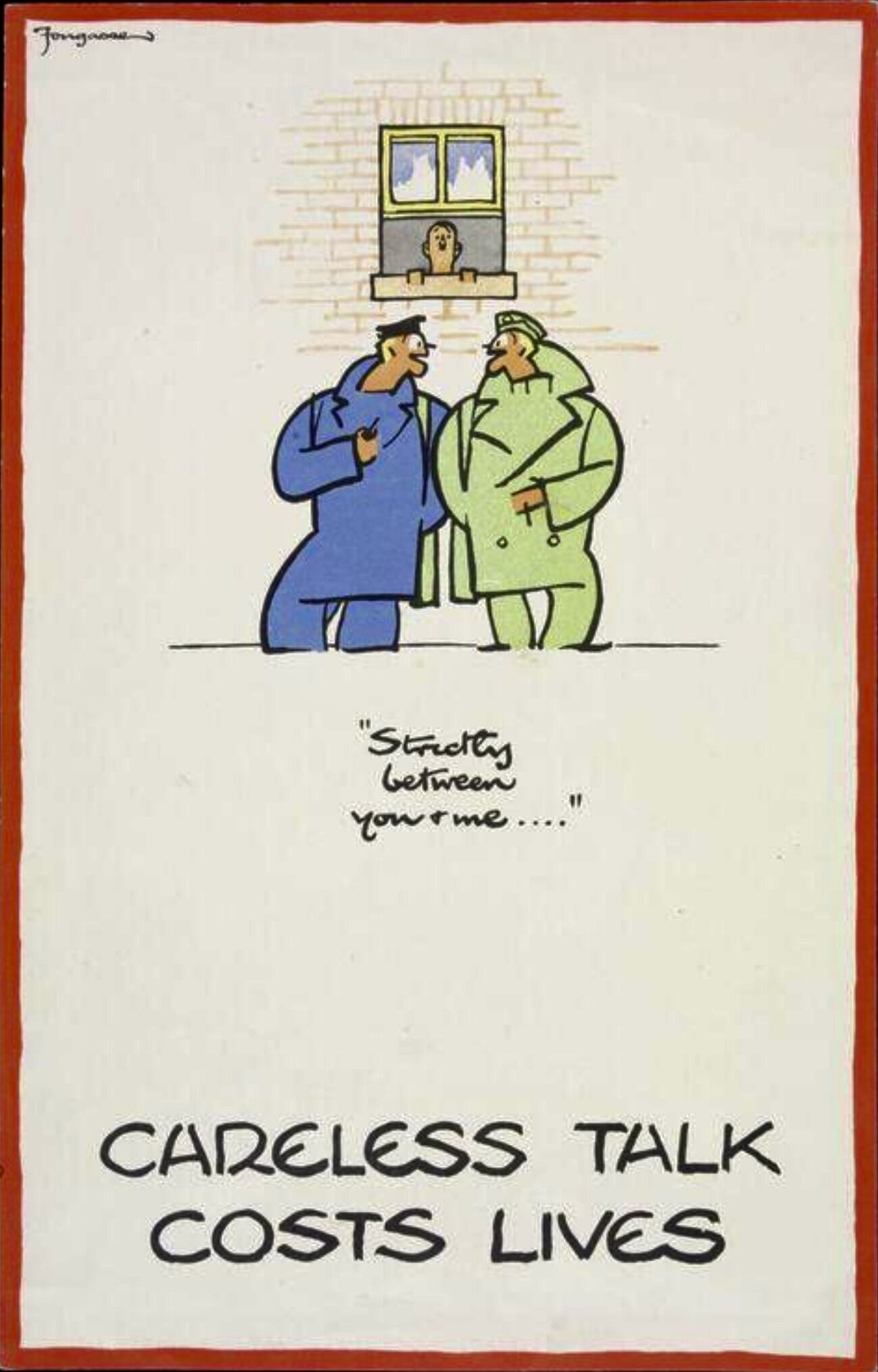
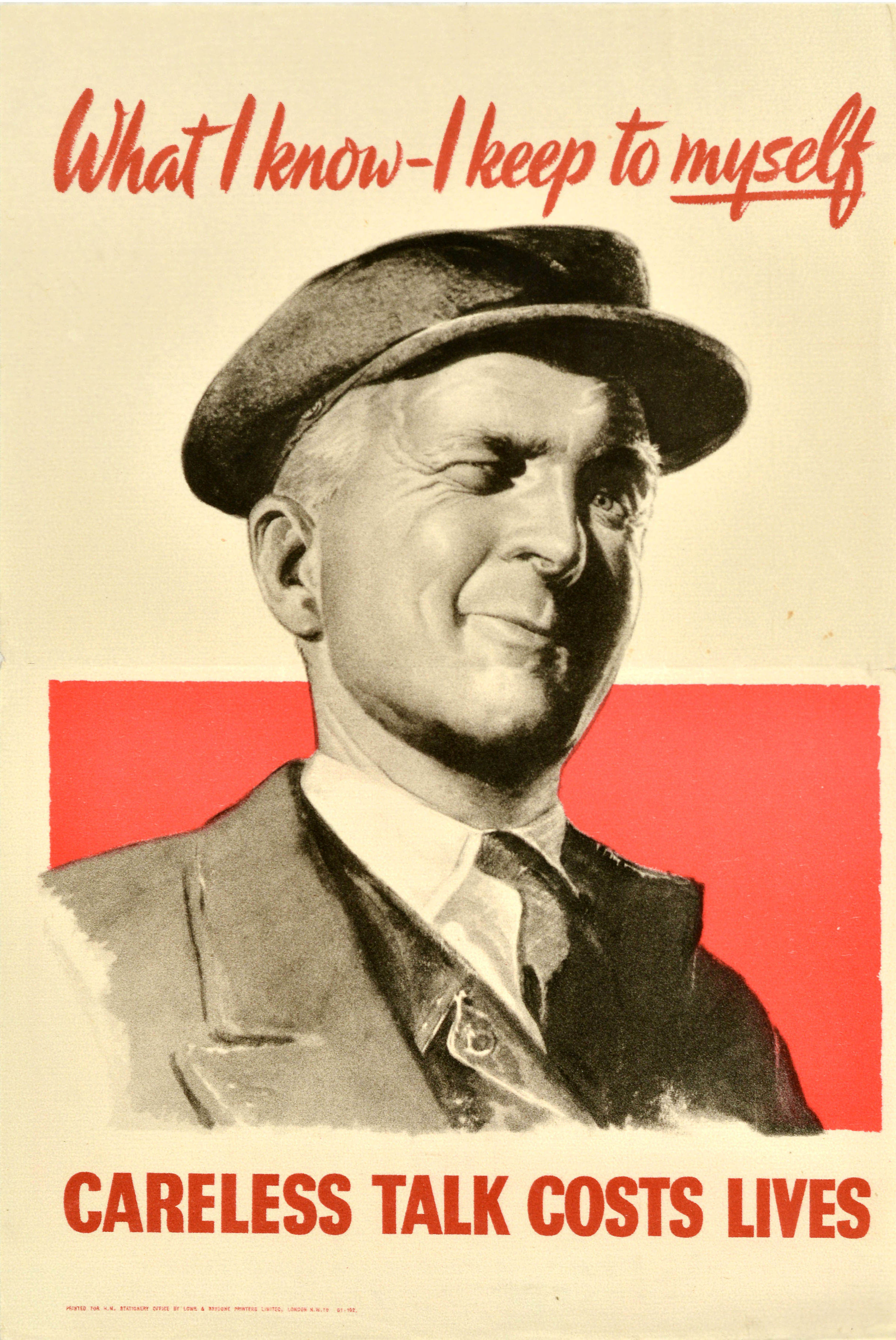
On the home front, there were two developments of note during the few months that Ted was at Biggin Hill (he was able to cycle home whenever he had leave, so no letters were sent to his mother Lizzie then). The first turn of events was the Careless Talk Costs Lives campaign, which discouraged the discussion of military operations in public and encouraged vigilance against spying.
The second was the rationing of essentials which, following its authorisation on the day that war was declared, was implemented during the time that Ted was at RAF Biggin Hill. From January 1940, the permitted quantities per person per week were butter (4oz), sugar (12oz) and bacon and ham (4oz); meat was included in March 1940 up to a monetary amount of 1s 10d per week. Ted’s letter below from Farnborough Hospital is interesting in this context. It includes a list of items for his mother Lizzie to bring on her next visit, including a request for certain provisions in short supply, worded with almost Dickensian pleading: “If you’ve got any sugar? Or a spot of butter? Not much, just enough to make the bread look buttered.” We do not know the precise dates of the three-week hospitalisation in Farnborough, nor the diagnosis — all we know in retrospect is that the complaint reoccurred at the end of the war, requiring an operation for acute peritonitis at Addenbrooke’s Hospital in Cambridge.
20a. Farnborough Hospital, Wednesday (April 1940)
County Hospital
Farnborough
Wed.
Dear Mum,
I have got both of your letters and was surprised to hear from you so soon. I got the one sent on from the camp on Monday and the other today.
I was pleased to see you down on Sunday and hope you can manage it next. I haven’t had a pain since the first night I was in here and I am now on a light diet (very light). I am going to buy some food if I can get the nurses to get it, and one of them who was off all day today was going to buy me some eggs but as she was off she got some from the stores instead, good of her wasn’t it! She’s going to buy me some biscuits today while she’s out.
When you come down on Sunday I should be on full diet again so if you could bring me some things down it should be OK. I’ll tell you what I could do with most and you could take the money out of my account till I come home if you’re short Mum.
If you’ve got any sugar? or a spot of butter? Not much, just enough to make the bread look buttered. Some marmalade for breakfast and tea, a couple or three good pieces of bread I could eat for Sunday tea. About half a dozen eggs. Tin of grease. Tube of oil. My clothes that is shirt, pants, and vest. Some biscuits.
Well that seems to be the list & I can’t think of any more. I’m feeling fit and should be going back to camp soon, say a week I hope..
Well Mum I haven’t got anything to tell you so cheerio until Sunday, hoping everyone is keeping well.
Best love,
Ted xxxxxx
By April 1940, there were about five hundred aircraft in the RAF strike force in France, and the British Expeditionary Force there had grown to ten infantry divisions. As the mounting evidence confirmed Hitler’s Scandinavian intentions, the British and French started on another operation together, their short-lived Norwegian Campaign. Perhaps the possibility of some kind of pincer movement was behind Ted’s comments in his first letter (below) from the new Fighter Command station at RAF Kirton-in-Lindsey in Lincolnshire: “The situation looks serious but I am sure old Adolf is going to run as fast as he can soon. He’ll get pinched soon, then’ll come the raids. When he starts raiding England we’ll know he’s in hot water. He’s afraid of getting the British back up as yet.”
Again Ted had arrived at his new posting before the air crew, and the wide variety of his preparatory tasks there is described below in the letter, including “laying telephone lines,” “equipping signals“, “repairing wireless sets,” “moving furniture,” “heaving coke” and “shovelling stones” while also safeguarding the Direction Finding equipment as and when it arrived at the base. His post-training experience with DF equipment at Biggin Hill seems to have prepared Ted well, given his characteristically confident comment below: “I don’t know this DF set but it looks pretty easy.”
As for Lizzie, she moved to another part of Harringay about this time, into her flat in Wembury Road off Archway Road where she remained throughout the war and for several years afterwards (and where I spent my first two years): “If you just tell the post office you have altered your address that will be OK. How are you feeling now Mum? I hope you aren’t feeling too lonely now you are by yourself.“
21. Kirton-in-Lindsey, undated (April/May 1940)
Dear Mum,
I was very pleased to get your letter as it came as a very welcome return to the south. I hope you are getting settled down now and the place is looking shipshape. I have made the allowance 2/- from the 30th so you can use the extra 7/- a week if you want to. I will get a post office book out when I come home and you can pay it in weekly as you draw it then. If you just tell the post office you have altered your address that will be OK.
How are you feeling now Mum? I hope you aren’t feeling too lonely now you are by yourself. Go in and see the Sharps sometime, but for goodness sake don’t say anything about Joyce as you will only make her embarrassed. They are always at home Sunday evening, and would be pleased to see you. Mrs. Sharp told me to tell you there is no excuse for not calling in. Also pop into Norm’s if you want him to do anything as he always will. As far as I remember you didn’t tell him for certain to come up. I don’t quite remember.
I’ve got quite settled down now although there is still some to go. I have been doing every job under the sun. Moving furniture; repairing wireless; detecting faults in sets; equipping signals; coke heaving; telephone line laying, this took us all over the show and I spent three hours on top of a hangar insulating the wire where it went off the edge, on a sloping roof with no edge guard, high hangars too; shovelling stones. Talk about versatile.
The weather so far has been lovely but this evening it is raining and blowing blue murder.
Today we started on DF, but not actual working. Now the stuff is all there, there has to be a guard and we are therefore starting our watches so three of us have to work a watch list. It was touch and go whether I stayed here or went to Withern, Lincs or Hallam, Yorks on forward DF, and it is not yet certain as they have only sent 2 to each as yet. I hope I keep here as it is on a first class road to Lincoln and a straight run to London so if we get 48’s some time I will be able to hitch-hike easily.
The Signals Officer is a swell chap and he said that although there was no chance just yet of passes owing to the work he will get them going directly he can. I don’t know this DF set but it looks pretty easy.
The CO and Station Warrant Officer especially are great guys.
When you see May you might ask her to give Jock my new address.
A couple of the chaps here now (W/Opps) were in H Flight at Cardington. One was in my class at Yatesbury.
One difference is that a good few of the Waafs are Northerners with a brogue.
I may go into Scunthorpe this week end to get some photographs but I’m not yet certain.
I am going to send for my bike as it’s a good mile and half to DF.
The situation looks serious but I am sure old Adolf is going to run as fast as he can soon. He’ll get pinched soon, then’ll come the raids. When he starts raiding England we’ll know he’s in hot water. He’s afraid of getting the British back up as yet.
Well Mum keep well, I’m feeling fine as a steeplejack.
Best love
Ted xxxxx
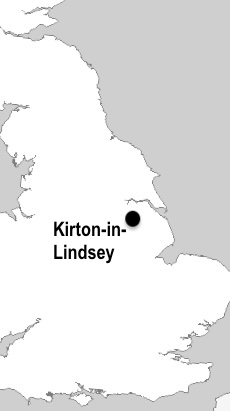
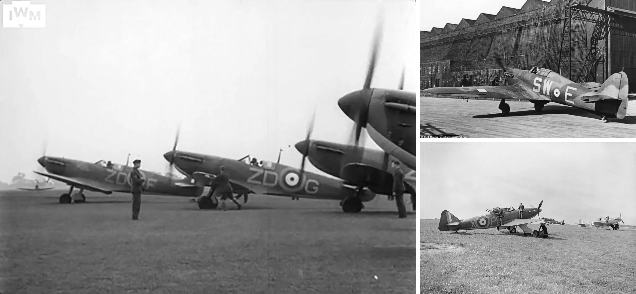
The Fighter Command centre opened at Kirton-in-Lindsey in May 1940, and the pilots arrived in June 1940 (65 & 222 Squadrons with Spitfires and 253 Squadron with Hurricanes) and July 1940 (264 Squadron with Defiant nightfighters). These photographs show Supermarine Spitfires about to take off from Kirton-in-Lindsey in June 1940 (centre), one of the Hawker Hurricanes during the Battle of Britain (top right, at Kenley in Surrey), and Boulton Defiants on Kirton’s grass runways in August 1940 (bottom right).
On 10th May 1940, the day Churchill became Prime Minister of Britain’s wartime coalition government, Hitler’s planned invasion of the Low Countries went ahead. Just four days later, the Luftwaffe bombing of Rotterdam caused more than nine hundred civilian deaths, leading almost immediately to the surrender of the Dutch army. On the same day as the Rotterdam blitz, 14th May 1940, the RAF’s bomber force in France attempted to halt the German advance close to the Belgian border, but flak and enemy fighters brought down many of the British aircraft.
In response to the Rotterdam attack itself, Bomber Command mounted its first large-scale strategic operation from bases in England, targeting oil terminals in Hamburg, Hanover and Bremen and then industrial plants and railway shunting yards all over the Ruhr. Hitler issued War Directive No. 13 on 24th May 1940, authorising the Luftwaffe to attack Britain, adding that — once sufficient resources were in place — there would be ‘an annihilating reprisal for the English attacks on the Ruhr’. The German advance into Northern France continued and, with town after town besieged and then captured, the British and French ground forces withdrew to the coast. The Dunkirk evacuation began on 26th May 1940, and the aerial defence of the beachhead involved intensive air combat for several days, with records suggesting that the RAF and the Luftwaffe each lost about one hundred and fifty aircraft over Dunkirk. The beach patrols included Hurricanes flying out of RAF Biggin Hill; the Farnborough County Hospital, where Ted had been admitted in April, also played a critical role by receiving evacuation casualties.
There were no letters from Kirton-in-Lindsey for several weeks during this precarious period, not until the end of June 1940. The first Luftwaffe attack on the east coast is said to have been on Teesside on the night of 25th May 1940 by a single German aircraft. Further targets in that area included the aerodrome at Stockton-on-Tees on 6th June, then Hull, Hartlepool and the ICI factories at Billingham on 19th June, carried out by Luftwaffe formations crossing the North Sea from their base at Wittmundhafen, which is near Wilhelmshafen and close to the Dutch border. Enemy aircraft again reached the east coast on 21st June, heading for Tynemouth, South Shields and Middlesborough, and on 26th June another group of about one hundred again descended on the north-east.
In Germany, the RAF’s attacks on oil refineries near the coast and industrial factories in the Ruhr were now on an almost daily basis. Oddly, a first air raid on the capital Berlin is said to have taken place on 7th June by a civilian aircraft that had been converted for the purpose by the French. According to the records, the first recorded bombing raid on Berlin by British aircraft was at the end of August 1940, so perhaps it is the French raid that Ted is thinking of in his letter dated 29th June 1940 (below): “By the way, we are bombing Berlin — I should imagine Winston is asking for retaliation to try out our defences“.
At sea, the impact of Luftwaffe bombers was catastrophic at this time — one of the targets, the troopship Lancastria, was sunk off the port of Saint-Nazaire on 17th June with over four thousand fatalities, news that was kept secret at the time. The French armistice was signed on 22nd June 1940, pointedly in the WW1 railway carriage in Compiègne, setting the stage for the next phase of German expansion, which would be closer to home — the Channel Islands were bombed on 28th June, and occupied three days later. In the letter below of 29th June 1940, Ted says to his mother: “What do you think of them dropping bombs and machine gunning the Channel Islands? Lot of rats aren’t they?”
It was said in the local records (the North Lincs Air Raid Records) that the first bombs to fall in the vicinity of Kirton-in-Lindsey were dropped eleven miles away on the steelworks in Scunthorpe on Thursday 6th June 1940. Five more high explosive bombs and two hundred incendiaries hit the steelworks and railway sidings three weeks later on 27th June, and the attacks continued there for two more nights. Ted refers to these raids in the letter of 29th June, seeming to play them down to lessen his mother Lizzie’s anxiety: “As you say the raids were near us but nothing of any damage was done. They blew a hole in a field about 10 miles away but that’s all. Don’t for goodness sake worry about me Mum, our buildings are like forts.“
One final remark in the letter below concerns the USA, hinting at the pro-Nazi positions that Roosevelt had to deal with before forging his eventual alliance with Churchill. Powerful adversaries kept the USA out of the war in the first instance, one being the ambassador to the UK at the time Joseph Kennedy, and another the industrialist Henry Ford. Kennedy was convinced that Britain was doomed to fall to the Nazis, and advocated US isolationism, and Ford made the news in June 1940 when, following the defeat of France, he vetoed a plan to build airplane engines for the Allies. In the letter, Ted sums up in a pithy way his reaction to the veto: “Henry Ford’s proved himself a nice friend hasn’t he? I don’t think.“
22. Kirton-in-Lindsey, Saturday 29th June 1940
641817 A.C.1 EJ McLEAY, W-OPP
BLOCK 41, ROOM 4
RAF
KIRTON-IN-LINDSEY
NR. GAINSBOROUGH
LINCOLNSHIRE
29th June 1940
.
Dear Mum,
I have received both your letters but did not answer the first one as there has not really been a great deal happening.
As you say the raids were near us but nothing of any damage was done. They blew a hole in a field about 10 miles away but that’s all. Dont for goodness sake worry about me Mum, our buildings are like forts.
I’ve written to Norm to tell him you will write when you want him to go up and get the blinds up, so just drop him a card and he will come down.
When I was hitching into Scunthorpe about 10 days ago a gentleman and his wife picked me up and asked me to go up and see them any evening I’m in town with nothing to do so went last night. I had a supper and when I was coming away
he made me take a couple of shillings.
I hope your headache is better now and you are feeling better Mum. The weather is a bit of a blighter what with the close weather and clouds. Still otherwise I’m feeling very fit.
Too bad about Jock still he will get a pass soon I hope. I should get a pass in a couple of weeks time but I cant be too sure yet of course.
I’m glad to know you had the book sent on thats another thing done anyway.
I was sorry to hear you had been up all night still it’s safer to get downstairs than up. I should imagine he would have a bit of a job to touch London. By the way we are bombing Berlin. I should imagine Winston is asking for retaliation to try out our defences. What do you think of them dropping bombs and machine gunning the Channel Islands? Lot of rats aren’t they?
Henry Ford’s proved himself a nice friend hasn’t he? I don’t think.
It would be great if you could get a few days off. At least it would be a rest as you say.
If you’ve got the stuff for a cake I should like one very much as they come in very useful when on night duty.
Well Bye Bye for now Mum,
Best love,
Ted xxxxx

Ted’s next letter (below) was written about a week later on 7th July 1940. With the much-appreciated supply of cake in mind, he writes: “If you can’t get the eggs don’t worry about the cake Mum. I’ll get it next week when I come home.” Interestingly, it was on that very same date that the rationing of margarine and cooking fats began, and tea, with an allowance of 2oz. per week for each item. Ted doesn’t mention these new restrictions, only that eggs may be hard to come by. He also notes in the letter of 7th July that “the raiders seem to have given us a miss for a while.” As it happens, the records show that nearby Hull experienced an attack on 30th June 1940, but only by a lone aircraft that arrived undetected and dropped sixteen high explosive bombs. Although these all just missed the target, an oil depot, by some fluke pieces of shrapnel travelled some distance and pierced the side of one of the tanks, which then caught fire and this flowed to a number of adjacent tanks causing an inferno. Further up the east coast, Newcastle and Jarrow were attacked on 2nd July, again the work of a single bomber, and this was followed by a night-time raid near Newcastle upon Tyne on 7th July. The fall in activity noted by Ted perhaps reflects the reshuffling of Luftwaffe resources in preparation for the Battle of Britain, i.e. transfers from airfields in Germany to those recently captured in the Netherlands, Belgium and France — indeed, the main attacks that week were launched from bases in occupied France, including the bombing of Swansea on 29th June and Cardiff on 3rd July, and the first Plymouth raid on 6th July 1940.
23. Kirton-in-Lindsey, Sunday 7th July 1940
641817 A.C.1 EJ McLEAY
BLOCK 41, ROOM 4
RAF
KIRTON-IN-LINDSEY
NR. GAINSBOROUGH
LINCOLNSHIRE
7th July 1940
.
Dear Mum,
I hope you don’t mind the pencil but I am doing someone else’s watch so I can learn a little bit of work other than my own and am having to stay up on it all night so I thought I would get my letters off.
I haven’t done much since last week as the raiders seem to have given us a miss for a while so we are naturally making the most of it.
Just in case I forget if I leave it I should be home on Friday or Sat providing I dont get held up by an invasion or something. Of course I cant be sure until I leave the the camp but still I hope I get home OK.
By the way Mum I should be a bit luckier with [may props?] than my one if I keep here. Not too soon of course.
If you can’t get the eggs don’t worry about the cake Mum. I’ll get it next week when I come home.
I hope you are keeping well Mum and not got another cold. I feel fine myself and am looking forward to see you again. I haven’t any needs at all, so bye bye
Best love
Ted xxxxx
Following the occupation of Guernsey and Jersey, Hitler asked for operational plans to be drawn up for the naval invasion of mainland Britain, code-named Operation Sea Lion. In anticipation of this likelihood, concrete blocks were placed on British beaches, signposts removed from crossroads, and the government issued over fourteen million copies of its advisory leaflet If the Invader Comes. In Ted’s letter of 7th July 1940 (above), he mentions the possibility of an invasion for the first time, quite gingerly in a way: “I should be home on Friday or Saturday providing I don’t get held up by an invasion or something.” The formal directive to prepare for Operation Sea Lion was issued by Hitler on 16th July 1940. On the following day, in Ted’s letter dated 17th July 1940 (below), he writes uncannily as if the invasion were imminent, hoping that continued cloud cover might stall things (or perhaps he is just convinced deep down that Germany’s invasion plans would come to nothing): “The weather is simply lousy up here but I hope it clears off for the invasion (I don’t think).”
On the east coast, in the ten days between Ted’s letters of 7th and 17th July 1940, Luftwaffe operations were back up to their previous level. A Junkers was shot down on 8th July near Sunderland by fighters operating from RAF Church Fenton in Yorkshire, the main fighter base in the sector to the north of Kirton-in-Lindsey. On the following day, Norwich experienced its first lethal raid; twenty-six died there on the evening of 9th July, including a group of Colman’s employees who were leaving work at the end of the day. On 11th July, in Bridlington in Yorkshire, a near miss at the railway station caused a train carriage full of ammunition to catch fire, and five people were killed elsewhere in the town. An attack on a shipyard in Aberdeen on 12th July killed twenty-nine people, and then just after midnight a large number of incendiary bombs were dropped on railway lines first at Hartlepool and afterwards at Consett.
Further south, concerted attempts were made by Germany to block shipping in the English Channel, again with mixed success. On 10th July 1940, when Dornier bombers headed for a convoy just off Dover, Spitfires and Hurricanes were warned by Direction Finding and were able to drive them back at ‘Hellfire Corner’ after battling there with the escort of enemy fighter planes. There were other German raids that day from their new foothold in occupied France, on Swansea in Wales and Falmouth docks in Cornwall, and on convoys in the Bristol Channel, and Luftwaffe bombers returned to the English Channel to attack shipping on 14th and 15th July. Bomber Command was active on a daily basis, first by sending ten aircraft to attack an occupied airfield in Amiens on 9th and 10th July, and one day later on 11th July they raided airstrips in the Netherlands. On 12th July, twenty-two bombers targeted Kiel and Emden in northern Germany (one of the RAF aircraft was hit by flak and then ditched in the North Sea near Cromer). Industrial targets at Mannheim, Leverkusen and Gravensbruk were next, on 13th July, and air strips at Paderborn and Diepholz on 14th.
As the warfare moved inexorably into a different gear, Ted sent his photo to his mother and asked her in the letter of 17th July (below) to have her own photograph taken for him one evening after work, perhaps thinking of the disruption that was surely on its way: “Get your photo done one night and take the money from the P.O.s. Send me one on, not too big.”
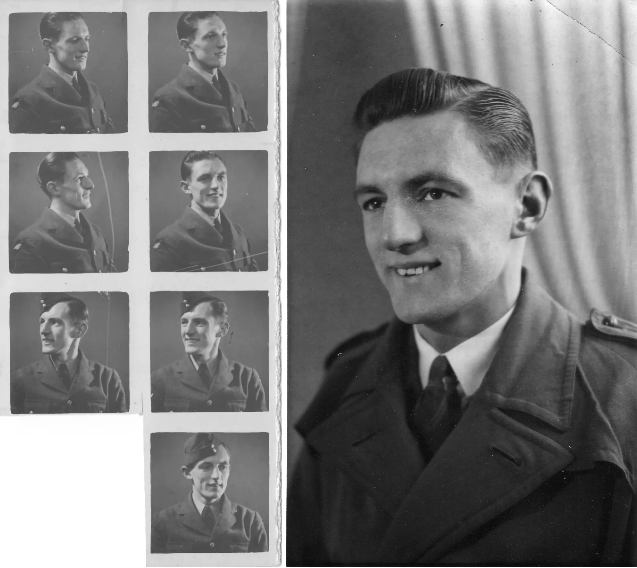
July 1940: the studio photograph (right) that Ted sent to his mother Lizzie from Kirton-in-Lindsey, as mentioned in his letter of 17th July 1940 (below), and a photo strip (left) from about the same time .
24. Kirton-in-Lindsey, Wednesday 17th July 1940
641817 A.C.1 EJ McLEAY
MQ 31, SIGNALS
RAF
KIRTON-IN-LINDSEY
NR. GAINSBORO
LINCOLNSHIRE
17th July 1940
.
Dear Mum,
I got back OK on Monday as you can see although it took a little longer than coming down of course. Still who’s worrying I got back at 8.30 in 6 hours which wasn’t too bad was it.
As you can see I got my photograph taken and thought I would send both to you so they will keep stiffer. You can give the other to Nan when you see her.
I went up to Stills but Tich has left and I don’t know where he’s gone to some tailors or something. Everyone seems be going along OK now though.
I didn’t get time to go up the school still maybe I will next time instead of going to Stills.
I got a wrist watch. The cheapest I could and it cost me 12/6. Swiss watches are now cut off to us you see.
The weather is simply lousy up here but I hope it clears off for the invasion (I don’t think).
I got a letter from Jock when I got back. He seems pretty fed up and not so downcast as he did at first. This will do him some good. Did you give May the fags? Did I give you the money if not take it.
Please send my glasses on Mum I forgot them. Cake is OK.
Cheerio for now,
Best love,
Ted xxxxx
P.S. Get your photo done one night and take the money from the P.O.s. Send me one on, not too big. Ted
The action plan for Operation Sea Lion specified a two-week assault on British airfields prior to the projected naval invasion, and it was on 1st August 1940 that Hitler issued the go-ahead to the Luftwaffe (War Directive No.17) to take on and destroy the RAF. The first significant move came on the morning of 12th August 1940, when early warning radar installations were targeted in Canterbury and along the south coast at Dover, Rye, Pevensey and Ventnor on the Isle of Wight. In the afternoon, over sixty Junker bombers and one hundred and twenty Messerschmidt fighter-bombers were spotted assembling over Cherbourg, before carrying out a second strike on Ventnor (the only radar station to be completely disabled) and then continuing to the Portsmouth dockyards. The Battle of Britain was now under way and the next few days saw widespread air attacks on fighter stations and their satellite airfields across the south in line with Hitler’s orders, with damage at RAF Martelsham in Suffolk, at RAF Detling, Manston, Hawkinge and Lympne in Kent, at RAF Tangmere in Sussex, at the charmingly-named RAF Middle Wallop and Worthy Down in Hampshire, plus RAF Northolt and Croydon on the outskirts of London (all shown on the map below).

Although it was feared at first that the Luftwaffe’s numerical superiority might prove decisive, the tables were turned on Thursday 15th August 1940 and the defences held in spite of the overwhelming assailment — an outcome summed up in Churchill’s memorable statement ‘Never was so much owed by so many to so few‘ (seventy-five enemy aircraft were brought down compared with Fighter Command’s loss of thirty-four).
On that day, 15th August 1940, the Luftwaffe made a significant tactical error that played straight into the hands of the fighter pilots stationed at Ted’s airfield and its adjoining sectors. Having focussed to begin with on southern England, the enemy widened its attack on 15th August by bringing in the 5th Air Fleet (Luftflotte 5, based in occupied Norway and Denmark) to destroy airfields in the east of England. Calculating incorrectly that the RAF squadrons in the east would be significantly depleted by the demand for additional fighters further south, Luftflotte 5 took the risk of dispatching their own bombers with an inadequate escort. There were two main formations:- (i) from Stavanger in Norway heading for RAF Usworth (between Newcastle and Sunderland) and onwards to two bomber bases, RAF Linton-on-Ouse and RAF Dishforth (both near York); and (ii) from Aalborg in Denmark heading for a third bomber base, RAF Driffield (between Bridlington and Hull). The first group of sixty-five bombers was spotted ninety miles out, having made the astonishing error of following the same route as their own decoy. Because the escort of thirty-five fighters lacked the range to cross the North Sea from Scandinavia, they were fitted with cumbersome long range drop tanks that had to be ditched eventually, all of which hampered the operation. The outcome was that eight Heinkel bombers and six Messerschmitt fighters were shot down with no RAF losses, and none of the bombs reached the primary targets. The second group comprised fifty unescorted Junker bombers from Aalborg, which were detected by radar when closer to the coast, off Flamborough Head as shown in the fading map extract below. They were intercepted by the Defiants of 264 Squadron, which were based on Ted’s station at RAF Kirton-in-Lindsey, plus the Spitfires of 616 Squadron at RAF Leconfield, the Hurricanes of 73 Squadron at RAF Church Fenton, and the Blenheims of 219 Squadron at RAF Catterick. Although seventeen of the fifty Luftwaffe bombers got through and destroyed a number of the aircraft parked at RAF Driffield, six Junkers were shot down during their withdrawal.
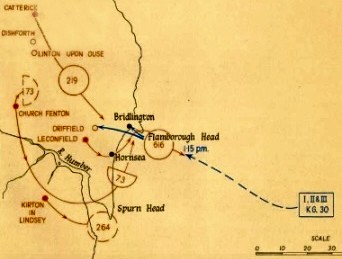
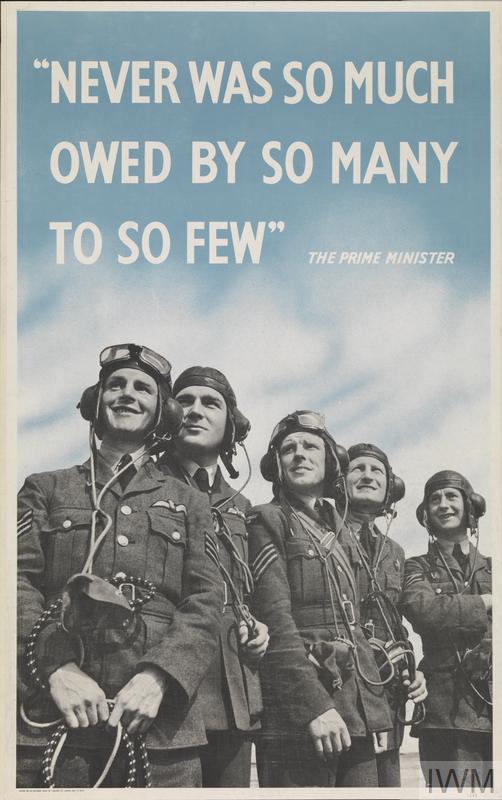
15 August 1940. Left: Battle of Britain Humber raid. The dotted line shows the flightpath of Junker bombers from Aalborg in occupied Denmark, which targeted RAF Driffield. Adapted from a map in ‘The Defence of the United Kingdom’ (HMSO 1957). Right: The poster Never Was So Much Owed by So Many to So Few that was published during the Second World War, Copyright: © IWM (Art.IWM PST 8774)
The entire operation was a disaster for Luftflotte 5, and they took no further part in daylight operations over Britain. Ted’s letter (below), sent a few days later on Tuesday 20th August 1940, tells his mother Lizzie how “it feels good to get a bit of time off in which to write,” as he is “back on ordinary shifts this week.” Although more large scale daytime raids did take place during the Battle of Britain, they were further south — RAF Biggin Hill (where Ted had been posted at the beginning of 1940) and RAF Kenley (where he would be posted in early 1943) were targeted early on 18th August 1940. In spite of widespread damage, Biggin Hill was back in service later the same day. Ted rounds his letter off by saying “I wish I were back at Biggin Hill in it” by which he no doubt means in the midst of things (definitely not the Londoners’ vernacular innit).
25. Kirton-in-Lindsey, Tuesday 20th August 1940
641817 A.C.1 EJ McLEAY
MQ 31, SIGNALS
RAF
KIRTON-IN-LINDSEY
NR. GAINSBORO
LINCOLNSHIRE
20 . 8 . 40
Dear Mum,
I was pleased to get your letter and cake, but was wondering if anything was up as it seemed a long time coming. The cake went down well as we, the occupants of this room, had a little supper on Sunday. In fact we stayed in from 12 midday till it was time to go to bed, the weather being so lousy. Its more like October weather at the moment.
Thanks for the shin pads. They’ll do nicely. I only hope we can get the football in. Its started off OK but these things peter out when it begins to get cold unless they’re properly organised.
We’re back on ordinary shifts this week and it feels good to get a bit of time off in which to write. The work hasn’t been so bad but it gets monotonous too much of it. I was on last night but didn’t get much sleep but there wasn’t any dropped near us. The nearest so far was over 5 miles away at that other drome some time ago. It seems in fact that you will be getting it pretty thick but still if your shelters are any good you’ll be safe enough.
I don’t suppose these little raids will affect Jock but I wish I were back at Biggin Hill in it. Was pleased to hear Jock got his stripe, I didn’t think so much money went with it though. What is he now? A cook or clerk?
I expect it was quite jolly having a gathering of the clans, anyway it is good to know everyone is still OK.
If you want any cash for your glasses lets me know Mum as I’ve got a quid of Norms but he wont mind and I expect I could get him to lend you some till I come home, so what do you say?
Don’t go worrying about the girls Mum as they are in the majority very nice. I only go out for company and usually jaw for about a couple of hours then go get a supper. I get on swell with most of them, probably because I dont treat things seriously so don’t worry. Besides I’ve finished being serious for some long while yet.
I hope you will go down to the Sharps some time to see Mr & Mrs Sharp, as they would like you to and I’ll bet you get a bag of greengrocery too.
Well I’m just going on duty so I’ll get this off. Be careful of the bombs.
Best love,
Ted xxxxx
Throughout the Battle of Britain, Bomber Command continued its raids with sorties varying from just four bombers up to about forty. They targeted (amongst other places) aircraft factories in Augsburg, Bremen, Kassel and Wismar (and also Milan), aluminium works at Ludwigshaven and Rheinfehlen, oil refineries in Dusseldorf, Salzbergen, Mannheim, Sterkrade, Gelsenkirchen and Frankfurt (as well as Bordeaux and St. Nazaire), the docks in Hamburg, a power station at Schornewitz and the Fiat works in Turin. Operations were also mounted on an increasing scale to disable the aerodromes that launched the Battle of Britain assaults, and on 20th August 1940 (the date of Ted’s letter above) it is said that that up to one hundred and twenty RAF bombers carried out raids on airfields in occupied France, Belgium and the Netherlands.
It is intriguing that Ted mentions the likelihood of bombing in London in his letter of 20th August 1940 (above).”It seems … that you will be getting it pretty thick,” he says, followed by a measured dose of hopefulness (or is it a classic example of cautious optimism?): “if your shelters are any good you’ll be safe enough.” Perhaps the heavy bombing in London really was Ted’s own prognosis, or maybe it was just a hunch about the way things would develop in the coming days. It is certainly intriguing, given that the first bombs to fall on residential London were dropped at 3.30am on the following morning, on Harrow. On that day, the Germans also started to shell Dover and the nearby coastal area with long-range artillery. On the east coast, enemy bombers were seen over the Humber Estuary on 21st August 1940, probably mine laying, and on the next night they were plotted over Harrogate, York, Middlesbrough, Bradford and Hull. By the 24th August, limited bombing took place all along the east coast from Newcastle to Hull, and minelaying was reported off Flamborough Head. In the south, a raid on Portsmouth led to the highest number of casualties sustained until then (over one hundred were killed there and three hundred injured), while stray bombs fell on Cripplegate in central London following an unsuccessful airfield raid, and they too caused civilian deaths.
The RAF retaliated immediately for the bombing of Central London, and in great strength, by attacking Berlin on the night of 25/26th August and for several days after that. As a result, an apparently furious Hitler ordered the Blitz on major British cities to start straight away, i.e. without having yet brought down the RAF, one of many strategic blunders that led in the long run to the demise of the Third Reich.
On 27th August 1940, before the onslaught on British civilians began, a lone Heinkel approached Kirton-in-Lindsey while Ted was outside, and his fortunate escape is described in the letter below dated 28th August 1940 as follows: “Up till yesterday evening we hadn’t even seen a Jerry but we had a ‘friendly’ Heinkel over last night. He came just in a nice light before dark and circled the drome. He then got up wind and came down from about 5000 to 200 ft, loosed a time bomb and scuttled for the coast. He got away. Clifford and I watched him circle and dive, everyone seemed to think it was a Hampden except us. Being in the line of fire from his machine guns, we hopped for the hedge in the road. Still he didn’t open up fire so we were OK. Anyway I’ll never mistake a Heinkel now.”
On the same day that Ted wrote his account of the not-so-friendly Heinkel, 28th August 1940, one hundred and sixty German bombers left northern France to carry out the first air raid on Liverpool and its docks, continuing over the next three nights and then regularly after that (there would be fifty raids on Liverpool during the next three months). The Blitz had begun.
FRIEND OR FOE ?

The six outline illustrations are taken from “Aircraft identification. Friend or foe?” which was published in The Aeroplane in March 19led to the collapse of the Third Reich. 40. As the letter below tells us, the attack on the airfield by a lone Heinkel took place on 27th August 1940.
26. Kirton-in-Lindsey, Wednesday 28th August 1940
EJ McLeay 641817
Kirton
Lincs.
28th August 1940
Dear Mum,
I got both your letters and am pleased to know everything is going along OK. I was wondering if any bombs had fallen round our way but you dont say.
Up till yesterday evening we hadn’t even seen a Jerry but we had a ‘friendly’ Heinkel over last night. He came just in a nice light before dark and circled the drome. He then got up wind and came down from about 5000 to 200 ft, loosed a time bomb and scuttled for the coast. He got away. Clifford and I watched him circle and dive, everyone seemed to think it was a Hampden except us. Being in the line of fire from his machine guns, we hopped for the hedge in the road. Still he didn’t open up fire so we were OK. Anyway I’ll never mistake a Heinkel now.
I hope you are getting your sleep OK and not getting down under the strain. It certainly doesnt worry me.
I was sorry to hear about Peg’s illness but I hope she’s better by now.
Bit of bad Jock not getting his stripe money yet still when he does it’ll come in handy.
We went down to Scunthorpe last night, thats the first time since I came back. Went to the pics and came back. Cpl Lord is getting a wireless this week so we’ll be a bit more homely at home.
I’ll either send you that pound with this letter or before the week-end and if you’ve got the rest you can get your glasses. This pound is mine so you can just add it on to my money Mum.
I wont be requiring any clothes as yet Mum as I’ve got a couple of pullovers here. I expect I’ll be home before it gets really cold.
I got a couple of games of football so far and am playing OK. I hope to get some good games soon.
We had a great supper in our room last night, in fact every third night. We’ve got a frying pan and kettle and had Fried eggs, tomatoes, sausages, bread, followed by pears and cream, milk & biscuits, lovely. We get on well.
Well Mum cheerio and best of luck as regards sleep.
Good night,
Best love,
Ted xxxxx
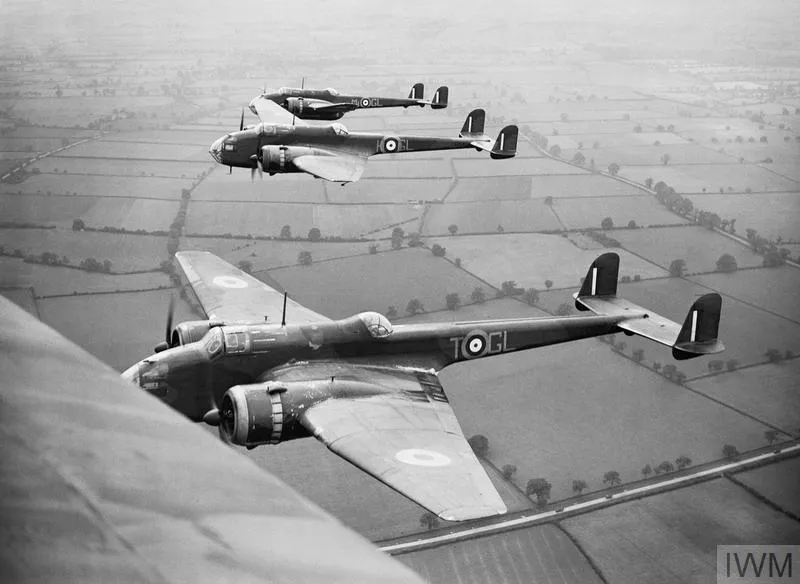
The London Blitz started on 7th September 1940, with the Luftwaffe shifting its focus away from RAF airfields towards the capital. At around 4pm on that day, a massive formation of about three hundred and fifty bombers escorted by more than six hundred fighters attacked London and a second group bombed London throughout the night using the fires started earlier as a guide. However, during a following wave of intense bombing on 15th September 1940 when almost every borough in London was hit, the RAF shot down fifty-six enemy aircraft which brought it home once again to German High Command that the presumed Luftwaffe air supremacy over Britain would be difficult to achieve. Ted wrote to his mother on 17th September 1940 (below) saying “I hope you’ve been getting some sleep through the last couple of nights, although I see they gave you the all clear at 3 and got you out at 4 again. Still I hope the damage isn’t too bad, and no bombs dropped up our way.” The letter of 17th September also tells us that Ted had just been home to Wembury Road, hitch-hiking to Harringay on 48 hour leave on the Friday or Saturday and returning to Lincolnshire in good time on Sunday 15th September: “Got four lifts very quickly out as far as Baldock and then got a car going as far as Lincoln. I got back to camp in 6 hours dead.“
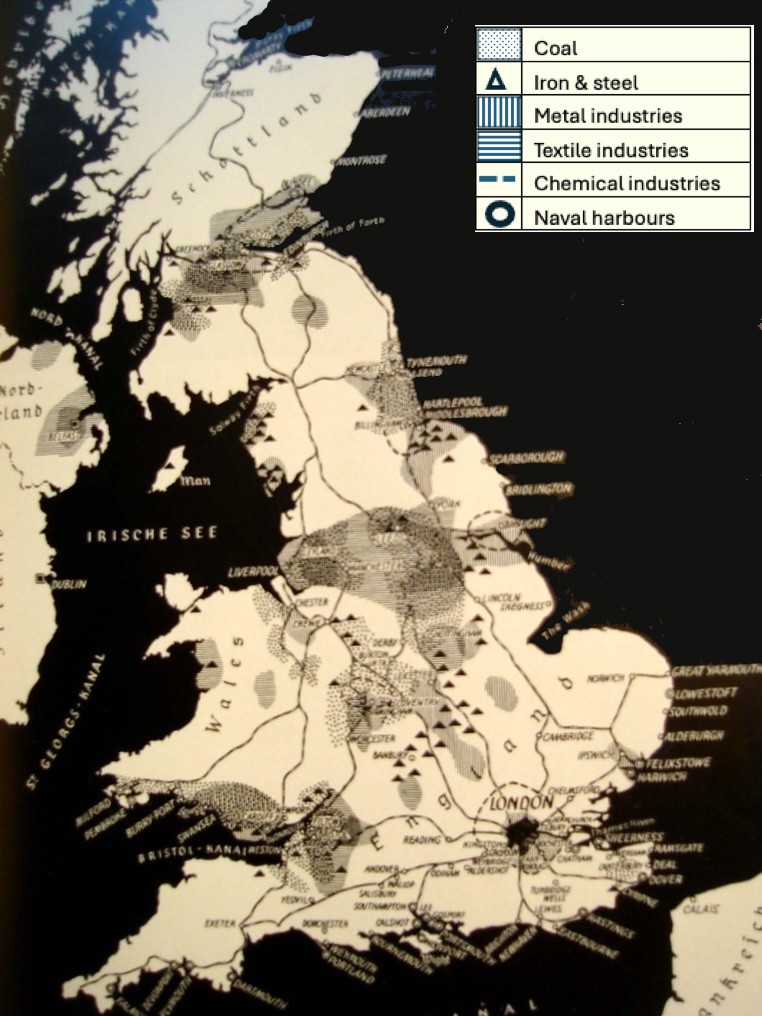
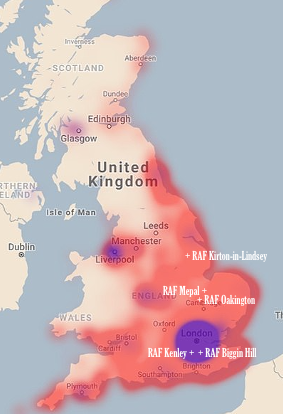
5th September 1940: The magazine Zeitung published the map on the left (Bombenregen über England) at the very beginning of the Blitz, showing the location of coal mining, iron and steel works, key industries and naval centres, the supposed key targets of Luftwaffe attacks (in fact, residential areas were just as likely to be hit during the Blitz). The heat map on the right is based on wartime data from 1939 to 1945 and provides an impression of where the bombs fell, the density of raids in red and the casualty numbers in purple (the three highest were 1 London, 2 Liverpool and 3 Birmingham). Ted’s postings in England as a radar and wireless operator have been added to this second map — they were at Biggin Hill January-April 1940, Kirton-in-Lindsey May 1940-July 1941, Kenley December 1942-May 1943, Oakington June 1944-July 1945 and RAF Mepal awaiting demobilisation.
27. Kirton-in-Lindsey, Tuesday 17th September 1940
641817 A.C.I. EJ McLEAY
MQ 31 RAF
KIRTON-IN-LINDSEY
NR. GAINSBOROUGH
LINCS.
17 . 9 . 40
Dear Mum,
As you can guess I got back very easily although I never left Wembury Road until 2 o’clock. However I just walked up to the top of the road. Got four lifts very quickly out as far as Baldock and then got a car going as far as Lincoln. I got back to camp in 6 hours dead. Pretty good eh?
I hope you’ve been getting some sleep through the last couple of nights, although I see they gave you the all clear at 3 and got you out at four again. Still I hope the damage isn’t too bad, and no bombs dropped up our way.
I got your letter today, it hadn’t got here yesterday, but I knew all you had to say of course. I also got Nan’s letter but it was no wonder it went miles round the camp with one of my old room numbers on it.
I got a peaceful nights sleep last night and expect to do so again tonight although I am on duty. All the same I’d rather be down home there.
I pulled Pats leg a bit about Irish nurses so you might tell her I really think they are swell sports. I suppose Mrs Gilbert told you I had dinner with her. I got our custard out meaning to have that but forgot it.
Everything is apparently quiet up here except the wind which has been blowing at gale strength all day.
Well Mum this is about all for now so cheerio will write again over the week-end.
Cheerio,
Best love,
Ted xxxxx
On the date of the above letter, 17th September 1940, a convoy passenger ship named The City of Benares was sunk by a u-boat with a loss of two hundred and sixty people, including evacuated children who were bound for Montreal. The public outrage at the time is reflected in Ted’s letter below of 24th September 1940: “Feeling ran pretty high the other day about the sinking of that kiddies’ ship as you can imagine.” Ted also reveals in this letter how enemy planes had been flying overhead at Kirton-in-Lindsey since late June 1940, although with little effect he says: “We get that terrible drone of engines all the time when Jerry kites are flying overhead, but we’ve got used to it now as its been going on for three months. All that’s happened since I’ve been back is half a dozen Incendiaries which did absolutely nil except light everywhere up.” It is always difficult to tell how much is understated in these letters for Lizzie’s peace of mind.
28. Kirton-in-Lindsey, Tuesday 24th September 1940
641817 A.C. EJ McLEAY
MQ 31 S.H.Q. RAF
KIRTON-IN-LINDSEY
NR. GAINSBORO
LINCS.
24 . 9 . 40
Dear Mum,
I got your letter this morning and was pleased indeed to hear that everything is
OK at home.
I have put in for a week-end but if you dont get a phone call by one o’clock on Sat you’ll know I’m not coming. I doubt if I will get away anyhow.
Feeling ran pretty high the other day about the sinking of that kiddies ship as you can imagine. I expect it was pretty badly felt down there too. The King spoke extremely well too I thought, and for quite a time. If only he had finished up on a more intimate note it would have been epoch-making.
Pleased to hear no one was hurt when bomb dropped near Pat’s home. I bet it shook her.
I’m glad to see you’ve fixed up about your glasses and hope it does your eyes some good to wear them.
Things are very quiet around here but we get that terrible drone of engines all the time when Jerry kites are flying overhead, but we’ve got used to it now as its been going on for three months now. All thats happened since I’ve been back is half a dozen Incendiaries which did absolutely nil except light everywhere up.
Last week they started educational classes in our spare time and I am doing a very little spot of French and German. Very little. Just one hour a week each. I can count up to 100 in French anyway and quote a rhyme in German. Talk about make you laugh etc. etc.
Will finish up as there is not much to tell you so bye bye for now.
Best love,
Ted xxxxxx
At the end of September 1940, the Tripartite Pact was signed in Berlin by the Axis powers, this time including Japan. When Italy had joined the war three months earlier, RAF bases in the British Crown colony of Malta were attacked by the Italian air force, and RAF planes based in Egypt reciprocated with raids an Italian airfields in Libya. By September, the confrontation had spread across the Mediterranean, with Hawker Hurricane fighter-bombers now attacking targets in Sicily from their new base in Malta. A route was opened up then to transport British- and later American-manufactured aircraft from the Gold Coast to Egypt, in order to supply the Mediterranean war zone (and then the Middle East, and after that the Far East) without having to brave the more dangerous passage over continental Europe. This vital artery for the Allied air forces was known as the West African Reinforcement Route, which operated out of Takoradi in the Gold Coast, where Ted would be posted later in the war in 1943.
The North Lincs Air Raid Records tell us that, on 29th September 1940, high explosive bombs fell about five miles from Kirton-in-Lindsey aerodrome, on Black Common at Messingham. This is not mentioned by Ted, whose only comment in the following days is a zestful northernism “There’s nowt doing up here.” From the letter dated Wednesday 2nd October 1940 (below), it seems that he went to London on another 48 hour pass on Saturday 28th September and returned to the base in a record 5 hours 50 minutes. An additional comment to Lizzie refers to the continued bombing of London: “I suppose it was the same again Monday & last night. I hope it [has] eased up by the time I get leave“, implying that there were raids on London over the weekend while Ted was there.
29. Kirton-in-Lindsey, Wednesday 2nd October 1940
641817 A.C.I. EJ McLEAY, W/OPP
S.H.Q. SIGNALS, MQ 31
RAF KIRTON-IN-LINDSEY
NR. GAINSBORO
LINCS.
2nd October 1940
Dear Mum,
As you can guess I got back OK and as a matter of fact in 5.50 mins which is pretty quick for coming up out of London, faster in fact than I came down on Saturday. We will be getting 7 days within the next six weeks or so, maybe sooner, so I doubt if I shall get another 48 hours for some weeks, possibly not before I get leave. Still that’s not so long to wait is it?
I hope you are still OK at work and Miss Cannon has come ‘home’ again to help you out at work. Still I shouldn’t worry as long as you can stand it because it’s
something to have a jobs isn’t it? I hope your glasses take the strain of your eyes now Mum, but I shouldn’t stop bathing your eyes as you may improve them again.
There’s nowt doing up here but I suppose it was the same again Monday & last night. I hope its eased up by the time I get leave so I can stay out to a respectable hour.
We, Signals, played football last night in the camp league and lost 1-0. I played decent and it wasn’t my fault we lost I’m pleased to say. However it’s the same every time and although that’s the first league game, we’ve already lost three games out of four. Still maybe we’ll have some luck in our future games.
I am going to be glad of those four pullovers I’ve got if this weather gets colder. I hope you’re a bit warmer in the shelter now. Don’t forget to pack a case full of clothes will you? They would come in very useful if anything did happen.
Well Mum everythings OK at present so I’ll pack up for now. The cakes a smasher. Cheerio for now and look after yourself
Best love,
Ted xxxxx
P.S. Remember me to Mrs Gilbert, George, Pat & Olive.
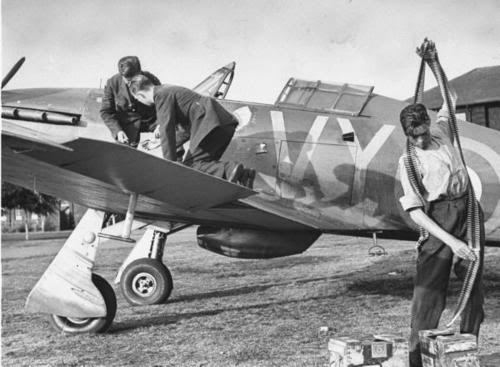
On 8th October 1940, the first US volunteers enrolled in the RAF, forming 71 Eagle Squadron at RAF Kirton-in-Lindsey and flying Hawker Hurricanes. About the same time, 307 Polish Night Fighter Squadron was formed, and their aircraft were Boulton Paul Defiant night-fighters (the first Free Polish fighter squadron, 302 ‘Poznanski’, had been established three months earlier in July 1940 at Leconfield in Yorkshire). In his letter dated 18th October 1940 (below), Ted tells Lizzie that “the Polish pilots are learning English and I’m teaching the pronunciation, that’s one of my jobs.”
On the same day, 18th October 1940, it was announced in the House of Commons that nearly half a million children had been evacuated because of the relentless Luftwaffe air raids on London. As for the planned naval invasion of Britain, we now know that it had already been deferred by Hitler and was eventually abandoned altogether, although the Blitz would carry on for several months more.
30. Kirton-in-Lindsey, Friday 18th October 1940
641817, L.A.C. EJ McLEAY, W/OPP
S.H.Q. SIGNALS, MQ 31
RAF STATION
KIRTON-IN-LINDSEY
NR. GAINSBORO
LINCS.
18 . 10 . 40
Dear Mum,
I haven’t had time to write before but am just commencing this afternoon although I don’t know whether I’ll finish this afternoon, still I’ll try.
I was pleased to get your two letters and the two parcels. The gloves are swell and the cake as good as usual. The Corporal in my room, Eric, my pal, hasn’t got any gloves so if [?] gets the wool from the fund and she can send the articles to anyone of the forces, I wonder if she would like to knit some for him? He is slightly larger in the hand than me and his No. & rank is Cpl Lord 534764. Same address as myself. I will enclose a note thanking her for my pair so would like to ask her.
I hope everything is going on OK and I expect it is. I am getting leave from 2.11.40 to 8.11.40, that is in a fortnights time so will be seeing you then I hope.
You remember I told you I went for a ride with Billie about 4 months ago? Well she’s engaged to a Polish airman now, but I don’t think it will last as I think it is only infatuation. Still I should worry.
I’ve been out to Scunthorpe a couple of times with Audrey, you remember I told you about her when I was home, she’s a Newcastle girl and extremely nice too with an attractive brogue.
The work has been pretty hefty of late mostly because I’ve made it so, you see I work at DF for 24 hours out of 3 days, that is 8 hours a day but of course we sleep one night so really we do about 17 hours work or about 6 hours per day. So when I’m off duly I go and find some work to do and the jobs are many and varied. You see the Polish pilots are learning English and I’m teaching the pronunciation, thats one of my jobs and I’m trying to learn a little bit of Polish, a very little bit, I just know, “yes no good and nights” so I can say no good, good night, no & yes. Unfortunately I have had to give up French but thats not a great loss and I’m trying to keep up my German. Among the other jobs that I have been doing are rigging up lights and wireless aerials, setting the stage ready for shows, that is fixing up curtains & loudspeakers etc.
I’ve got your runner and will fetch it home when I come up on leave.
By the way I’ve got a bit of money to put in the bank, so I’ll get a book up here at Kirton P.O. and will put my money in.
Yes LAC means [?] something on my arm now as well as the wireless badge. We’ve got plenty of praise recently down at the DF so maybe I’ll get on further although I dont want to go too fast do I?
I wrote to Nan & Auntie Bet a couple of weeks ago but haven’t heard from them yet so if you ring up you might tell Auntie Bet I’m still OK.
I’m still getting a game of soccer about once a week so I’m feeling OK.
Well cheerio for now Mum,
Best Love
Ted
P.S. Have mislaid letter of yours sending gloves & cant think whether it was Pat or Olive who knitted gloves, so please thank her and I’ll write a note later on. Ted
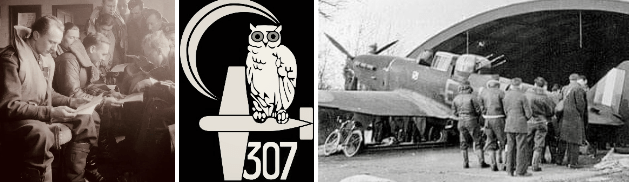
Polish aircrew with 307 Squadron participating in off-duty English lessons (left, taken later at RAF Churchstanton), and standing by a Boulton Defiant in front of its hangar at Kirton-in-Lindsey (right). As mentioned above in his letter of 18th October 1940, one of Ted’s extra duties was to teach English pronunciation to the Polish pilots shortly after their arrival at Kirton in September 1940.
On 25th October, the RAF bombed Berlin and Hamburg heavily. Two days later, on 27th October 1940, a Heinkel bomber scored a direct hit on No.1 hangar at Kirton-in-Lindsey, and the windows were shattered in the control tower. The North Lincs Air Raid Records also mention that on the same night a single high explosive bomb came down elsewhere in the area, in Scunthorpe, injuring 11 people. Ted provides no details of the previous day’s air strike on his base in the letter dated 28th October 1940 (below), writing succinctly to his mother Lizzie “Just a very short note to let you know I am OK“ adding that he “will be home on Saturday unless this new upset messes things up.”
31. Kirton-in-Lindsey, 28th October 1940
641817, L.A.C. EJ McLEAY
MQ 31,  SIGNALS
RAF KIRTON-IN-LINDSEY
NR. GAINSBORO.
28th October 1940
Dear Mum,
Just a very short note to let you know I am OK and will be home on Sat. unless this new upset messes things up. I’ve been very busy since I got your letter. Ever so busy and I’ll tell you all about it when I see you.
I managed to get a note off to Jock but couldn’t think of much to say so I hope it suffices.
Well Mum I really must close, I’ve been working since 5 and its now 10.30 so I want to get a spot of sleep before 3 in the morning when I expect we’ll start again.
Best love for now,
Ted xxxxx
On 14/15th November 1940, the night of the heavy bombing raid that devastated the centre of Coventry, there was another attack on the airfield at Kirton-in-Lindsey, this one just before daybreak. The local wartime records (the North Lincs Air Raid Records) tell us more about the incident. It seems that a lone Dornier dropped incendiary bombs over the airfield, but in point of fact there was no damage and there were no casualties. Ted wrote in his letter later that day: “We had a dawn raid this morning just before the light came. Talk about fireworks.” As for Coventry, the RAF retaliated the next day, dropping bombs on Hamburg yet again. In the same letter, Ted also asks about the situation in North London “From what I hear on the wireless you have had it a bit easier the last few nights, is that right? I hope so.“
32. Kirton-in-Lindsey, Wednesday (dated ex-post 14-Nov-40)
641817 L.A.C. EJ McLEAY
SIGNALS MQ
RAF
KIRTON-IN-LINDSEY
NR. GAINSBORO
LINCS.
Wednesday
Dear Mum,
I’m sorry I have not written before but I have been expecting to shift to a forward wireless station but as I haven’t yet gone I thought I had better let you have a line or two. As a matter of fact when I did get back and was told I would be shifting I had already written a line to you but scrapped it as I thought I would be going almost immediately.
Well as you can see I got back OK but could not get through to you on the phone although I had about three goes and lost 4d[?] in getting 3588, I dialled OK so the lines must have been wonky.
I wasn’t really sorry to get back although I enjoyed seeing you there wasn’t a lot to do was there?
As I say the place is a forward wireless station about 40 miles from here and I wasn’t too pleased at hearing about it after getting such a nice girl friend as Audrey here. I wont go if I can get out of it but it is doubtful if I can.
When I got back I found that people had been posted galore mostly to our wireless stations, one or two away from camp and one of the w/ops overseas.
I’ve lost most of those spots on my face and I think my cold’s getting better.
I hope you are feeling OK and getting your sleep OK. From what I hear on the wireless you have had it a bit easier the last few nights, is that right? I hope so.
We had a dawn raid this morning just before the light came. Talk about fireworks.
There’s not been to great deal of work since I got back. What there has been has taken place during the day.
I went down to Scunthorpe on Monday to the pictures and to a whist drive in the village last night. It was a partner drive and Audrey and [I] won the booby with 139 for 24 hands.
Well there’s no more to say for the moment so cheerio Mum.
Will let you know if I move.
Best love,
Ted xxxxx
In the letter above, dated 14th November 1940, Ted tells his mother that he would be moving from the Kirton airfield to “a forward wireless station about 40 miles from here.” The next letter, dated 1st December 1940, was sent from Brickyard Farm near North Somercotes, close to the North Sea. Ted was still setting up the outstation, trying amongst other things to ensure a 24 hour watch given contingencies such as illness within the crew there: “We had a bit of work the other afternoon. Just a practice run and my other two chaps who were on pulled it off OK so the stuff seems OK too. Everything seems fine for crews as all the four of us can operate so if anyone falls ill I’ve got a standby ready by just shifting in one of the others and doing a watch by myself, understand?” The location of the forward station at Somercotes is shown below on a map of coastal radar coverage (more specifically, a map showing the extension of coastal radar coverage in 1940 from the pre-war level in 1939).
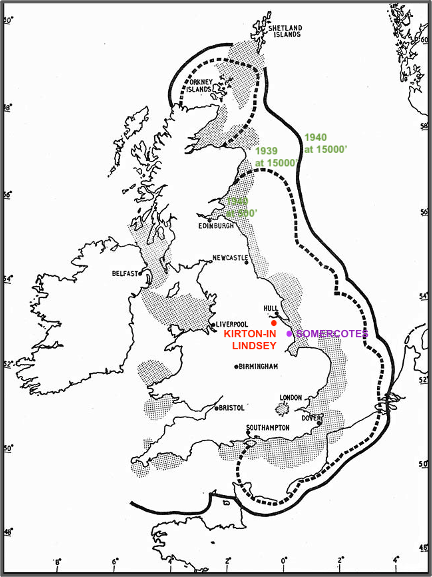
33. Brickyard Farm, Somercotes, Sunday 1st December 1940
L.A.C. EJ McLeay RAF
c/o T Cartwright Esq.
Brickyard Farm
Nth Somercotes
Nr Louth
Lincs.
1 . 12 . 40
Dear Mum,
I was pleased to get your letter, sent to this address, also one from Kirton & the parcel with my pyjamas in. Thanks a lot for the writing pad Mum but don’t get me anything else as I wish you’d save yourself some money. I wont be needing any more money as I’m having my bike done up and it’s only 40 miles to Kirton I find. So it will be a nice ride. Although if you’ve got that money it would be best that you let me have it so you couldn’t spend it then you’d know just how you stood.
I am enclosing the letter I left out also a whist drive ticket from down the village where I got 1st prize. It was a pullover. That makes the 3rd time I’ve won in about two months.
I got the hanks ok and the letter saying Mrs Gilbert was thinking of going home, but but didn’t have it to hand when I wrote. I’ve written to Aunt Bet & Nan so I
expect you found out when you got there Sunday.
We had a bit of work the other afternoon. Just a practice run and my other two chaps who were on pulled it off OK so the stuff seems OK too. Everything seems fine for crews as all the four of us can operate so if anyone falls ill I’ve got a standby ready by just shifting in one of the others and doing a watch by myself, understand?
By the way I did some clothes washing the other day and they turned out swell. 14 hanks, 4 collars, pants, vest, shorts & towel & socks. All done to a treat too.
There’s a big pond on the farm and full of fish so the people let fishermen use it for 6d a time, It’s quite a well known pond around here and folks come for miles around to fish. One the people is an old friend of the families and comes from Grimsby on a Sat afternoon and Sundays. He is a very nice gentleman and fetches his wife and Mrs Cartwright’s daughter, husband & children down with him on Sundays. He says I can use his tackle any day in the week I like and and any time I’m in Grimsby and wish to stay the night just go round to his house. On a Saturday he will take me up if I like to go and come back on Sunday. OK isn’t it?
There’s plenty of poultry here, Chickens, Cocks, Turkeys, Ducks & Drakes, & also cattle for milking, about 8 and three calves. Also pigs for eating in every form from sausos to roast pork. Vegetables and Corn are the main growths, no fruit hardly. But can the people round here cook, I’ll say. They have great big kitchen ranges and cook a treat. The lighting is done off oil lamps. No gas or electric lighting.
I don’t think I need the cake as its really a waste of postage. Well that’s about all for now Mum so bye bye,
Best Love,
Ted xxxxxx

Ted’s winning Whist Drive scorecard, mentioned in his letter of 1st December 1940
In the letter above, in addition to telling Lizzie about the Whist Drive in the village near Brickyard Farm, Ted also explains that there is a large fish pond on the property. The farmer Mr Cartwright, he says, lets “fishermen use it for 6d a time … it’s quite a well known pond … and folks come for miles around to fish.” One the anglers is an old family friend, “a very nice gentleman” who comes down from Grimsby with his wife at weekends, bringing with them the farmer’s daughter, son-in-law and children. Ted is clearly pleased when the visitor offers the use of his fishing tackle. Indeed, In the next letter sent on 10th December 1940 (below), Lizzie hears more: “Well I’m still OK and still fishing. Yesterday I caught seven in 2½ hours and this morning four in 1½ so I’m improving a bit.” The property is still in the Cartwright family to this day, we have heard, and is now known as Brickyard Fishery.
A recent photograph of the pond at Brickyard Farm (now Brickyard Fishery), at dusk on a moonlit night

While Ted and his group were setting up operations at Brickyard Farm, the attacks on British cities were relentless — 29th November brought a massive overnight bombing raid on Liverpool, 30th November and 1st December on Southampton, 2nd December on Bristol, and 3rd December on Birmingham. In his letter of 10th December 1940 (below), Ted writes “I see in the papers that London has had another couple of heavy nights so I suppose there are some fresh bomb craters to be seen.“
It was at the beginning of December 1940 that Hitler ran into an unexpected problem with the alliance between Fascist governments, until then a growing number. The regimes in Hungary, Romania and Slovakia had added their signatures to the Tripartite Pact between Germany, Italy and Japan, and the French government in Vichy was collaborating as well, but Franco surprised them all by ruling out the involvement of Spain in what he saw as a potentially disastrous war. Perhaps Spain’s proximity to North Africa explains his reluctance, as December 1940 saw the first Allied offensive there, against Italian forces in the Western Desert.
34. Brickyard Farm, Somercotes, Tuesday 10th December 1940
L.A.C. McLEAY
LINCS.
10 . 12 . 40
Dear Mum,
I got your letter a couple of days ago but haven’t answered sooner as I wanted to see when I would be getting home on leave. I have now heard that we shan’t be getting 7 days yet but can get 4 days on the 18th. So you can expect me home somewhere about then. I’ll try to get a chicken when I come home and some eggs but can’t promise anything as yet. I should tell May not to order a fowl as she could share yours only it would be too big for you alone.
Well I’m still OK and still fishing. Yesterday I caught seven in 2½ hours and this morning 4 in 1½ so I’m improving a bit.
I got some repairs done on my bike and it ran into £1. 5. 0 so I haven’t been able to save any as yet.
You seem to have a lot of news but myself I cant find a thing to say. Since I last wrote I haven’t really done a thing of interest.
I see in the papers that London has had another couple of heavy nights so I suppose there are some fresh bomb craters to be seen.
Well Mum I don’t think there is any more to tell you but if I have to miss my 4 days I’ll write and let you know.
Bye bye for now,
Best love,
Ted
During the two weeks that followed the letter above dated 10th December 1940, major German air raids were directed at Sheffield from 12th–15th December, at Liverpool from 20th-22nd and at Manchester from 22nd-24th December. It was during this period that Hitler made the astonishing foreign policy u-turn that shaped the direction of WW2, when he began planning for the invasion of the Soviet Union. Some of his entourage felt that Britain should be defeated first, but fortunately they were ignored. It seems that the Molotov–Ribbentrop Pact had not worked out as intended, and the Soviet advance into the Baltic States (including Lithuania, which was to have been under German control) convinced the Nazis that Stalin was forming an anti-German bloc. The diplomatic hijinks were remarkable— while Ribbentrop was busy negotiating a new alliance between the Axis Powers, the Soviet Union and others (stretching, they claimed, from Gibraltar to Yokohama), Hitler was equally busy laying down plans for Operation Barbarossa, the Eastern Front that in his mind would reach Moscow, Leningrad and Stalingrad in a matter of months. Much has been written about all this by historians, even that the planned invasion of Britain may have been some kind of bluff. Regrettably, however, Hitler’s new Russian plans did not bring an end to the Blitz at this time.
The letter of 10th December 1940 highlights a more down to earth aspect of wartime Britain. On the home front, food rationing had been extended once to include meat (in March 1940) and then again for margarine and tea (in July 1940). Egg rationing would be next, starting in June 1941. For Ted, the recollection of wartime scarcities prompted him many years later to tell us the story of the eggs and the fowl, which can be traced back to the letter above: “I’ll try to get a chicken when I come home and some eggs but can’t promise anything as yet. I should tell May not to order a fowl as she could share yours only it would be too big for you alone“. As Ted was billeted on a working farm, he was able to bring one of their chickens and some eggs to London, a real Christmas treat for his mother, given the shortages, and enough to share with her brother Jock and his wife May living down the road. Carrying a kit bag, a plucked chicken and a tray of eggs was enough of a challenge, and once Ted was on the train he felt like a character in a Hitchcock film, under suspicion while making his getaway, the RAF uniform adding to the enigma. The passengers travelling in his carriage reacted with incredulity at first, as if Ted might be implicated in some sort of racket, but he soon joked about it with them. In fact, having delivered his seasonal offering, he returned to Brickyard Farm before Christmas, on 23rd December, and went on duty for a long shift before writing home on Christmas Eve. Knowing that his letterof 24th December would be received a day or two later, he adds “Hope the chicken goes down OK, or rather went down OK“.
It looks as though these consignments from the farm continued into 1941. In a subsequent letter dated 18th January 1941, he writes “I’ll get as many eggs as I can but if the cold spell lasts it wont be very many.” A bit later, on 27th January, he says much the same: “I shan’t be able to get many eggs this time, about a couple of dozen, but I’ll do my best.” Ted then adds that he will be bringing an old stewing hen for friend Norman’s mother, Mrs Huff, but he guesses that Lizzie would not be interested in one as well: “I’m going to get a boiling fowl for Mrs Huff so if you like boiled chicken let me know Mum. I shouldn’t think it would be worth getting you one though.”
35. Brickyard Farm, Somercotes, Tuesday 24th December 1940
L.A.C. McLeay
24 . 12 . 40
Dear Mum,
Just a short note to let you know I got back OK. The postman should soon be here so I haven’t much time to write this.
As usual I left quite a few things behind. My tin hat, toothbrush and I believe something else so you might send them on please Mum.
I went on duty last night and have just come off. We had to work.
I got Rene’s pair of gloves OK. But I didn’t send them a card. I hope you put me on yours. Anyway I’ll write to them in a few days time.
Hope the chicken goes down OK, or rather went down OK.
Mr Cartwright is a bit wheezy on his chest at the moment and is staying in bed for a couple of days.
The weather round here is pretty good although there was a pretty cold East wind blowing when I got back That’s dropped a bit now so it’s not too bad. I think those pullovers will come in pretty useful.
I’ve just remembered what else it was I wanted. Could you turn out my drawers and find some blanket pins There should be half a dozen at least, if not would you get me a doz. Mum please.
Well I’ll say cheerio as I expect the postman will soon be along.
Best love for now,
Ted xxxxx
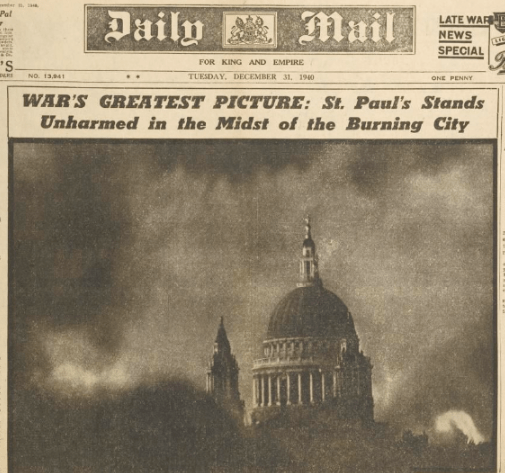
The heaviest bombing in the London Blitz was on the night of 29/30th December 1940, causing over fourteen hundred fires — reproduced above is the iconic photograph of St Paul’s Cathedral that appeared in the Daily Mail the following day, unscathed and against a smoke-filled sky. In response, twenty thousand incendiary devices were dropped on Bremen on 1st/2nd January 1941 by 95 aircraft from Bomber Command. However, on the night of 2nd/3rd January, Cardiff experienced its heaviest bombing of the war, York was subject to a fire-bomb attack, and Ipswich was struck by an Italian air force contingent based in Belgium on its last raid on Britain. The next night, the 3rd/4th January 1941, Bristol saw its longest attack of the war lasting twelve hours, during which the Luftwaffe dropped its 2,000 kilogram Satan bomb, and on the morning of 5th January 1941 a lone aircraft dropped bombs on Norwich. In his next letter, dated 11th January 1941, Ted explains how “None of the East Anglian Raids have been near us although we have had Jerries about sometimes. Only in ones though.“
It seems curious now to read that, in the middle of the Blitz, there was some kind of Hogmanay celebration at RAF Kirton-in Lindsey. “I had a grand time at the New Year’s Eve dance at camp … I got to bed about 4 o’clock,” Ted tells his mother, his narrative style reminiscent of the author P.G. Wodehouse: “Talk about jolly, I’ll say it is was“. Ted stayed at Kirton for about two weeks over the New Year, worked in Signals during the daytime and “played cards most evenings“. He then made his way back to Brickyard Farm.
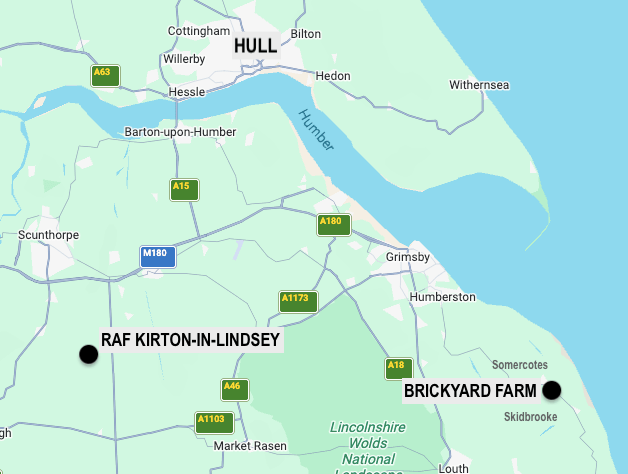
36. Brickyard Farm, Somercotes, Saturday 11th January 1941
L.A.C. McLEAY
LINCS.
11 . 1 . 41
Dear Mum,
Well I am now back at Skidbrooke so can write a decent letter for a change. I am sorry I couldn’t write before but I didn’t have any of my kit up at Kirton or the convenience for writing long letters. Anyway I’ll see what I can do now. I start off by mislaying my pen and best pencil.
I hope you are OK and keeping quite well as I see you’ve had a few quiet nights just lately.
I’m pleased to see you had a nice time at xmas and a quiet and peaceful one at that. I think I’ve got everything you’ve sent so far. Tin hat, three vests and tooth brush which I left then socks and pins which I can use. I’m pretty well stocked at the moment with three new pairs of socks and the big ones which are lovely and warm. I got the gloves from Rene and a PO from Nan and U Bob Stichbury. I haven’t answered any of them as yet but will do tomorrow night when I get my pen locked up. As it is I’m on duty and cant get it.
Mr Cartwright is up all day now but he isn’t as well as before as the East Winds get at his chest. However I hope Mr Jessop is better next time you hear from him.
None of the East Anglian Raids have been near us although we have had Jerries about sometimes. Only in ones though.
The pins will be OK thanks Mum as I only want to to pin some sheets together to make a pallias to fill with chaff.
I hope this pair of socks will last me until I return to camp and get back into boots again but if you get some wool and are knitting nothing else then perhaps it would be just as well to get another pair knitted as I may have to stay here if things liven up.
I’m pleased to hear you have plenty of work Mum as [?] appears to be quite decent and may remember it later on if things slack off at all after the war. As long as you don’t overdo it its all right.
I’ll hang on to the basin as it may come in handy to bring something home in.
I had a grand time at the New Years Eve dance at camp. I got to bed about 4 o’clock. Talk about jolly I’ll say it is was. I also enjoyed the rest of the stay. When the snow stopped on the ground, I thought I had best stay until it is cleared so I went and saw Mr Peters and he told me I could go into Signals during the daytime so I did that for a fortnight almost. I played cards most evenings so it went OK.
I managed to get a couple of shirts and a radio but its not much good although it works which is something. It is one of the [compre?] sets.
I should get seven days in about a month’s time so is not worth getting a W.E. before then is it.
Well Mum bye bye for now. Got a letter from Joyce. Sends you her best wishes.
Bye-bye, Best love
Ted
On the date of the above letter, 11th January 1941, a bomb landed outside the Bank of England and demolished Bank Underground station, killing fifty-seven people. Ted’s reaction in the letter to his mother dated 18th January 1941 (below) seems surprising now, quite out of character, but perhaps his wording just reflects the very sad fact that loss of life in this way was no longer atypical: “It’s a bad job about that tube collapsing but it’s по use wasting time worrying a great deal over folks you don’t know nowadays is it when everyone you do know is in danger.” The underlying philosophy is intriguing. Could it be ‘to worry only about those things over which you have some control‘, i.e. to not worry about things you cannot impact? In a similar vein, holding two opposing thoughts in our heads at the same time may be demanding, but we know that Ted found it both unsettling that his mother Lizzie went to work in London throughout the Blitz, yet admirable at the same time (as he told us later in life). There was also the subtle wartime pressure ‘to display emotional restraint,’ and perhaps all of these factors influenced his thinking. The never-ending barrage of attacks certainly brought the violence closer to home, and one letter (further below, dated 12th March 1941) describes a near miss involving girlfriend Joyce and the carnage she saw around her: “I heard from Joyce a couple of days ago and she says that she was walking down the road when a bomb fell one hundred yards in front of her. She had to walk through the dead and injured people and said it was ghastly hearing their moans.“ Lastly, on this subject, Ted’s own work was to locate invading aircraft so that RAF fighter pilots could intercept and destroy them, thus sending air crew into danger with a significant risk of not returning. Perhaps that is also what he may have had in mind — ‘to focus on safeguarding those who you can easily put in peril‘. There is a moral framework to explore here, akin maybe to theories of a Just War.
37. Brickyard Farm, Somercotes, Saturday 18th January 1941
L.A.C. EJ McLEAY W/OPP
c/o BRICKYARD FARM
NTH SOMERCOTES
NR LOUTH
LINCS.
18 . 1 . 41
Dear Mum,
I was pleased to get your letter and know you are keeping well. I hope the present cold spell isn’t worrying you a great deal as the wind this afternoon seems to be coming from the south.
Am pleased to hear about your spot of luck at work as it certainly gives you heart to do a spot of extra when you know its appreciated.
It’s a bad job about that tube collapsing but it’s по use wasting time worrying a great deal over folks you don’t know nowadays is it when everyone you do know is in danger.
I’ve written to Rene, Nan and Bob Stichbury so that’s just about cleared me up in correspondence line.
By the way Mum would you see if my skates are home and if so send them on. I think they are at Norms though and have written to him also.
I hope to be home on the fourth of next month so let me know if there is anything special you want. How about Swedes? Would you like a couple? I’ll get as many eggs as I can but if the cold spell lasts it wont be very many as the eggs are a bit scarcer.
I’ve been loading manure from the yard to the fields today in a horse and cart and on Monday am going to help with threshing. I am still getting on the road to being a farmer, but not if I can help it.
There hasn’t been a great [amount] of work to do and I haven’t been out anywhere yet since getting back and don’t suppose I shall bother to either until I’ve had my leave.
The WAAF who lives down at Harringay is I believe coming home the same week as me so I’ll have some company I expect for messing about in the daytime.
Joyce is still a telephonist down at the Archway exchange and is as far as I know keeping quite well. I drop her a line about every couple of months but tell her not to bother to answer. The did over Xmas though. She’s eighteen now, nineteen in March.
Well Mum I’ll pack up now as the tea’s on the table so bye bye for now.
Best love
Ted xxxxxx
While he was at his forward station, Ted spent time helping out on the farm between his radar shifts. In the letter dated 1st December 1940, the one in which he tells Lizzie about the fishing pond, his first impressions of Brickyard Farm are also recounted, and with an evident buzz of enthusiasm: “There’s plenty of poultry here, chickens, cocks, turkeys, ducks and drakes, and also cattle for milking, about eight, and three calves. Also pigs for eating in every form from sausages to roast pork. Vegetables and corn are the main growths, no fruit hardly. But can the people round here cook, I’ll say. They have great big kitchen ranges and cook a treat. The lighting is done off oil lamps. No gas or electric lighting.” The stint at Brickyard Farm clearly opened up a new world to Ted. In the letter dated 18th January 1941, he writes “I’ve been loading manure from the yard to the fields today in a horse and cart and on Monday am going to help with threshing” and then on 27th January “We had [another] threshing day last Friday at one of the neighbouring farms and we went along ratting and mousing. There were two dogs and they got all seven rats in the stack and a good few mice too. In fact I should say there was about five hundred mice altogether. I managed to swipe several. I’m just hoping they’ll thresh our stack while I’m here and not while I’m on leave. We’ve got a smashing ratter, a lovely Black retriever and four red hot mousing cats. One of the cats is about fifteen years old at least but can it move after mice.” The Brickyard Farm letters certainly showcase a rural lifestyle far removed from the big city. “There’s a pig being killed today so I’m going to see it,” he says on 27th January, and in the undated letter further below his news is “I’m now milking two cows a day and managing to do quite a few odd jobs on the farm.” Just before his time there came to an end, Ted tells Lizzie once again about his participation in yet more threshing: “There’s good day’s threshing to be done tomorrow providing the weather is OK and I’m chief rat and mouse organiser.“
38. Brickyard Farm, Somercotes, Monday 27th January 1941
L.A.C. EJ McLEAY
LINCS.
27 . 1 . 41
Dear Mum,
I got your letter a couple of days ago but have left it down at the hut so can’t answer it properly, although I don’t think there was a great deal to answer.
I hope to be home on the fourth which is a Tuesday and return on the Monday. I shan’t be able to get many eggs this time, about a couple of dozen, but I’ll do my best. I’m going to get a boiling fowl for Mrs Huff so if you like boiled chicken let me know Mum. I shouldn’t think it would be worth getting you one though what d’you say? I’ll get half a pound of tea if poss.
There’s a pig being killed today so I’m going to see it.
We had a threshing day last Friday at one of the neighbouring farms and we went along ratting and mousing. There were two dogs and they got all seven rats in the stack and a good few mice too. In fact I should say there was about five hundred mice altogether. I managed to swipe several. I’m just hoping they’ll thresh our stack while I’m here and not while I’m on leave. We’ve got a smashing ratter, a lovely Black retriever and four red hot mousing cats. One of the cats is about 15 years old at least but can it move after mice.
I got my skates from Norman but the ice has thawed so I can’t use them until it freezes again if it does.
We went to a whist drive in the village and had a regular scream. I didn’t get very good hands but managed fourth which wasn’t too bad. Anyway I won the raffle which was a lovely cake.
I’ve just about written to most people I think and got a letter from Nan today saying she was OK but hadn’t heard from you for weeks.
Well there’s no news so cheerio for now,
Best love,
Ted xxxxxx
39. Brickyard Farm, Somercotes, undated
L.A.C. McLEAY
c/o BRICKYARD FARM
NTH SOMERCOTES
NR LOUTH
LINCS.
Thursday
Dear Mum,
I was pleased to hear from you and know you are OK. I haven’t written sooner as I expected you to write in answer to my letter.
I haven’t troubled to send that money on as its meant drawing it off the bank book and as you said it wasn’t necessary as you would be able to save it in a month so I didn’t bother. If you want to borrow it any time though, let me know and you can have it of course.
I’m now milking two cows a day and managing to do quite a few odd jobs on the farm. I can’t think that there is anything really to tell you. The weather has bucked up quite a bit lately although it’s none too warm.
Well this isn’t much of a letter but its about all there is to tell you so I’ll pack up until I hear from you and hope I’ll have more to tell you then.
Cheerio Mum,
Best love,
Ted xxxxx
Although Ted’s letters cover the various things that he does with his spare time, organising the Direction Finding work was of course the reason for his posting to Brickyard Farm. In his letter of 12th February 1941 (below), Ted writes that “The boys have been working twelve hours a night for the past few nights so I expected quite a bit to do last night when I went on. As it turned out a very poor night, later in the evening I got some good sleeping hours in. I got quite a bit to do this afternoon though.“
Behind the scenes at this time, diplomatic efforts were about to have a significant and positive impact on Britain’s ability to fight back and eventually win the war. The House of Representatives in the US passed the Lend-Lease Bill on 8th February 1941. Churchill’s pleas to “give us the tools” seemed to speed up the process, and the all-important Anglo-American Lend-Lease Agreement was signed by Roosevelt the next month.
40. Brickyard Farm, Somercotes, Wednesday 12th February 1941
L.A.C. McLEAY
c/o BRICKYARD FARM
NTH SOMERCOTES
NR LOUTH
LINCS.
12 . 2 . 41
Dear Mum
I am just writing a few lines to let you know I got back OK. The weather was terrible when I started and it took me about four hours to do 50 miles so I was well behind schedule. However I got along pretty quickly after that and got to Louth about 10 miles from here about 5.30. I thought I was going to have a nice walk from there but I hitched an Air Force Officer in a small two seater and he turned out to be a rookie at a nearby training camp out for a spin, and ran me right to the lane end. So the whole journey didn’t take more than 7¾ hours even after my poor start.
The boys have been working twelve hours a night for the past few nights so I expected quite a bit to do last night when I went on. As it turned out a very poor night later in the evening I got some good sleeping hours in. I got quite a bit to do this afternoon though.
I got back to the farm this morning, to work I mean, and took the cart horses out for a bit of exercise. The land’s a bit too soft for them to do any work of course so they have to go for a walk to keep them from getting stiff. Young Ivon, the grandson, he’s fourteen, rode the young horse, he’s eighteen, and I the old one, he’s 25. Their backs are terribly broad and they have terrific knobbly backbones Talk about fun. I managed it OK.
The cake went down well and I was glad of its last night on duty. I am sorry I left the place in such a mess but I forgot that I only had until six to travel in and nearly left it too late. As it happened I was just in time.
There’s a whist drive down in the village tomorrow so I am going to do what I can again.
Well Mum I’ll finish now hoping you’ve lost your cold altogether. Bye bye for present. Hope I haven’t left anything, bye bye.
Best love,
Ted
P.S. Shall & keep £1 till I come home or do you want it?
In the letter of 12th February 1941 (above), we learn about Ted’s friendship with Ivon Cartwright, the farmer’s fourteen year old grandson, when they ride on the cart horses while exercising them: “I got back to the farm this morning, to work I mean, and took the cart horses out for a bit of exercise. The land’s a bit too soft for them to do any work of course so they have to go for a walk to keep them from getting stiff. Young Ivon, the grandson, he’s fourteen, rode the young horse, he’s eighteen, and I the old one, he’s twenty-five. Their backs are terribly broad and they have terrific knobbly backbones Talk about fun. I managed it OK.“ Two weeks later, in the next letter dated 26th February (below), we hear more about Ivon and the cart horses: “I have been out with the horses quite a few times and its hasn’t affected me at all. The exercise is doing ‘old’ rather good and he is quite capable of raising a trot for some distance. It is quite a job sticking on at times when they just jog along with thuds. However it’s something very useful to know, how to ride a horse, even if it’s only an old farm horse. Today we had a bit of bad luck, as it was quite muddy, old Dick dipped and as we happened to be trotting, Ivon, who had been holding a loose rein, went over his head, but they go down pretty lightly for their size and I’m always ready for a spill so I feel quite safe.“
With regard to the war at this time, Hitler is said to have issued orders to the Luftwaffe to concentrate on British port facilities, with fewer raids on metropolitan areas. Nevertheless, on the night of 13/14th February a single bomb dropped on West Hendon, with eighty-five fatalities, and on 17/18th February a bomb fell on an arch at London Bridge station where people were sheltering, and this time sixty-eight died. Somewhat disturbingly in the circumstances, given the fatalities in London, Ted writes in his letter to his mother dated 26th February 1941 how he “was glad to read you had been out a bit even if there was a raid on it makes thing a bit easier does a change.”
Elsewhere, in South Wales, a major Blitz on Swansea started on 19th February and lasted three days, almost completely obliterating the town centre.
41. Brickyard Farm, Somercotes, Wednesday 26th February 1941
641817 L.A.C. EJ McLEAY
c/o BRICKYARD FARM
NTH SOMERCOTES
NR LOUTH
LINCS.
26 . 2 . 41
Dear Mum,
I’m sorry I’ve been so long winded answering your last letter but I hadn’t anything really worth while writing about before last night and I couldn’t write last night as I was on duty and working nearly all night.
I hope you are still feeling as well as you were when you wrote and that your cold hasn’t returned. I’m feeling quite OK and up to scratch. Seems that not wearing our overcoats does me some good. These last couple of days have been really nice and the sun has got quite hot during the day. There is still a bit of snow about as it snowed a couple of inches of Monday night.
Ivon & I have been out with the horses quite a few times and its hasn’t affected me at all. The exercise is doing ‘old’ rather good and he is quite capable of raising a trot for some distance. It is quite a job sticking on at times when they just jog along with thuds. However it’s something very useful to know, how to ride a horse, even if its only an old farm horse. Today we had a bit of bad luck, as it was quite muddy, old Dick dipped and as we happened to be trotting, Ivon, who had been holding a loose rein, went over his head, but they go down pretty lightly for their size and I’m always ready for a spill so I feel quite safe.
Was glad to read you had been out a bit even if there was a raid on it makes thing a bit easier does a change.
Hope you’re not working too hard as you’ll have plenty of work every week now I suppose.
Of course I enjoyed my leave OK. That was a funny PS to put. I thought I said so before. Anyway I always enjoy coming up to London for a change.
Last Thursday I won the raffle at the Whist Drive and this week the 1st Gents with 177 and you still call it luck. I tell you I didn’t use to watch you all playing cards on a Sunday evening for nothing. I can remember how many of each suit has gone down and who sits with the masters now. They were both money prizes by the way and since Christmas I’ve managed to put a few shillings in the bank. I bet you cant guess how much? Be moderate now.
I got a letter from Norm and he has registered for the RAF. He said he banked £20 last week so he’ll have it when he rums short in the service. He had to queue up for 4 hrs 20 mins when he went. He put down for Armourer but doesn’t reckon he’ll gets it, the fellow told him he should know something about guns but that’s rot. He goes for his medical on the 5th March.
There’s good days threshing to be done tomorrow providing the weather is OK and I’m chief rat and mouse organiser. The two dogs and myself are quite pals now and go out hunting together. The son here is a good shot and wings ducks as they settle on the pond. The other day one of them was badly wounded and when we got near to it on the raft it just dived under water and swam about 20 yards away before coming up. I happened to see it swimming by once and shoved my hand under and grabbed it by the tail. It did kick some.
Well Mum I can’t think of any more news for now so cheerio, keep well,
Best love,
Ted xxxxx
The above was Ted’s last letter from Brickyard Farm. In his next, dated 15th March 1941, he tells Lizzie about his new responsibility for one of the night watch duties back at Kirton-in-Lindsey: “I have returned to camp and am now working in opps in charge of a watch. … We have been very busy the last two or three nights … flying was carried out from dusk till dawn and very hectic too.” The North Lincs Air Raid Records confirm bomb damage at Kirton-in-Lindsey on one of those nights, 13/14th March. Around Britain, it is known that Buckingham Palace was hit on 8/9th March, Portsmouth suffered heavy casualties after another night of heavy bombing on 10/11th March, and an extensive strike on Glasgow and the shipping industry along the River Clyde occurred on 13/14th March, the same night as the airfield damage at Kirton-in-Lindsey.
One encouraging remark in the letter concerns the RAF’s own raids in Germany. The records tell us that, on the night of 12/13th March, a total of 257 RAF bombers attacked Hamburg and Berlin, and the Focke-Wulf aircraft factory in Bremen. Ted comments on this to Lizzie: “Glad to see we sent out so many bombers the other night as its shows we wont take anything … without hitting back.“
In the same letter, Ted reflects on his station’s limited ability to deal effectively with the Luftwaffe onslaught: “We had quite a few of these bombers down in this sector the other couple of nights … I hope we get some new night-fighters soon so we can do a bit better.” The reference here is to the anticipated replacement of the defective Boulton Paul Defiant night-fighters. As a turret fighter without forward-firing guns (see image below), they proved to be vulnerable to the more manoeuvrable enemy planes, and for this reason were taken out of active service during 1941.
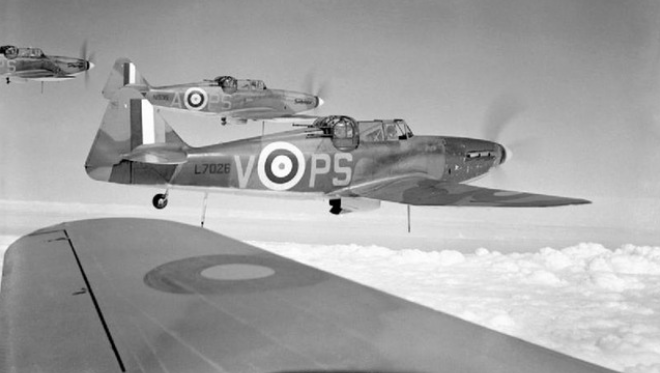
Boulton Paul Defiant night-fighters from RAF Kirton-in-Lindsey in flight. They were employed at Kirton from July to October 1940 by 264 Squadron, from September to November 1940 by the Polish 307 Squadron, and from November 1940 to May 1941 by 255 Squadron.
42. Kirton-in-Lindsey, Saturday 15th March 1941
641817, L.A.C. EJ McLEAY
S.H.Q. SIGNALS
RAF
KIRTON-IN-LINDSEY
NR. GAINSBORO
LINCS.
15 . 3 . 41
Dear Mum,
I’m sorry I haven’t written sooner but as you can see from the address I have returned to camp and am now working in opps in charge of a watch. I am coming home on the 29th of this month for 7 days providing everything goes on OK.
We have been very busy the last two or three nights have been on night duty, flying was carried out from dusk till dawn and very hectic too. I am off DF as you can see and am not sorry. I may be able to tell you some good news when I next write, cant say yet for certain.
I only got your letter yesterday as it had to be forwarded and I was told over the phone it had come so I waited until I got it before replying. I am glad everything is OK at home and at work. It has as I say been pretty busy round here but nothing has touched the camp.
I went down to Scunthorpe last night and again today with one of the chaps in the section. Today we got out of camp by 2 and when we got to the crossroads a car from Scunthorpe was going to Lincoln first and coming back after an hour so we went in it and had a walk around Lincoln then back to Scunthorpe and had tea at those people I told you about and then stayed for the evening instead of going to the pics.
I may go to another outstation in the summer as the people have to be changed around. Still we’ll see anyway, it would be a bit better in the summer so I shouldn’t mind so much.
We had quite a few of these bombers down in this sector the other couple of nights although only one from this station. I hope we get some new nightfighters soon so we can do a bit better. Was glad to see we sent out so many bombers the other night as its shows we wont take anything laying without hitting back.
The weather has been absolutely glorious for the last few days and although I have to sleep some days now I should be able to get some time in the sun out on my bike. You see we are indoors all the time on duty with artificial lighting.
Well Mum there’s not a lot to say. I hope you are keeping well and hope I will hear from you soon.
Cheerio Mum,
Best love,
Ted xxxxx
P.s. No, £10 in bank.
On 14/15th March 1941, more than 450 Luftwaffe bombers mounted attacks right across Britain – north, south, east and west – including Glasgow (about 200 bombers), Sheffield (about 120) and Leeds, Huddersfield, Tilbury Docks, Plymouth and Southampton. A few days later, on 19th March, London was the target of another widespread attack, with heavy damage inflicted by incendiary devices. When Ted wrote to Lizzie on 22nd March, his first comment was “I see you have been having it pretty bad recently and from what I hear Palmers Green has got the worst of it.” His friend Joyce lived in Palmers Green, and it is later in this letter where Ted describes how Joyce “was walking down the road when a bomb fell one hundred yards in front of her.” This of course is the horrific event mentioned earlier, when Joyce saw the bloodshed at first hand. Ted continued “She’s having some near misses isn’t she.”
In the same letter, Ted confides in his mother “I’ve got quite a nice lot of chaps under me.” They were certainly a diverse group on night watch duty, including a schoolmaster, an organist and a tea plantation owner. It is astonishing now (and touching as well) to think of a twenty year old taking responsibility for such a group of well educated, older people. The war seems to have propelled the levelheaded into positions of responsibility, however young, and Ted was getting on well in the RAF — “I’m always getting called on now,” he says to Lizzie.
43. Kirton-in-Lindsey, Saturday 22nd March 1941
KIRTON
22 . 3 . 41
Dear Mum,
I got your letter OK and was pleased to know everything is OK. I see you have been having it pretty bad recently and from what I hear Palmers Green has got the worst of it.
Everything is going on as it should here. I will be home OK on the 29th Sat. about 2 o’clock so hope you will have some dinner ready. I’ll see what I can do about your eggs but it’s doubtful if I’ll get any.
I heard from Joyce a couple days ago and she says that she was walking down the road when a bomb fell 100 yds in front of her. She had to walk through the dead and injured people and said it was ghastly hearing their moans. She’s having some near misses isn’t she.
Norm has gone to have his final medical and may now be in the RAF but I haven’t heard from him as to that.
I’ve got quite a nice lot of chaps under me. One is a very famous organist although his name hasn’t got to be a household name because he doesn’t broadcast. It’s Cliff Burchell. Most of the other fellows are quite well educated and came from good jobs. On some of the watches there are some really well up people. One chap’s a Master at St. Paul’s Harrow and Dublin University, another as tea planter from India, so you see theres quite a selection isn’t there.
I was expecting to finish this off yesterday but I’m always getting called on now. It’s a job to get a letter written properly without interference. I’m really very tired now, it being 7 o’clock Monday morning so I’ll finish off otherwise you wont get this letter before I come home.
So cheerio for now Mum,
Best Love,
Ted xxxxx
On the night of 24/25th March, shortly after the letter above was written, the RAF carried out a large raid on Berlin with assistance for the first time from the Polish contingent (their 300 Squadron). Bomber Command also began a protracted campaign against Nazi battlecruisers in the French port of Brest to stop them attacking shipping in the Atlantic. Elsewhere, however, Greece and Yugoslavia were over-run by Panzer divisions and in Libya the Afrika Korps took up the offensive, driving the British back to Tobruk near the Egyptian border.
In Britain, on 3rd April 1941, Bristol suffered another heavy air attack, as did Belfast on 16th April, and London experienced a major air raid on 19th April, with damage to St. Paul’s and other Wren churches. Kirton-in-Lindsey airfield was hit again during this period, on 16th April 1941, as recorded in the North Lincs Air Raid Records. Ted mentions the attack in his letter of 21st April 1941 (below), but downplays it as usual: “We have been fairly quiet the past few nights and I hope it keeps like it although they did drop five very small bombs on the drome which did no damage.”
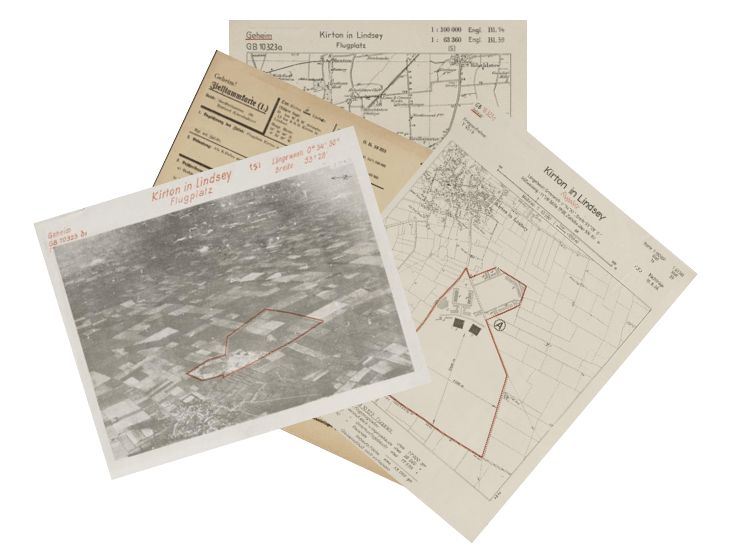
Ted finishes off the letter of 21st April 1941 with another analysis of his workload, i.e. nearly fifteen hours per day on watch over a three day period: “I’ve been on alternate shifts since Saturday morning and have done 44 hours out of 72 so you can guess how much sleep I got over this weekend. I went to bed at 12 last night though and the next thing I knew was someone shaking me at 12.30 this morning. That’s sleeping for you. Don’t worry though I’m feeling lots fitter now and I’m back on three watches which is only eight hours a day, 56 a week and a bit more if you get called out.“
44. Kirton-in-Lindsey, Monday 21st April 1941
641817, Cpl. McLeay
S.H.Q. Signals
RAF KIRTON
Nr. Gainsboro
Lincs.
21 . 4 . 41
Dear Mum,
I was pleased to get your letter so soon after its was posted that is on the 18th and know everything is OK. I hope the last raid on Sat. wasn’t too bad as from what the papers said it was pretty heavy. By the way Mum should you ever want to send me a telegram our number is KIRTON LINDSEY 341 Corporal McLEAY. That will get to me if you send it by phone as all phoned telegrams come in via the section.
We have been fairly quiet the past few nights and I hope it keeps like it although they did drop five very small bombs on the drome which did no damage.
I have been filling in my time pretty well just recently as I’ve had a couple of games of football, also I’ve got my bike running and went for a ride to Scunny on it t’other day.
I have also got an Irish girl to take out in the evenings and she makes a good companion. She’s from Belfast. We go down to Scunthorpe on our twenty four hours off and it passes the rotten evenings away pleasantly. I took her round to those friends of mine in Scunny yesterday, and she was pleased to see a civvy digs again and eat off a tablecloth. She is fed up with the Waafs at the moment but if she was out she would be more so I think. They (Mrs Green & Mr) asked us to stay the nights as night as we need not go back at night on our 24s but it would have started a bit of scandal if we had’ve gone back to camp the next morning wouldn’t it? Of course Mrs Green meant in separate rooms so there’s no need to think your son is going to the dogs Mum. By the way dont get the idea I’m on the way to getting married or something, we’re only pals.
If you can get any marmalade made you might send me a jar Mum, we dont get any for breakfast now. Dont go spending your rations now.
Was pleased to see you got a bit of rest at Easter as too much work is no good.
I will be needing the pyjamas soon as these are getting a bit oldish & in respect to washing anyway. Was pleased for the collars and hanks too as they came just as I was going out in a dirty collar.
I haven’t written to anyone else except [?] of Yatesbury & Biggin Hill so I’ll have to get cracking on some letters the first time I feel like it but on my job you don’t feel like much else but sleep when off duty.
I’ve been an alternate shifts since Sat morn and have done 44 hours out of 72 so you can guess how much sleep I got over this W.E. I went to bed at 12 last night though and the next thing I knew was someone shaking me at 12.30 this morning. That’s sleeping for you. Dont worry though I’m feeling lots fitter now and I’m back on three watches which is only eight hours a day, 56 a week and a bit more if you get called out.
I hope Mr Jessop is keeping well and not working too hard.
Jean’s mother has joined the Waafs and poor old Jean is terribly cut up. I don’t know what made her do that I’m sure.
Well Mum it’s nearly eleven and I’m on at half past till eight in the morning, so cheerio for now.
Best love,
Ted xxxxx
At the end of April 1941, Plymouth suffered three nights of heavy bombing, and the Luftwaffe followed this at the beginning of May with seven nights over Merseyside, which resulted in widespread destruction. Liverpool was a prime target as its docks were vital in the Battle of the Atlantic, and in the dockside area of Bootle eight thousand houses (about half of the town) were either destroyed or damaged. Belfast also experienced heavy bombing on 4th May 1941, as did the shipbuilding area of the River Clyde in Scotland.
As Ted indicates in his letter of 4th May 1941 (below), surveillance in Kirton-in-Lindsey was required all night during the first quarter’s waxing moon: “Well Mum the moon’s on its way and last night we got the first taste of it, on all night.” Unknown to Ted at the time, apart from Hull and London a few days later, the heavy Blitz raids on Britain were coming to an end. In his letter, he hopes that the tables will be turned at some point: “We certainly seem to be having some bad luck in this war business although it does seem to be the other fellow who gives in first all the time. Anyway I expect we shall start handing it out one of these days in no uncertain manner. Let’s hope so anyway.”
45. Kirton-in-Lindsey, Sunday 4th May 1941
Cpl. McLeay
S.H.Q. Signals
RAF
Kirton-in-Lindsey
Lincs.
4 . 5 . 41
Dear Mum,
I expect you are wondering why I haven’t written sooner but actually it was your fault. You see when you wrote your letter you missed out S.H.Q. Signals and its been waiting for someone to collects it as they didn’t know where to send it in the post office. It only got sent out to Signals when the parcel came so you see why I was a long time answering. Well Mum I hope you are keeping well and that the raids have eased up. I was very pleased to receive your parcel and especially the marmalade. Thanks a lot, I hope you’re not going short. I will send my pyjamas to a laundry in Scunthorpe with my collars to get a better standard.
Margaret, the Irish Waaf I was telling you about did some last week but admitted failure on those collars of mine although she did them quite nicely.
Was pleased to hear about the wireless. I would give Jock something if I were you. If you’re short I’ll let you have some. Do let me know Mum. I am going to buy some pants as these Raf pants are in ribbons and its another four weeks before I can get them charged.
Well Mum the moons on its way and last night we got the first taste of it on all night. However I got two hours before coming on duty and two and a half on so I went out today to get some sun which is something we very rarely see. Its been a glorious day so I [?].
I’ve been out with Paddy a few times lately and we get on fairly well together as pals so at least I have something to do when off duty which certainly is a pleasure.
We certainly seem to be having some bad luck in this war business although it does seem to be the other fellow who gives in first all the time. Anyway I expect we shall start handing it out one of these days in no uncertain manner. Let’s hope so anyway.
I hope you have been able to get out [.. ? ..] makes a change.
Well Mum there is nothing else for now so cheerio, best love,
Ted
On 9th May 1941, The Yorkshire Post reported that a total of 37 enemy aircraft were brought down during the defence of Humberside and Ted’s letter of 13th May 1941 tells us that, during this action, fighters from Kirton-in-Lindsey shot down six of the bombers in forty-five minutes.
The Hull Blitz took place on 7th, 8th and 9th May 1941. In the letter dated 13th May (below), Ted tells Lizzie about his station’s contribution in detecting and destroying a number of the attacking aircraft: “As you know the Humberside had some very heavy raids a couple of nights running and of course ours was the east coast station mentioned in the news, you know for getting six in forty five minutes. I wasn’t worried and they haven’t done much round here except give us a lot of work.”
In London, the last major raid of the Blitz was on the night of 10th May 1941, between 11pm and 5am, damaging the House of Commons in the process. It is said that more than five hundred aircraft dropped high-explosive and incendiary bombs in this final assault which claimed about fifteen hundred lives, destroyed eleven thousand houses and damaged almost all the major stations and hospitals. In his letter, Ted comments on the London bombardment in his usual way, hoping very much that Lizzie’s locality of Harringay is little affected: “I see you had a very heavy raid a couple of nights ago and hope the damage up our end wasn’t too bad.” He mentions the bombing in London again in his follow-up letter of 18th May 1941: “We realised it must have been a big raid as 33 were shot down. It certainly was good to hear. I bet it makes Jerry think when he loses 33 planes in a night raid.”
The attacks on Hull and London obviously kept Ted busy throughout. As a result, he says to his mother on 13th May that he is not sure of visiting in the coming weeks: “I very much doubt if there will be any [weekend leave] yet a while more, or seven days for that matter, so you had best get your holidays in while you can.”
While the May 1941 assaults marked the end of the heavy Blitz, with Germany shifting its focus towards the Soviet Union, it was not the end of raids altogether. Sporadic and lethal attacks continued, using increasingly larger bombs.
Interestingly, at this time, a U-boat (U-110) was captured in the Atlantic by the British navy and an Enigma machine retrieved, the second of these to be seized and an important breakthrough in the middle of the mayhem, which speeded up the cracking of the enemy communications code.
46. Kirton-in-Lindsey, Tuesday 13th May 1941
641817, Cpl. McLeay
S.H.Q. Signals
RAF Kirton-in-Lindsey
Nr Gainsboro
Lincs.
13 . 5 . 41
Dear Mum,
I was pleased to receive your letter a couple of days ago and to know you are quite well. I see you had a very heavy raid a couple of nights ago and hope the damage up our end wasn’t too bad.
As you know the Humberside had some very heavy raids a couple of nights running and of course ours was the east coast station mentioned in the news, you know for getting six in forty five minutes. I wasn’t worried and they
haven’t done much round here except give us a lot of work.
The marm is certainly going down OK but am I going sparingly, I’ll say.
I showed Paddy thats bit about behaving and it rather tickled her. She seemed to think it a funny thing to read in a letter.
Hope you do slack up a bit now Mum. as it doesn’t do to over do it and make yourself ill.
I very much doubt if there will be any W.E.s yet a while more or seven days for that matter so you had best get your holidays in while you can.
I have had a couple of games of cricket in the last week for the station, quite decent games although I was off form owing to no practice and got only 4 in the first match although in the second it was 22. We just lost them both and the second match we had PA Gibb, Yorkshire and England opening batsman up against us, so it wasn’t bad was it.
Well Mum I’m very tired so must pack up so cheerio
Best wishes,
Love,
Ted xxxxxx
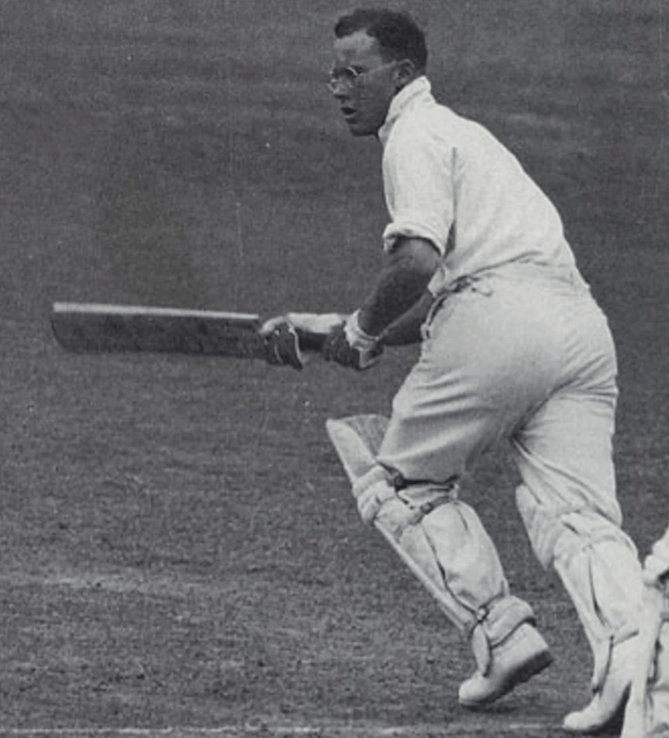
Paul Gibb, Yorkshire and England cricketer, who played against the RAF Kirton-in-Lindsey team, as mentioned in the letter of 13th May 1941
47. Kirton-in-Lindsey, Sunday 18th May 1941
RAF
Kirton
18 . 5 . 41
Dear Mum,
I got both your letters OK and didn’t answer the first one as you said you would be writing again first. Well it was nice to know you were OK as we realised it must have been a big raid as 33 were shot down. It certainly was good to hear. I bet it makes Jerry think when he loses 33 planes in a night raid. The old moon is disappearing now so I expect the numbers will fall off quite a bit. I see in this mornings paper that it’s well over the hundred for this month now.
We have quietened right off now since those three rights running and I don’t suppose will wake up again yet awhile. At the moment we are very busy training people and have an Australian and a new American Eagle squadron here. I still find plenty of things to keep me occupied as there are several new Waafs on the
Signals section and I’ve got 6 on my watch which is quite a liability. I manage to gets along OK still and am not in anyone’s bad books as far as I know so I dont worry about a bit of work.
Paddy is going on leave in a couple of days time so I shall have a couple of weeks to concentrate on my cricket, just enough to get my eye in which is all I need at present, as the times I’ve batted show. The first time I was unlucky as a ball went off my pads onto the wicket for 4. The second time I was getting nicely set when I stopped on my pad just about on the leg stump for 25. Last Thursday we played an evening match and had a time limit of an hour’s batting each side. We were in first and had scored 60 for 5 when I went in with only 15 mins left so the captain told me and the other chap to hit out which we did and got 40 in 10 mins then I swiped at a straight one and missed and was out for 15. That was a bit of bad still a bit of practice will improve it. We won the last one by 40 runs or so. I actually wanted white shirt, trousers & socks but if you can see any reasonable trousers let me know and I will have to look about around here.
I am sure I don’t know when to say I shall be home as everyone is sort of tied down a bit for leave as they don’t know much about postings and what not. My leave becomes due from the 3rd June onwards. But whether we shall get it next quarter is a matter of query owing to forthcoming events. Anyway If [you?] dont get home before then you can always come over to Scunthorpe for a couple of days can’t you?
Can get chocolate up here OK but if you have any of those seed cakes you made they will go down very well.
Well Mum will pack up now as there’s nothing to tell you so cheerio,
Best love,
Ted xxxxxx
In his letter of 18th May 1941 (above), Ted writes to Lizzie that he expects activity to decrease as the moon is now on the wane: “The old moon is disappearing now so I expect the numbers will fall off quite a bit.” Bombing raids tended to be in the fifteen nights around the full moon, the period when it reflects enough light to pick out features of the landscape (with the downside that the aircraft are themselves more visible). The next sentence in the letter above confirms that the attacks had already subsided: “We have quietened right off now since those three rights running and I don’t suppose [it] will wake up again yet awhile. At the moment we are very busy training people and have an Australian and a new American Eagle squadron here.” The new arrivals were 452 RAAF Squadron who flew Spitfires from Kirton until they moved on in July 1941, and 121 Eagle Squadron with both Hurricanes and Spitfires who stayed until December 1941.
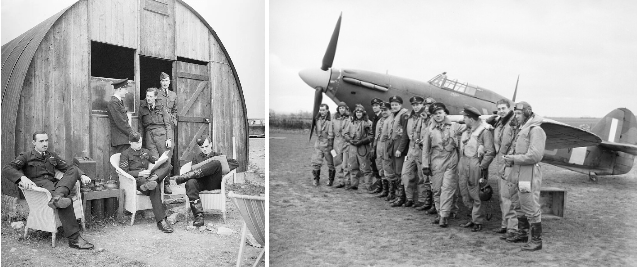
1941: Australian pilots outside their dispersal hut at Kirton-in-Lindsey (left), and American Eagle Squadron pilots in front of one of their Hawker Hurricanes (right)
48. Kirton-in-Lindsey, Monday 9th June 1941
641817, Cpl. EJ McLeay
S.H.Q. Signals
RAF Kirton-in-Lindsey
Nr Gainsboro
Lincs.
9 . 6 . 41
Dear Mum,
I was pleased to hear from you again as your letters are the only ones I get these days after losing touch with Edith.
I’m glad you liked the brooch as it was the best they had although its not really so hot. Dont worry about the penny I’ll try and afford it out of my own “wealth”. Its nice to know the quid covers my expenses as I still have a little bit to put away now.
I think the rationing of clothes is quite a stinger of an idea. It certainly is cutting down the rich peoples expenditure. By the way Mum I hope you’re managing to bank that money now. Talking of money reminds me they are stopping £1.1.0 a month income tax now. I hope it doesn’t get to any more or I shall have to be calling on you again. I dont think there’s any fear of that though.
I didn’t play at Scunthorpe over Whitsun unfortunately, but yesterday at Cranwell we got beaten easily. I dont bowl nowadays as I’m well out of practice.
Glad to hear the bombing hasn’t left things in too bad a state and hope we haven’t had more near ones.
I’m sorry if I sounded fed up when I last wrote but I didn’t feel that way. I guess you must have read is wrongly.
I don’t suppose you will be getting out much if the weather is as bad down there as it is up here. Anyway there is one boon that it keeps the full moon covered up for a bit.
Paddy enjoyed her leave and although I don’t see her quite as much since coming out of ops we still get on OK.
Two of us went to the whist drive in the Waafs mess the other evening and I got first and him second prize. That’s what our solo playing does for you.
I’m afraid its hopeless trying to get cigarettes up here so you wont be able to expect my fetching up any on leave.
When you manage to make a cake you may as well send it unlesss you want it yourself as they certainly make a change.
Well Mum cheerio for now and
best love,
Ted xxxxx
On 1st June 1941, civilian clothing was rationed for the first time. Coupon points were allocated (66 per year to each adult, although reduced as the war progressed) to be submitted when buying new clothes. That is, shoppers still had to pay the market price for clothing, but also hand over the relevant number of coupons, e.g. for a dress (11 coupons), a shirt (8), a pair of trousers (8), shoes for men (7) and women (5), and so on. It is said that about a quarter of the population wore uniform as a member of the armed forces (or the auxiliary and voluntary services), and the increased demand had put enormous pressure on Britain’s textile industry to provide for the forces as well as for civilians. The news seems to have come as a complete surprise to most people but welcomed as a way of distributing clothing more fairly. In his letter of 9th June 1941 (above), Ted wrote to his mother along these lines, as follows: “I think the rationing of clothes is quite a stinger of an idea. It certainly is cutting down the rich people’s expenditure.” As mentioned previously, an egg rationing scheme was also introduced at this time, and the last day for customer registration with egg retailers was 14th June 1941, the idea being that retailers would ‘receive supplies in accordance with their registered customers, which means that there will be fair distribution’ . Ted commented on this in a later (undated) letter “I was pleased to hear about the new egg rationing scheme as you should profit by it” — as he would too, given the number of cakes Lizzie sent to him!
Another development in the war can also be dated to 14th June, although further afield in this case. German and Italian assets in the United States were frozen on that day, paving the way for US entry into the conflict about six months later (the Eagle Squadrons already at Kirton-in-Lindsey were made up of US citizens who joined the RAF voluntarily). Perhaps it was attributable to the early arrival of the the Americans that military order was now being imposed more strictly — Ted says in his next letter of 15th June 1941 (below) how : “Things are being tightened up quite a bit now Mum. Passes being examined more frequently. Colour hoisting every third day. It’s wicked for one’s constitution.”
49. Kirton-in-Lindsey, Sunday 15th June 1941
641817, Cpl. EJ McLeay
S.H.Q. Signals
RAF K L
NR GAINSBORO
LINCS.
15 . 6 . 41
Dear Mum,
Thanks very much for the cake and tobacco which came in very handy. I and still on the cake which certainly is benefitted by the fruit. The boys were pleased about the tobacco which is very scarce although for the past week it has been a bit more prominent. I will give you the cash for its sometime later so hope your not waiting for it now.
You bet I’ll put down what I allow you on my my IT returns. I’ll make its read so that an undertaker would burst into tears.
Its a good idea to get that wardrobe. If you carry on that way we’ll soon have a home again. That is to say one that looks like one.
After a few days good? weather again we have now got a gale blowing from the the N West. This is a blinkin’ county for winds. Luckily its not as cold as Yatesbury here or we shouldn’t be able to live.
Things are being tightened up quite a bit now Mum. Passes being examined more frequently. Colour hoisting every third day. Its wicked for ones constitution.
I didn’t lose anything by going back on DF. It was just that I did know all about it and there were a few mistakes being being made so I was sent on it. I have been doing daytime supervision until today and I’m taking over a watch for a week, as someone is on leave. It’s quite a good job one way and another so there’s nothing to worry about. I expect they will be changing Corporals on outstations again soon, so I shall be going out. Goodness knows where, I expect it will be the worst of the lot which is a place way up in Yorkshire, miles from anywhere. There are some quite good places I could go to such as a little place just outside Gainsboro, about three miles. That would be OK. Also Cleethorpes. Right in the centre of town. Skidbrooke wouldn’t be so bad considering it should be summer time now. I suppose I should feel more at home at Skidbrooke. Anyway I haven’t heard anything yet so I shall not worry until I move.
I will remember about the eggs when I come home Mum, but I cant say whether I shall get them as yet.
I got a letter from Nan yesterday saying she was very well and quite fit, I only hope she keeps so. Its nice to hear she is getting a bit extra money as she says she is quite rich.
I got some credit in the Naafi for that whist drive prize which was quite useful.
Glad to see you are getting out a bit now and hope you make the most of your Sundays off. I still go out with Margaret and we get along quite well. She is good company for a bloke.
Its pretty good to know you have some work to do as you should get on very well if you don’t make any mistakes. Hark who’s talking.
Well Mum I haven’t hear from Norm for some time now so I couldn’t say where he is. I’ll have to write some letters this week whilst on duty.
That seems to be about all for now Mum so cheerio.
Best love,
Ted xxxxxx
In the letter of 15th June 1941 (above), Ted explains to Lizzie how he’s back using radar equipment on Direction Finding work, after a spell on wireless communications. “I didn’t lose anything by going back on DF … a few mistakes [were] being being made so I was sent on it. I have been doing daytime supervision until today and I’m taking over a watch for a week, as someone is on leave. It’s quite a good job one way and another so there’s nothing to worry about.” He returns to this subject again in his next letter (below), which is undated as Lizzie appears to have torn off the top right corner with the address and date. “Did I tell you I was back on the old job again? I can’t remember. Well this time I’m in charge of the homer and its a day-time job. When the moonlight nights are here it will be all night every night. Still if the weather clears up a lot I can sleep in the sun during the day.” The ‘homer’ was a transportable radar unit, as depicted in a watercolour in the Imperial War Museum collection (reproduced below) with Spitfires in the background.
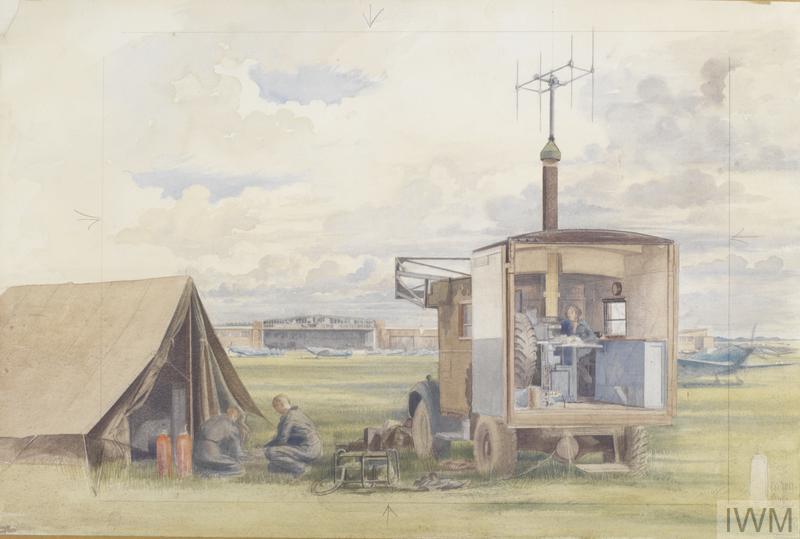
With regard to the threat level, the change in Nazi priorities became reality on 22nd June 1941, when the German invasion of Russia (Operation Barbarossa) began. Although this meant that the heavy bombardments of the Blitz came to an end, raids continued nonetheless. In the letter below, Ted writes: “Well Mum everything OK up here and I’m pleased to see that you’ve been having it lightly down there for some time now. I hope you have been having a quiet moon but I suppose they will be across directly its gets up. Anyway it will be nice to see if our fighters can improve on their last moon’s tally.“
50. Kirton-in-Lindsey, undated (about 1st July 1941)
(top right corner torn off)
Dear Mum,
I’m sorry I haven’t written before now but for the last two weeks I don’t seem to have had the Inclination for sitting and writing. Every day I’ve sort of said leave it till tomorrow, but somehow tomorrow hasn’t come until today.
Well Mum everything OK up here and I’m pleased to see that you’ve been having it lightly down there for some time now. I hope you have been having a quiet moon but I suppose they will be across directly its gets up. Anyway it will be nice to see if our fighters can improve on their last moons tally.
Thanks a lot for the cake, it went down swell. When I come home again I will have quite a bit of sleep and if you have some more cakes will knock them back. That seems to be the best thing to do on leave, eat & sleep. I will fetch home the two tins too as I expect you are getting short of them. I was pleased to hear about the new egg rationing scheme as you should profit by it.
[NB Part of the next paragraph was on the back of the torn off address, so the left hand side of the first five lines is missing]
Our next leave period commences on […………….??…………..] don’t suppose I shall get […………….??…………..] July so I’ve got plenty of time […………….??…………..] […………….??…………..] Mum if you could get May […………….??…………..] the boys up here would be grateful as tobacco is very scarce. Also if you’ll let me know how much I owe you I’ll send some cash. If I think of it I’ll slip a £1 in here at the end in case you need it. I cant remember whether I did before or not.
Thanks a lot for the trousers & socks, shirts as well. They make me look a bit more like a cricketer I’m pleased to say. On Monday we are playing Lincolnshire at Scunthorpe unless the weather is too bad, so you see we are getting on.
Paddy has been on leave for the past week so you can guess I have not been doing a great deal except play cards and come on duty. Did I tell you I was back on the old job again? I cant remember. Well this time I’m in charge of the homer and its a day-time job. When the moonlight nights are here it will be all night every night. Still if the weather clears up a lot I can sleep in the sun during the day. At the moment its like a winters week.
Well Mum I can’t think of anything else to say right now so I’ll pack up till next week.
Best love,
Ted xxxxx
9th July 1941I hope you are laying in plenty of coal for the winter Mum, as it looks as if there are going to be even more difficulties in the coal transport this year. It was announced 1 July that coal deliveries are to be limited to one ton per month, maximum, for all establishments. This did not bother householders too much, because most households didn’t use that much anyway!
The Russian affair is rather vague at the moment you can’t tell what is really going on over there. Still it’s nice know we are doing something in the way of bombing. Thank goodness too.
I am now back on the Duty Signals NCO racket but anyway I am and in a way its quite good. That is to say there is more interesting work to do and I do get a 24hr stand off every three days. The snag is sleeping in the day and not getting much sun. You see how I mean:-
51. Kirton-in-Lindsey, Wednesday 9th July 1941
641817, Cpl. EJ McLeay
S.H.Q. Signals
RAF Station
Kirton-in-Lindsey
LINCS.
9 . 7 . 41
Dear Mum,
I was pleased to get your letter but I didn’t answer over the week and as I was intending to get a new pen so thought I would wait and see how you liked it.
I hope you have settled about your holidays as I am not getting leave until August 12th. I should have bee able to get August [?]th except for the fact that there was a moon period then. That is why it’s so awkward to arrange leave as the other NCOs have all got to get their leave singly too. It’s a bit of a nuisance but still it wont worry me as long as I can as my seven days this quarter some time.
I still haven’t written to Norman yet. In fact since losing my pen I haven’t written to anyone at all.
As you remember Cpl Lord (Eric) my buddy since I came to this station, not Pot[?], well he has been on an outstation for some time and has just returned so what with Eric & Cliff sometimes and Margaret others my evenings are kept quite full. We, Eric, Cliff & I, are all in the same room which is quite OK isn’t it.
When your letter came the other day quite a few of the boys told me there was one of my own letters returned and others wanted to know if I was so lonely I wrote to myself.
What do you think of Gracie Fields photo. She certainly looks older doesn’t she?
The moon hasn’t meant much activity as yet. I hope it doesn’t mean any at all but of course you can never tell in this war.
I heard that London had an excessively hot day last week, so I suppose you felt it. Our hottest was kept quite cool in comparison by this never ceasing breeze we get up here. I hope you are laying in plenty of coal for the winter Mum, as it looks as if there are going to be even more difficulties in the coal transport this year.
The Russian affair is rather vague at the moment you can’t tell what is really going on over there. Still its nice know we are doing something in the way of bombing. Thank goodness too.
If Jock is going to Nuneaton for a time, I could probably hitch out there myself for a day, What date Is Jock going?
I cant remember telling you I am now back on the Duty Signals NCO racket but anyway I am and in a way its quite good. That is to say there is more interesting work to do and I do get a 24hr stand off every three days. The snag is sleeping in the day and not getting much sun. You see how I mean:-
Take me a C watch:
You see, I was on, say, Sunday night, so I sleep all Monday, come on at six till 11.30, go to bed, on at 8.20 Tuesday till 1.15, then off for 24 hours except for colour hoisting at 8 o’clock Wed morn. On at lunch Wed. then again all night, and so it goes on 8hrs per day, 7 days per wk, 48 wks per year. It more or less puts the tin hat on Cricket — as you know it’s underground and very weakening.
The grub is pretty good and I am having a nice time so I mustn’t grumble about working must I?
Am getting ready to go on duty now so cheerio, and keep well Mum,
Best love,
Ted xxxxx
52. Kirton-in-Lindsey, Friday 25th July 1941
641817, Cpl. EJ McLeay
S.H.Q. MQ 36
Signals
RAF
KIRTON-LINDSEY
NR GAINSBORO
LINCS.
25 . 7 . 41
Dear Mum,
I was pleased to get your letter and know you got back OK. I was certainly pleased to see you up here and to know you had a very nice time down at Mrs Greens. I have not yet been down there but hope to on Saturday and will tell them I appreciate their kindness very much. I need my pyjamas pretty badly too. My present ones have a big tear in them which you’ll have to sew up on the old machine.
It was good to hear you liked Margaret as there are very few people who don’t. She is really a great girl In many ways and we manage to get on well together.
I won’t be able to get down to Nuneaton this week-end as I am playing cricket on Sunday. I hope the weather bucks up as the past few days have shown quite a spot of promise in the sun line although it has been quite foggy.
What do you think of this part of the country Mum? Quite a farmers county all right isn’t it. Scunthorpe is quite a decent town to have so close isn’t it. Our manoeuvres finished at 11 o’clock on Sunday morning but as I was on duty from 08.20-13.15 I couldn’t get down in time to let you know.
I got absolutely drenched hitching back from Scunthorpe on Friday but haven’t felt any effects at all I’m pleased to say.
I have put down for a WOM’s course (Wireless Op. Mechanic) which is a 4 months course. I thought I may as well as they are being held at Cranwell which
is only just south of Lincoln and when I pass out I should be able to get a fairly decent posting. I don’t know how it affects my pay or anything but I will at least learn a bit more even if I go back to A.C.2.
Well Mum at last I’ve heard from Norm and he is in Staffs, at Hednesford. He seems a bit fed up I’m afraid and he has already done 19 days jankers for taking five days off. I am writing to him to give him some tips so I’ll pack up for now.
Cheerio, Best Love,
Ted xxxxx
I’ve been on from 1-5 this afternoon and from 11.30-8 tonight which is a nice spell as there’s a brilliant moon and that usually means activity.
I hope he leaves you alone as he has been doing for the past couple of weeks. Its nice to know you haven’t been bothered as there’s nothing to worry about.
As you can see it’s all started again in Europe, lets hope we can get there in time that’s all. I expect by the time you receive this things will be a bit clearer one way of the other.
53. Kirton-in-Lindsey, undated 1941
641817, Cpl. McLeay
S.H.Q. Signals
RAF KIRTON-LINDSEY
NR GAINS.
LINCS.
Sunday
Dear Mum,
I thought I would drop you a line to let you know I got back OK on Friday. I called into Mays shop on the way and then went to the pics before going to Kings X. We were back at camp, before nine and got something to eat so it wasn’t too bad.
It was funny yesterday. I found we were on from 8.30-1 and then off for 24hrs, so after dinner Jon a chap on my watch and I went to Scunthorpe and finished up the week by going to the pics again. Then we got tea out and we went to the YMCA and played snooker, then went to their dance and listened to one of our own bands play.
I’ve been on from 1-5 this afternoon and from 11.30-8 tonight which is a nice spell as there’s a brilliant moon and that usually means activity.
My chest is a bit sore and I’ve had some rotten headaches the last couple of days but I expect this cold will pass off before this weeks out anyway. It doesn’t make your head very clear in our atmosphere.
I left my collars and when you get them back from the laundry send them up wont you Mum. They look much smarter and last longer starched.
I hope he leaves you alone as he has been doing or the past couple of weeks. Its nice to know you haven’t been bothered as there’s nothing to worry about.
As you can see it’s all started again in Europe, lets hope we can get there in time that’s all. I expect by the time you receive this things will be a bit clearer one way of the other.
Its ever so cold up here and the coal we’ve got is just dank — still it’ll all come
right in the end so I think I’ll finish for now,
bye bye
Best love,
Ted xxxxxx

The Battle of Britain cost the Luftwaffe 873 fighters and 1,014 bombers. The RAF lost 1,023 fighters.
7th December 1941 The Japanese attack the American Pacific Fleet at Pearl Harbour, leading Britain and the USA to declare war on Japan the next day. Germany declares war on America on the 11th.
30–31 May 1942 : First thousand-bomber raid, 1,047 aircraft dispatched in “Operation Millennium” against Cologne. This saw the first use of the “bomber stream” to overwhelm enemy radar and defences by flying in a narrow dense formation.
EJM’s note: “Then posted to Cranwell”
According to the Imperial War Museum, 51% of (bomber?) aircrew were killed on operations during the whole war, 12% were killed or wounded in non-operational accidents and 13% became prisoners of war or evaders. Only 24% survived the war unscathed. IWM
On 3rd February 1941, in view of the British advances made against Italian forces in North Africa, Rommel was appointed head of the Afrika Korps and headed for Tripoli.
- The ↩︎
 Stuart McLeay
Leave a comment